
TT#17 – My Verdict on BAAJA
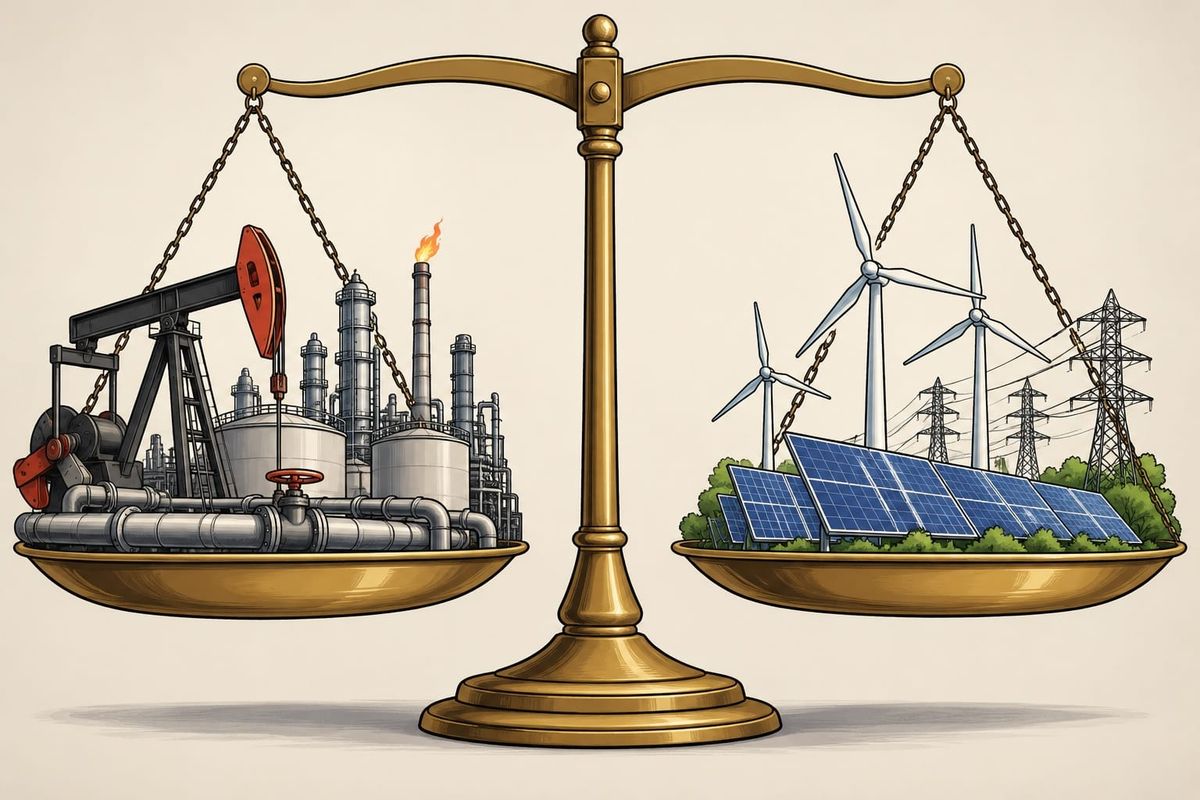
The bipartisan permitting reform bill would remove key hurdles to the energy transition—especially hurdles to siting transmission—and unlock vast amounts of wind and solar power. On the whole, it would be a net benefit to the climate and the energy transition.
IN BRIEF
- The Senate bill will benefit both fossil and clean energy projects. However, many observers see the overwhelming majority of the benefit going to the clean energy sector.
- The bill is about a lot more than permitting. It also offers important protections for project developers that could protect them from the kind of discriminatory federal overreach and interference that clean energy projects have received under the Trump administration.
- This is no time to let the perfect be the enemy of the good. This bill (or its successors in the next Congress) could make essential progress on energy transition objectives that is currently impossible to make.
Much has been written already about the bipartisan permitting reform bill known as the Bipartisan American Affordability and Jobs Act (BAAJA), introduced in the US Senate on September 30. So rather than delve into the details, as I customarily do, I offer here my brief verdict on it. I encourage those who are interested in the details to explore the links to the cited sources.
What is it?
A 417-page bill designed to speed up permitting for energy projects—both fossil fuel projects and renewable energy projects.
Why is it necessary?
Energy projects are often subject to notoriously long review processes before they can be approved, frustrating their developers and advocates. Wind and solar farm developers have been stymied by everything from protracted environmental reviews under National Environmental Policy Act (NEPA) to the “arbitrary and capricious” canceling of wind projects already approved and under construction (in the words of the federal judges who overturned the cancellations). Indeed, Jane Flegal, a former Biden administration climate official who is now a senior fellow at the liberal think tank Searchlight Institute, observed that the environmental review reforms are “seriously helpful” in her thread about the bill on X:
Especially NEPA (and NHPA). We have decent evidence NEPA already hits renewables and transmission hardest. From 2010-2018 more EISs were done for solar and transmission than anything else, and solar EISs got litigated and projects cancelled more than any other type.
Transmission projects are desperately needed to unlock the vast potential of wind and solar resources, but are being built at a glacial pace amid the opposition of local activists who are often animated by fossil-fuel industry propaganda. Boosters of AI data centers and natural gas project developers want to see faster approvals for natural gas infrastructure. Developers of oil pipelines want a faster path to market. Support for permitting reform isn’t just bipartisan; it runs the gamut of the energy industry.
What might the bill’s provisions achieve?
The most extensive analysis of the bill’s effects I’ve seen is a five-byline explainer from the Heatmap team, so if you’re looking for a detailed rundown, check that one out.
Jennifer Granholm, President Biden’s Secretary of Energy, offered these highlights:
1. Build the transmission we desperately need. Stronger FERC backstop authority, better regional and interregional planning, and a clearer path to actually getting big lines built.
2. Use the grid we already have. The bill pushes grid-enhancing technologies — technologies that can squeeze more power through existing wires faster and cheaper than building new ones.
3. Make data centers pay their way. Large data centers would be responsible for the transmission costs associated with serving them — instead of shifting those costs onto everybody else.
4. Give VPPs and distributed energy a real seat at the table. Rooftop solar, batteries, EVs, smart thermostats — aggregated together, these are grid resources. The bill pushes wholesale markets to treat them that way.
5. Put a clock on permitting. One year for environmental assessments. Two years for environmental impact statements. And a 150-day window for legal challenges. Environmental review still happens. It just can’t take forever.
6. Give energy projects some certainty. A future administration shouldn’t be able to single out an entire technology — wind, solar, geothermal, whatever — and simply stop permitting it. Once a project has gone through the process, its permit should mean something.
It would also put new limits on the duration of lawsuits over energy projects, and head off the kind of interference that the Trump administration has raised against energy projects while giving FERC siting authority for transmission projects.
How the bill’s provisions to safeguard projects against presidential interference would work in practice is an interesting question. Emily Pontecorvo walked through some helpful examples in her coverage of the issue for Heatmap. On the whole, her assessment suggests to me that while the bill’s provisions wouldn’t entirely protect energy projects from discriminatory treatment by a hostile president, and would leave the burden of self-defense on project owners, it would considerably improve the overall legal landscape and prevent some of the abuses committed by the Trump administration.
Who would benefit?
Both commercial energy industry players and the public would benefit.
‘Climate tech sectors’ that would benefit, in the reckoning of Heatmap journalist Katie Brigham, include:
· Geothermal energy and exploration companies
· Grid enhancing technologies
· Virtual power plant (VPP) aggregators
· Critical minerals companies
The public would benefit chiefly from unlocking a large amount of clean wind and solar power that is languishing in permitting queues, both for the generation projects themselves and for the transmission lines needed to bring their power to market. Modeling by the nonprofit Center for Climate and Energy Solutions (C2ES) and consulting company Greenline Insights and cited by Bloomberg sees “gigaton-scale emissions reductions over time” from transmission reform alone. But the grid enhancing technologies and VPP aggregators would also make better use of the existing grid capacity, benefitting all utility customers.
Zeke Hausfather offered a helpful scorecard enumerating each of the various provisions in the bill and assessing whether they would help the clean energy industry, the fossil energy industry, or both:

Source: Zeke Hausfather
On the whole, Zeke says:
Bottom line, I think the bill will likely reduce US greenhouse gas emissions.
The net benefits
While the bill certainly has its detractors and objectors, particularly in the environmental activist community, the observers I follow generally consider the bill’s trade-offs worthwhile and see the balance of outcomes in favor of the energy transition.
In his interview with bill co-sponsor Senator Martin Heinrich (D-NM) on his Energy Empire podcast, Jigar Shah boiled it down like this:
Republicans got Clean Water Act certainty for gas pipelines. He expects to lose some votes on the hard right and some on the left, and he said that is okay. I agree; that is what 60 votes costs.
C2ES president Nathaniel Keohane said the bill “on net is good for the economy, it’s good for consumers, and it’s good for climate.”
Rob Gramlich, president of the consulting firm Grid Strategies LLC, said it “enables a clean energy future” that’s “just going to be very hard to get” otherwise.
Jane Flegal called the bill “awesome” in her thread about it on X, observing:
You really have to contort yourself to believe tech-neutral reforms that make it easier to build big stuff, especially on federal land, won't help clean energy more than anything else. But I'm sensing this is the debate some groups want to have.
Permitting involves tradeoffs and hard calls, no question. But this bill is clearly a net positive for climate and for the country. Heartfelt thanks to the senators who got it done. Let’s make it law.
Environmentalist and O.G. climate author Bill McKibben laid out a range of views he’s seeing, and ended up conflicted in his final analysis, while acknowledging that his long experience as a climate campaigner may have left him a bit jaundiced:
It is obvious that federal policy necessarily proceeds by compromise—the question is whether the compromise risks too much. This may be a place where being involved for too long in these fights is a handicap, making one risk-averse from prior experience.
But Steve McBee, founder of Amped and my guest in the Nelder Notes #9 podcast (and if you haven’t listened to that one yet, definitely do, I think it’s one of the most exciting and enervating interviews I’ve ever done) called the bill a “no-brainer”:
Some commentary will grade this bill against an ideal one. That’s the wrong frame. The choice isn’t between this bill and a better bill. It’s between this bill and no bill. No bill means the status quo: queues that take years, projects that die in review, capital idling on the sidelines waiting for someone to tell it the rules.
Over the course of my career I’ve written policy, lobbied for it, run a public company that lived by it, and raised capital that priced it. The totality of my experience tells me this deal, while not perfect, is nonetheless a no-brainer.
After laying out his argument and the pros and cons, Steve winds up with a call to action:
This bill is a test of whether we’ve learned anything. If we split into camps, grade the bill in public, and wait for someone else to carry it, we’ll get what we deserve. If we move as one, fast and loud, we’ll get it passed and walk into the next fight with proof that we can win.
So let’s get behind it now, publicly, without hedging. Every company, every investor, every trade group. Put your CEOs on the record. Call your members. Then start building the machine for the fights after this one, because this is the first, not the last.
Game on.
What’s next
The bill is just that—a bill. Sen. Sheldon Whitehouse (D-CA), who co-sponsored the bill, said that amendments to the bill will be considered when the Senate reconvenes in November. Energy trade group Advanced Energy United expects the bill to pass the Senate sometime after the November elections, but it would need at least 60 votes to pass the filibuster.
Whether the House takes up a complementary bill in the lame-duck session remains to be seen. McKibben cites Rep. Jared Huffman (D-CA) as saying that doing so would be “negotiating from a position of weakness” because the Senate bill reflects what’s possible with the current, Republican-dominated Senate, and the prospects could be much better in the next Congress if the Democrats manage to snatch the reins of power away in the midterms:
The bottom line for me, and I believe most Democrats, is that November 3rd is coming and we are likely to soon have a far better negotiating position. Folding our hand now or in the lame duck makes no sense when we can keep working on this and, in a few more months, have a much better deal that works for everyone.
I’m not enough of a political expert to judge that point. If I had to lay money on it, I’d bet that the House doesn’t act on this in the lame duck and it does get punted to the next Congress, simply because Congress under Speaker of the House Mike Johnson has been notably unproductive, passing many bills with very few becoming law.
But that doesn’t make the current Senate bill useless. It represents an enormous amount of ground work over four years that will still describe a potential solution set for the next Congress, which should enable them to move fairly quickly on permitting reform even if this Congress can’t get the bill over the line.
My verdict
I’m with Steve McBee on this bill. It does give the fossil fuel industry opportunity to expand its footprint and increase emissions, and it could have some undesirable impacts on water, but such is the stuff of legislative compromise—that’s unavoidable.
More importantly, it will massively improve everything from renewable generation to transmission siting to implementing various technologies that optimize the grid. I think Jane Flegal is right in saying that on net, this bill will help clean energy more than fossil energy, and will amount to a net gain for the energy transition and a net reduction in emissions. After all, once these reforms are in place, fossil energy still has to compete with renewables, which are still going to be cheaper, faster to build, cleaner, and better overall. That’s why renewables have utterly dominated the market for new electricity generation capacity for many years running, and will continue to do so.
I’m also very pleased to see that the bill contains provisions designed to ensure that the operators of AI data centers pay for their grid costs instead of shoving them onto utility customers. I laid out those arguments previously in Transition Times #11, Transition Times #15, and Nelder Notes #3.
This is no time for purity tests or letting the perfect be the enemy of the good. What we need now is action and this bill would move the ball down the field where the kind of progress it offers simply isn’t available today. That’s what really matters.
Got an item you’d like us to cover?
We’d like Transition Times to help increase the visibility of all the great work that’s being done out there. So if you have an article, report, study, podcast episode, newsletter post, video clip or anything else that you think is worthy of a shout-out in Transition Times, email it to suggestions [at] transitiontimes [dot] net! We welcome all submissions, as long as they’re relevant to the energy transition.
Sources
Matthew Daly and Jennifer McDermott, “Federal judge throws out Trump order blocking development of wind energy,” Associated Press, December 8, 2025.
Jane Flegal thread on the bill, X, September 30, 2026.
Robinson Meyer, Emily Pontecorvo, Jael Holzman, Matthew Zeitlin, Jillian Goodman, “The Senate’s Big Bipartisan Permitting Deal, Explained,” Heatmap, September 30, 2026.
Jennifer Granholm post on the BAAJA, LinkedIn, October 1, 2026.
Jigar Shah, “The Permitting Bill Is Out. Senator Heinrich Walked Me Through It.” Energy Empire, September 30, 2026.
Diana DiGangi, “Senate permitting bill would expand federal role in transmission siting,” Utility Dive, October 1, 2026.
Emily Pontecorvo, “What a President Can and Can’t Do Under the Senate Permitting Bill,” Heatmap, October 5, 2026.
Katie Brigham, “The Climate Tech Winners and Losers of the Senate’s Permitting Bill,” Heatmap, October 1, 2026.
Zahra Hirji and Leslie Kaufman, “What the Senate Permitting Deal Means for US Climate Emissions,” Bloomberg, October 2, 2026.
Zeke Hausfather, “What's in the Senate permitting deal, and what it could mean for US emissions,” The Climate Brink, September 30, 2026.
Bill McKibben, “Reform or Regresssion?” The Crucial Years, October 1, 2026.
Steve McBee, “The Starting Gun,” Amped, September 30, 2026.
We never use AI to produce any of the written or spoken content you find on Transition Times. We do use AI as a research tool (and vet the information so received).
We also occasionally use AI to generate graphics and sounds.