
TT#11: A New Hope for the Data Center Resistance
As data centers continue to be built across the US and elsewhere, popular resistance to them is mounting in reaction to rising grid power costs and resource demands. Accordingly, regulators and legislators are finally beginning to respond.

The AI data center juggernaut continues, but not without some resistance.
As has been widely reported, New York Governor Kathy Hochul signed an executive order July 14 pausing the development of hyperscale data centers for one year, effecting the nation’s first statewide data center moratorium:
The order specifically pauses state environmental reviews for facilities over 50 megawatts for a year. It instructs the state’s Department of Public Service to assess the environmental and energy impact of data centers during this time, and to develop a new generic environmental impact statement, a general permitting process for complex environmental issues that may arise with data centers that want to build in the state. Hochul is also proposing an end to all tax incentives for data centers.
I have been thumping the table about this for two years now. Back then, I felt like a lone voice in the wilderness when the buzz was all about how to meet the new load and the business opportunity in it, with not a word about the impact on host communities.
So I’m glad to finally see some elected officials being asked to explain how locating data centers in their communities actually benefits them. Simply allowing elected officials and civil servants to greenlight the facilities without even subjecting them to the kind of review that any other major energy consumer would need to undergo—like a new subdivision or a manufacturing facility—is unacceptable.
Public opposition to data centers locating in their communities has been growing sharply over the past year or so.
Data center opposition has skyrocketed through the first half of the year in the US. A report released earlier this month by the Coalition for Responsible Data Center Development, a group of researchers compiling information on data center resistance, found that membership in anti-data center Facebook groups has grown sevenfold between December 2025 and June 2026. At least 30 states across the country have counties or cities that have enacted local moratoriums or pauses, according to Data Center Moratoriums, a website that tracks data center legislation.
Brandon Owens of AlxEnergy, an AI market intelligence company, calls this moment a “data center reckoning” as dozens of state and local jurisdictions consider data center moratoria:
The common denominator is uncertainty. A large data center can require new substations, transmission upgrades, water infrastructure, backup generation, road improvements, and noise mitigation. Local governments are asking whether existing zoning codes are adequate. Utilities are asking how to plan for large loads that may or may not materialize. Regulators are asking who should pay for infrastructure if a project is delayed, downsized, or canceled. Communities are asking whether the tax benefits justify the pressure on land, water, power systems, and quality of life.
Another publication that has been keeping tabs on the resistance is Heatmap News, which has published on the order of 100 articles, by my count, on data centers over the past three years. On July 13, executive editor Robinson Meyer observed:
At this point, we’ve written about results from our polling that show Americans overwhelmingly oppose local data center construction, that majorities of Americans now support a national data center moratorium, and that the only group of Americans who feels more optimistic than pessimistic about artificial intelligence is … men older than 65 years old.
The poll he references showed that some 70% of Americans would now oppose a data center being built near their home.
That is the same share of Americans who oppose data centers in their area according to a Gallup poll from May:
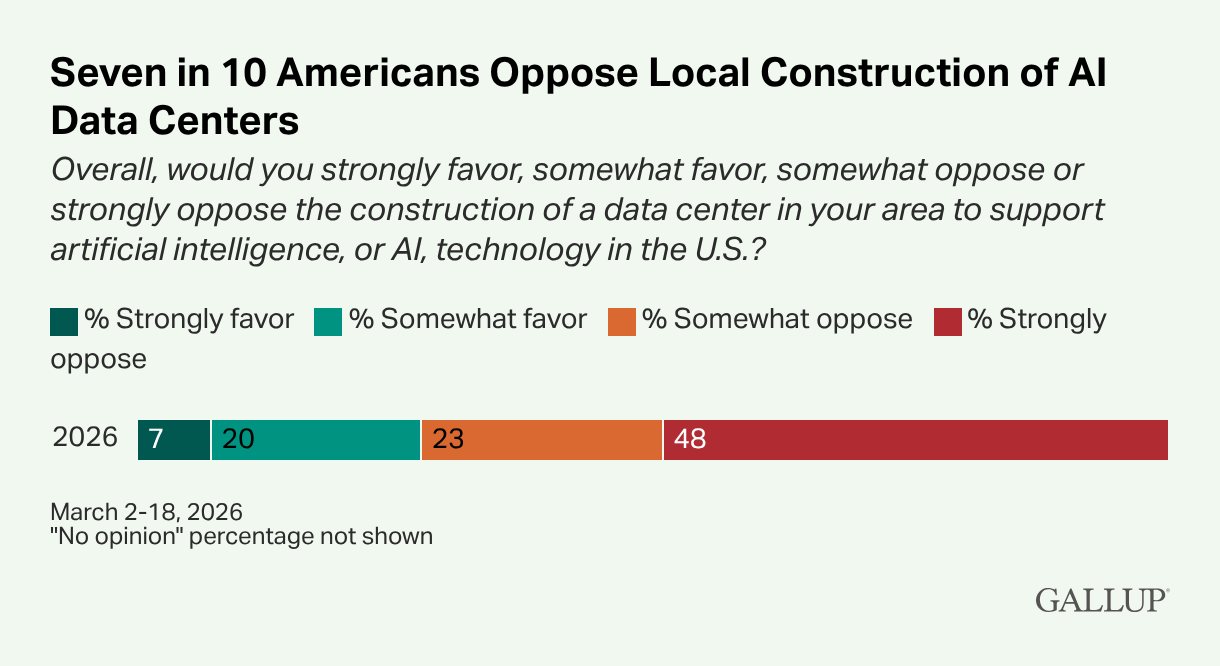
Source: Gallup
Interestingly, that’s a larger percentage than those who oppose a nuclear power plant being built in their communities (53%), according to Gallup.
The reasons for their opposition are numerous:
| Reason | Share of respondents |
|---|---|
| Effect on resources | 50% |
| Quality of life concerns | 22% |
| Effects on costs | 20% |
| Pollution | 16% |
| Economic effects | 14% |
| Negative views on AI | 14% |
| Specific AI concerns | 13% |
| Other/No opinion | 25% |
What struck me about this data is that mere opposition to AI ranked down at the bottom of the list. But when data center apologists get the microphone, that’s the issue they seize on, while ignoring entirely the top concerns that people actually have. That makes sense, because there’s no getting around the resource consumption or impact on local communities, whereas calling the opposition Luddites is easy.
As I mused in “#NN3: Data Center Revolt,” data centers are consuming so much power and water, and having so much of an impact on the communities where they are located, that the public really deserves and needs an opportunity to consider whether it is in their best interest to host the monster facilities:
But I think elected officials would be wise to perk up their ears to the cries of outrage and resistance being heard wherever new data centers are being built, to ask whether their communities really have to bear the burden of new AI infrastructure, and to demand that if new data centers are built in their jurisdictions, that they are powered entirely by clean generation, and that their costs are not shoved onto helpless captive utility customers. Because they are in the position to impose those requirements to protect the people they were elected to serve. And every journalist covering a new data center project ought to be asking those officials to state, on the record, exactly what their decision calculus was.
I’m not seeing many journalists holding those in office to account on the question just yet, but politicians who aspire to office are being forced to confront it, and choose between being responsive to the concerns of their constituents or touting the jobs and economic growth benefits:
In this deeply polarized country, opposition to data centers is among the few issues that unite voters across ideological lines. Just a third of Americans approve of the pace of data-center construction, according to a June Reuters/Ipsos poll. Only 14% of respondents would support a data center being built in their community.
That tension is increasingly pronounced in Michigan, where at least 13 data centers are in various stages of planning — and communities in Saline and beyond are fighting back.
Developers withdrew a project in Washington Township after residents mobilized against it; in Augusta, petitioners stalled development and forced a public rezoning vote.
As backlash spreads, the fight over data centers is no longer confined to town councils, leaving politicians here and across the nation scrambling to keep up.
So far, supporting data centers has not been a winning strategy for those seeking elected office, which really calls into question their purported reasons for supporting them—bringing jobs and revenue into their communities:
In June, Utah state Senate president Stuart Adams lost in the Republican primary after he supported a proposed data center backed by investor Kevin O’Leary. Two other local officials who backed the project also lost in primary elections.
Nor is this an issue that aligns neatly with the left-right divide so commonplace in American politics. Although the fossil fuel Lobbyist in Chief seems intent on making it one:
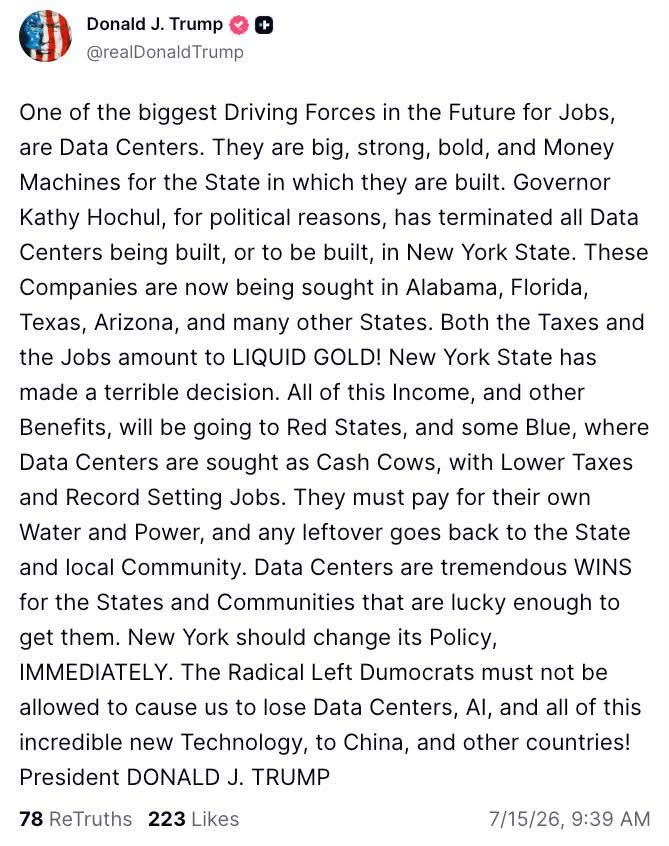
Perhaps he has the juice to convince his base that having these ‘big, strong, bold Money Machines’ around is a fair trade-off for higher electricity bills, water shortages, declining property values and 24x7 noise, but so far, the opposition to data centers is bipartisan and has a lot more to do with economic strata than with mere party identity, especially in rural areas:
“Most people aren't interested in some massive development here,” said Tammie Bruneau, who has led local pushback. “They're interested in protecting the farmland.” […]
"It seems like the big tech companies are kind of steamrolling the citizens,” said Jeff Samoray, 57, a Democrat who lives in Huntington Woods, outside Detroit.
And indeed they are. At least 75 data center projects worth around $130 billion have reportedly been blocked or delayed by local opposition in Q1 of 2026 alone, according to Data Center Watch:
Q1 2026 produced the largest single-quarter concentration of blocked and delayed data center projects on record, with at least 75 projects worth approximately $130 billion disrupted by local opposition. The quarter reflected a structural shift rather than a cyclical spike: communities have internalized an opposition playbook, legislative sessions introduced formal regulatory uncertainty, and the number of active opposition groups more than doubled across 49 states.
It’s not just the data centers getting blowback, either. So are their executives:
In recent months, mounting opposition to AI has given rise to a surge of violent rhetoric, threats against people and property, and a serious attempt at harm. The phenomenon has executives at tech companies large and small reconsidering their personal security arrangements and how they talk about their products to a public that is increasingly wary of the technology and the societal changes it is ushering in.
But many data centers are going ahead anyway, after big tech companies succeeded in steamrolling the citizens.
And the impacts are significant. Data centers are consuming vast amounts of water in places where water supplies are already stressed; they make noise that disturbs residents; and they impose grid upgrade costs on the rest of the local utility’s customers.
There’s not much that can be done about the water and noise; those come with the data center territory, at least with the technologies in use today.
But the costs are getting a reaction.
Surging costs and resource demands
The July capacity auction in the PJM, the largest structured wholesale market in the US, set alarm bells ringing [emphasis mine]:
Power prices in PJM Interconnection's latest annual capacity auction on Tuesday held near record highs at about $325 per megawatt-day, the maximum allowed under a temporary price cap by the largest U.S. grid operator to curb rising bills for households and businesses.
Prices in the auction, which is aimed at securing enough electricity supplies to cover the highest-demand days on the PJM grid that covers 13 states in the Mid-Atlantic and Midwest regions, have soared in recent years largely because demand driven by data centers has outstripped supplies.
For the second auction in a row, PJM fell short of its reliability requirement, meaning it is at higher risk of electricity shortfalls that could lead to blackouts during times of high demand.
Since 2024, so-called capacity prices determined by the auction have jumped by more than 1,000% due to that supply-and-demand imbalance. That's raised energy bills for those living in the regions covered by PJM, or about one in five Americans.
Those Americans are struggling to see how paying ever-higher prices for their electricity are really getting the benefit of that expense—especially if it winds up costing them their jobs. (More on that later.)
In one case cited by CNBC:
“The people of Pennsylvania have paid $492 million in upgrades to the electricity grid that went to support data centers."
That CNBC video largely concerns the “Colossus” data centers built by Elon Musk’s xAI outside of Memphis, Tennessee, where the company has installed 59 natural gas turbines without securing federal clean air permits. Some data centers have been able to sidestep the usual consumer protections like environmental studies and public hearings by locating their generators “behind the meter” (not connected to the local grid) with the help of local authorities who fast-track the approvals. But the air pollution and the noise still impact the local communities, which in the case of xAI’s Colossus, are historically Black and already burdened with toxic air pollution.
It doesn’t help that Colossus was used to train Grok, the LLM that has been generating artificial nudes and sexualized images of children in response to user prompts since at least the beginning of this year, despite numerous investigations and outrage.
Paris Marx addressed all of the above in his recent appearance on CBS. He has a new book coming out in October titled Hyperscale which promises a deep dive into the resource consumption of data centers and the pushback they’re receiving. It looks very timely:
In Hyperscale, journalist Paris Marx uncovers the excesses of hyperscale data processing. He exposes the deceptive, exploitative ways tech companies are siphoning energy and resources from vulnerable communities in their pursuit of digital power, abandoning the pretense of social responsibility.
Amid energy shortages and tech-induced battles over drinking water, Marx makes a powerful case for technology that promotes the social good over the bottom lines of tech billionaires. He joins the incredible efforts of people and social movements pushing back against the profit-driven interests of Big Tech, illuminating a path toward the sustainable future we all deserve.
The AI boom and its infrastructural demands have accelerated our many modern catastrophes. With razor-sharp reporting and incisive analysis, Marx shows us that the greatest threat is not the specter of AI overlords but a global environmental disaster already in the making.
Data centers in the US consume more power than in any other country, which may explain why much of the resistance to them is centered in the US. But resistance is growing elsewhere as well.
In Ireland, data centers are imposing real costs on the public:
The rapid expansion of data centres has drained a staggering €715 million from the Irish economy between 2015 and 2023, according to a new report commissioned by Friends of the Earth Ireland and Beyond Fossil Fuels, showing the EU the risks of betting on AI development without proper safeguards.
The report, The Cost of Data Centres: Modelling the Household Electricity Costs of Ireland’s Data Centre Sector, authored by postdoctoral researcher Dr Seán Fearon, reveals that during the last energy crisis, the poorest households paid an extra €209 in total between 2021-2023. Furthermore, it warns that in the event of another global energy shock caused by events such as the Russian full-scale invasion of Ukraine and the war on Iran, additional costs could soar to as much as €1.6 billion over the next decade.
The Greens are mounting a campaign against data centers in Scotland to prevent the same from happening to them [emphasis mine]:
Scotland is currently facing a wave of speculative hyper-scale data centre planning applications. With 24 proposals for major new sites in Scotland, if all are approved they will consume up to 6000 megawatts of power - more than 1.5 times Scotland’s total peak power use now.
And the European Union will develop minimum energy-efficiency standards for data centers:
The European Commission said it would develop minimum performance standards for both new and existing data centres, with a "needs assessment" due by 2027. […]
Data centres are expected to drive 20% of growth in electricity demand in advanced economies by 2030, according to the International Energy Agency.
The EU is also working on a sustainability label for data centres, covering criteria including water use and clean energy supply, which large facilities would have to make public.
I won’t belabor the point by attempting a global survey of how every country or region is responding to the demands of data centers, but they have largely similar contours everywhere.
Integration, or resignation and accommodation?
Recognizing that the data center juggernaut is still proceeding, some are turning to mitigation, looking for best ways to integrate the new data centers loads on the grid and minimize the impact they have on citizens.
For its part, FERC is pushing US grid operators to rewrite rules for large data-center loads:
The Federal Energy Regulatory Commission draft "show cause" orders direct the six regional grids under its jurisdiction, which excludes Texas, to justify or overhaul their process for powering large energy users. The aim, FERC said, is largely to speed up the connection of data centers while minimizing the impact on grid stability and power bills for Americans.
"This is the biggest priority our country is facing at the moment," FERC Chairman Laura Swett said.
The tech nonprofit Climate Cabinet Education, which provides a database of climate science, recently launched a series of briefings called “Taming Data Center Turmoil” which purports to be a regulatory framework that can help policymakers understand the trade-offs involved in hosting data centers.
As Justin Gerdes highlighted in his Quitting Carbon newsletter, the NC Clean Energy Technology Center (NCCETC) has launched a policy tracker called the 50 States of Energy Affordability Report, which could be a useful resource for policymakers looking for information on how other states are dealing with rising electricity costs:
This inaugural report finds that 46 states, the District of Columbia, and Puerto Rico took a total of 362 actions to address energy affordability this year, through June 2026.
According to the report, the largest number of actions related to large load cost-shift prevention (including large load tariffs); customer bill assistance programs; incentive programs for low- and moderate-income customers; and performance incentive mechanisms.
In North Carolina, Duke Energy has responded to the public concerns over rising utility bills caused by data centers by proposing a special “large load tariff” under which the data centers would be billed:
Around the nation, large load tariffs are gaining steam as states scramble to prevent the AI boom from exacting an enormous cost on consumers and the climate. At least 75 such tariffs have been proposed or approved in some 35 states, according to data tracked by the Smart Electric Power Alliance and the North Carolina Clean Energy Technology Center.
Special tariffs could help protect consumers from shouldering the burden of grid enhancements needed to support the data centers, but regulators must carefully review the tariffs’ minimum payments, contract duration and allocation of grid-upgrade costs to ensure that they adequately protect customers, and that is not something that all state regulators are equipped or staffed to do.
New Jersey is taking a novel horse-trading approach, accepting the data centers in exchange for the data center operators helping residents to electrify:
New Jersey is offering data centers an unorthodox way to get the power they need: by bankrolling home energy upgrades.
Last week, Gov. Mikie Sherrill (D) signed a bill that will create a first-of-its-kind program to incentivize data centers to secure clean capacity by reducing demand elsewhere on the grid. Data centers will be able to pay for households to replace their energy-hogging electric-resistance space and water heaters with much more efficient electric heat pump appliances — or to install rooftop solar and batteries.
The scheme could lower electricity bills for potentially millions of households statewide by hundreds to thousands of dollars annually. In return, the data centers would get priority in the interconnection queue.
But costs aren’t the only concern. Some jurisdictions are finally waking up to the climate impact of data centers as well:
Dozens of planned gas plants to directly power data centers in the United States could emit as much greenhouse gas annually as Australia or France, according to a report by an environmental group published on Wednesday.
The Environmental Integrity Project reviewed 74 gas-fired U.S. power plant projects proposed or planned to provide electricity directly to data centers, which would sidestep the process to connect to the U.S. electric grid. It estimated that they would generate 143 gigawatts of electricity and result in 662 million tons per year of greenhouse gas emissions.
Not every data center operator is wantonly throwing climate under the bus in pursuit of power. To its credit, Google has contracted to buy all of the electricity from the first two phases—1.6 GW of solar and 1.9 GWh of storage—of an Arkansas solar-and-battery complex called the Steel River Energy Center. Those two phases will use three million solar panels made by First Solar, the largest US-headquartered solar manufacturer. Longtime solar developer Cypress Creek Energy is building the project, which after the third phase in 2029 will sport 2.45 GW of solar and 2.9 GWh of battery storage, potentially making it the largest solar project in the United States:
This scale places Steel River at the forefront of U.S. solar facilities. While several operating projects have broken the gigawatt barrier in other parts of the world, U.S. developers have only crept up to that threshold. The Edwards & Sanborn plant came online in California’s Mojave Desert in early 2024 with a national-best 875 megawatts of solar and nearly 3.3 gigawatt-hours of storage. Steel River would blast past that solar capacity level, though it won’t store quite as much in its batteries.
Legislation has been proposed in several US states to prevent hyperscale loads from undermining existing clean-power mandates, including New York, Michigan, Minnesota, Oregon, Colorado, and Georgia:
Legislation on the desk of New York Gov. Kathy Hochul would require data centers over a certain size to meet renewable energy benchmarks starting in 2030 and, by 2040, get at least 90% of their energy from renewable energies. The bill’s author, state Sen. Kristen Gonzalez, a Democrat, said the targets are realistic.
“We are literally talking about the wealthiest companies in the world that are looking to build in New York state, and if they have the resources to put billions of dollars into data center development, then they certainly should have the resources to build out renewable energy sources to power them,” Gonzalez told The Associated Press.
Michigan, Oregon and Minnesota led the way, enacting laws in the last 18 months designed to protect their pre-existing requirements that electric utilities use only emissions-free energy sources by 2040.
The deeper questions remain
In the spirit of ‘staying in my lane,’ I try to restrict my focus to the issues around energy and emissions. But there’s also a growing unease around the impact that AI will have on society, on culture, and on jobs. So I greatly appreciated Paul Kedrosky’s channeling of Jonathan Swift in his recent satirical take. I’m not even going to quote it in hopes you’ll click the link and read it for yourself.
This post draws on just a fraction of the stories that crossed my desk in recent months about data centers. Rather than attempting a comprehensive review, I tried to offer one or two examples of the various facets of this behemoth new industry rising under our feet even as we try to learn how to balance atop it. This is only the beginning, and the rules are still largely unwritten.
I hope we get them right.
Got an item you’d like us to cover?
We’d like Transition Times to help increase the visibility of all the great work that’s being done out there. So if you have an article, report, study, podcast episode, newsletter post, video clip or anything else that you think is worthy of a shout-out in Transition Times, email it to suggestions [at] transitiontimes [dot] net! We welcome all submissions, as long as they’re relevant to the energy transition.
Sources
Molly Taft, “New York Governor Signs First Statewide Data Center Moratorium,” Wired, July 14, 2026.
Episode 226 – Load Growth Shenanigans, Energy Transition Show, June 12, 2024.
Brandon Owens, “America’s Data Center Reckoning,” AlxEnergy, June 25, 2026.
Robinson Meyer, “Who Actually Likes Data Centers?” Heatmap, July 13, 2026.
Jeffrey M. Jones, “Americans Oppose AI Data Centers in Their Area,” Gallup, May 13, 2026.
Helen Coster and Valerie Volcovici, “Americans are angry about data centers. Politicians are feeling the pressure,” Reuters, July 16, 2026.
Lora Kolodny and Jeniece Pettitt, “Elon Musk’s Memphis AI empire is the epicenter of the data center backlash,” CNBC, July 16, 2026.
Q1 2026: Data Center Watch Report, Data Center Watch.
Lindsay Ellis, Zusha Elinson, and Tina Li, “The AI Backlash Has Tech Executives Fearing for Their Lives,” The Wall Street Journal, July 15, 2026.
Laila Kearney, “US PJM power grid auction prices expected to stabilize near record highs.” Reuters, July 14, 2026.
“Elon Musk’s Memphis Takeover — The Marvels And Messiness Of SpaceX’s AI Buildout,” CNBC, July 16, 2026. [YouTube]
Press release: “NVIDIA Ethernet Networking Accelerates World’s Largest AI Supercomputer, Built by xAI,” NVIDIA, October 28, 2024.
Disha Raychaudhuri and Valerie Volcovici, “Pollution from Musk’s unpermitted xAI power project hits hardest in Black communities,” Reuters, July 14, 2026.
Andrew Hutchinson, “X’s Grok chatbot is still generating fake nude images,” Social Media Today, June 14, 2026.
Andrew Hutchinson, “US Attorneys General Call on X To Address Sexualized Deep Fakes,” Social Media Today, January 27, 2026.
Paris Marx on “Details on New York's data center construction pause, a first in the U.S.,” CBS News, July 15, 2026. [YouTube]
Paris Marx, Hyperscale, Riverhead Books, October 2026.
Dan McCarthy, “Data centers use more power in the US than in any other country,” Canary Media, July 3, 2026.
Press release: “As Europe bets on AI and data centres, Ireland shows the risk: higher electricity bills for households,” Beyond Fossil Fuels, May 28, 2026.
Stop Hyper-scale Data Centres in Scotland, Scottish Green Party.
Kate Abnett, “EU plans energy standards for data centres amid concerns over soaring power use,” Reuters, June 3, 2026.
Laila Kearney, "Top US energy regulator pushes grids to overhaul data center power rules," Reuters, June 18, 2026.
Taming Data Center Turmoil, Climate Cabinet Education.
Justin Gerdes, “What I’m reading: Special research roundup edition,” Quitting Carbon, July 7, 2026.
50 States of Energy Affordability Report, NC Clean Energy Technology Center.
Elizabeth Ouzts, “Duke Energy proposes special rules for data centers in North Carolina,” Canary Media, July 6, 2026.
Alison F. Takemura, “New Jersey law will let data centers pay for home energy upgrades,” Canary Media, July 16, 2026.
Valerie Volcovici, “Gas plants for US data centers to be major source of climate change-linked emissions, report says,” Reuters, July 1, 2026.
Julian Spector, “Google buys power from record-busting solar-battery site in Arkansas,” Canary Media, July 15, 2026.
Marc Levy, “As gas plants rise to power AI, renewable energy allies are fighting for cleaner alternatives,” Associated Press, July 11, 2026.
Isaac Pound interviews Gil Duran, The Tech Report, July 16, 2026. [YouTube]
Paul Kedrosky, “A Modest AI Proposal,” Paul Kedrosky, July 10, 2026.
We never use AI to produce any of the written or spoken content you find on Transition Times. We do use AI as a research tool (and vet the information so received).
We also occasionally use AI to generate graphics and sounds.