
TT#15 – Data Center Emissions
Before Big Tech gets much farther along in their heedless pursuit of gas-powered data centers, we ought to have a proper public debate about whether having AI is worth throwing the climate under the bus.
- Data centers in the pipeline in the US could increase greenhouse gas emissions by as much as 662 million tons per year, or 45% of the emissions of the entire US electric power industry.
- Big Tech’s AI expansion is colliding head-on with its climate commitments.
- The real question isn’t simply how much AI we can build, but whether its benefits justify locking in decades of additional emissions.
So far, I have published two pieces—NN#3 and TT#11—about why the rush to build data centers to power AI poses serious challenges to the environment, to public tranquility and health, to the cost of electricity, and to the management of the electricity grid.
But I have yet to fully articulate my main concern, which is about the carbon emissions of the power plants being built to power the data centers. These generators are increasingly being built “behind the meter” (on-site) where utility regulators generally lack jurisdiction. So in this post, I want to explain why this is a serious issue.
Those who are familiar with my previous podcast, the Energy Transition Show, may recall that we raised the issue of data center emissions several times over the past couple of years:
· In Episode 226, Mike O’Boyle described the deluge of data center demands for power that was just starting to hit utilities as “a litmus test as to whether utilities are ready to build a grid that's headed toward zero emissions.” (The two years since then proved beyond a shadow of a doubt that they are not.)
· In Episode 240, I warned that big tech companies seeking new power supplies for their data centers "could simply steamroll the energy transition, placing their private interest above what should be the public's priority of halting global warming."
· In Episode 244, I noted that big tech companies engaged in the AI arms race aren't waiting for Small Modular Reactors (SMRs) to be built. Instead, they're turning to gas-fired power plants and "happily throwing climate action under the bus."
· In Episode 253, I decried how private companies are procuring power capacity outside the usual utility process and without air pollution permits, with no emissions requirements imposed on them by regulators, saying, “We are throwing the climate under the bus in the service of powering AI, and so far, there is next to nothing to prevent or restrain that.”
However, it was difficult to estimate just how much additional carbon dioxide these power plants would emit because most of the data centers were still in planning phase. When we recorded the interview for Episode 226 in 2024, there was clearly a lot of “venue shopping” going on, where the tech companies were looking for power in multiple regions for a single data center in order to see where they could get the best deal from a local official offering tax breaks and other goodies as sweeteners. How many of those data centers would actually materialize, and exactly what their power demands would be, was a very murky question.
The vast majority of data centers are still in planning, but after a couple of years of development, it’s becoming clear that there are lot of new gas-fired electricity generators in the pipeline. A new report from Global Energy Monitor (GEM) has the data:
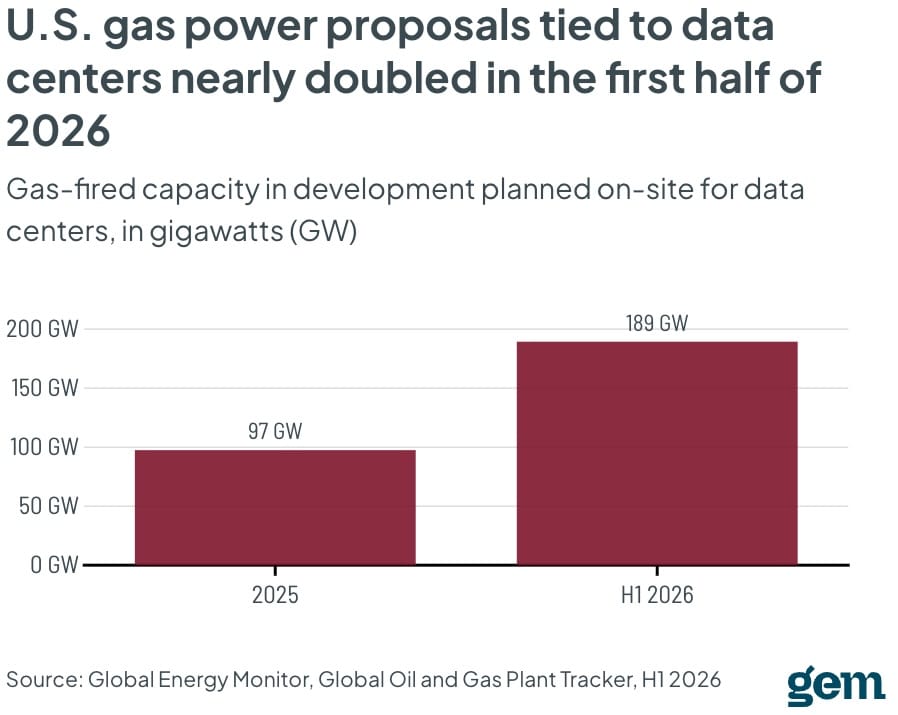
GEM notes that of all gas power capacity in development (not just the capacity destined to power data centers), the US has a third of the global total at 378 GW. Some of that may also wind up powering data centers, although how much is hard to estimate. But GEM observes that if all of it were built, it would increase the size of the existing gas fleet in the US by roughly two-thirds. It’s hard to imagine how that much additional gas capacity could be needed to power things other than data centers, especially given that wind and solar have dominated new power generation procurement in the US for more than a decade now. That suggests that a good chunk of the capacity not currently earmarked for use in data centers likely will be used by data centers.
We’ll just use the 189 GW figure for now, and bear in mind that it could be significantly larger.
The capacity that actually gets built could also be quite a bit smaller, since the aforementioned venue shopping has led to numerous duplicative, “phantom projects” and “long-shot pitches,” as Bloomberg’s Matt Day and Mark Chediak put it in their recent estimate of data center emissions.
They based their estimate on 126 GW of total planned on-site gas generation capacity across 22 states, and the number is startling [emphasis mine]:
Ninety-nine proposed plants tracked by BloombergNEF would emit about 318 million metric tons of carbon dioxide annually if run at industry-standard rates, according to a Bloomberg News analysis. The entire US electric power industry emitted about 1,485 million metric tons of carbon last year, according to Energy Information Administration data, meaning one slice of data center infrastructure has the potential to lift US power sector emissions by 20%, and as much as a third should the new plants run flat out.
If we scale their calculation to the 189 GW of new gas-fired, on-site capacity that GEM identified, we get 447 million metric tons of CO2, or about a third of the emissions of the entire US electric power industry.
That’s a demoralizing thought, especially for those who put in years of effort just to get a state utility regulator to require a utility to consider building, say, a solar farm instead of another gas-fired power plant. Many years of such effort across the country seem poised to be nullified by a sudden flood of data centers getting built by tech companies with obscene amounts of money without even having to get the permission of a regulator or an air-quality board.
Another estimate reported by Reuters’ Valerie Volcovici put the emissions much higher:
The Environmental Integrity Project reviewed 74 gas-fired U.S. power plant projects proposed or planned to provide electricity directly to data centers, which would sidestep the process to connect to the U.S. electric grid. It estimated that they would generate 143 gigawatts of electricity and result in 662 million tons per year of greenhouse gas emissions.
That implies an emissions increase equivalent to 45% of the entire US electric power industry.
If we treat that 662 million metric ton estimate as the possible ceiling, perhaps a recent analysis by the Financial Times gives us a floor [emphasis mine]:
An FT analysis of 60 of the largest planned data centres being built in the US by Amazon, Microsoft, Google and Meta found that they could together produce 101.5mn tonnes of carbon dioxide emissions a year once fully operational, based on the most recent snapshot of US power generation.
That would be equivalent to about 7 per cent of US power-sector emissions in 2025 — the annual emissions of 27 coal plants or 24mn petrol-powered cars.
[Most annoyingly, the FT article never states the actual capacity of the power plants and instead just counts them, so it’s hard to align their analysis with the preceding figures from GEM and BloombergNEF. Hey FT, seriously: “coal plant” is not a unit of account. In the US, there are 100 MW coal-fired power plants, and there are 3,400 MW coal plants. Use the bloody units, please!]
Reconciling these various estimates would be a research project in itself to examine their respective methodologies, so it’s hard to know whose numbers to believe. But even without having certainty about the aggregate emissions of data centers across the US, we can be absolutely certain that individual plants could be massive emitters of carbon pollution.
As Michael Thomas first reported in his Cleanview newsletter, Amazon has acquired land in Pecos County, Texas and filed permits to build a 7.65 GW gas-burning facility to power a datacenter dubbed Gigawatt Ranch [emphasis mine]:
In January, GW Ranch received a permit from the state of Texas allowing the gas power plant to emit 33 million tons of carbon dioxide into the atmosphere. If the project emitted that much CO2, it would be the largest single source of pollution in the United States—emitting more greenhouse gases than the country’s largest coal plant. It’s worth noting that companies rarely emit as much as their permits allow.
In fact, that single data center power plant would be larger than the largest power plant in the US today, the 6.8 GW Grand Coulee Dam. At 7.65 GW, it would also be the largest single gas power plant in the world.
Elsewhere in Texas, another 6 GW gas plant has been proposed by data center developer Nexus.
But those plants would be far surpassed by a 9.2 GW natural-gas fired power plant to be built by the US Department of Energy and used by OpenAI under what Heatmap appropriately called an “arcane” ownership structure:
This morning, OpenAI announced that it is leasing an enormous data center facility that will be built in Pike County, Ohio. The facility’s ownership structure will be arcane, to say the least: It will be built on federal land, operated by a subsidiary of the Japanese firm SoftBank, and partially backstopped by the chip designer Nvidia. The project is the most significant example so far of the increasingly creative off-book financing that’s now driving the artificial intelligence boom. […]
While its continued operation will likely be protected by two-way federal contracts with Nvidia, SB Energy, and other counterparties, the Trump administration has already stretched the bounds of contract law to allow for, let’s say, entrepreneurial federal policy making on its chosen issues.
In case you were wondering, the US Government hasn’t been in the business of building big power plants since the 1970s, when it started building the third unit at Grand Coulee, and the Watts Bar nuclear plants operated by the Tennessee Valley Authority. Those plants serve large populations of the public, for which an investment by the public is appropriate.
Bipartisan opposition
So why is Donald Trump going into business with the Japanese government to construct a single massive power plant on federal land to power a single data center that will be used by a private company? You’d have to ask him, but I’d imagine that “largest natural gas generation projects [sic] in the world” has a nice ring to him.
Trump has also offered very vocal support for data center construction in recent days, apparently in reaction to Texas Governor Greg Abbott’s announcing a moratorium on the approval for new data centers until authorities can complete a “comprehensive verification and audit of all data centers” being added to the state’s grid, another moratorium called by New York Governor Kathy Hochul last month, and an executive order issued by Kentucky governor Andy Beshear that set air and water quality standards for data centers and directed utility regulators to ensure Kentuckians don’t pay more for electricity.
Trump said communities who opposed the data centers were making a “mistake” and said the “smart ones” want them, but considering that many of the communities resisting data centers are in red states that have supported Trump, I’m not sure how swayed they’ll be by his rhetoric when weighing it against the noise, electricity cost, air pollution, and water consumption that impacts them personally. Historically, Big Tech hasn’t exactly had a natural constituency in rural communities.
As Robinson Meyer points out in Heatmap, their polling finds that data centers are about as unpopular in urban areas as rural areas:
These results help explain why Republicans have suddenly turned on a dime against data centers: Their base has rejected it. As a political reporter friend put it to me, after looking at our data, you don’t want to be on the wrong side of a trend that’s uniting college-educated and non-college-educated Americans.
Indeed, when Anthropic CEO Dario Amodei admits that AI suffers from a crisis of trust, with people worrying that companies or governments are "cooking up some new way to screw them over," he’s not just talking about leftist opposition.
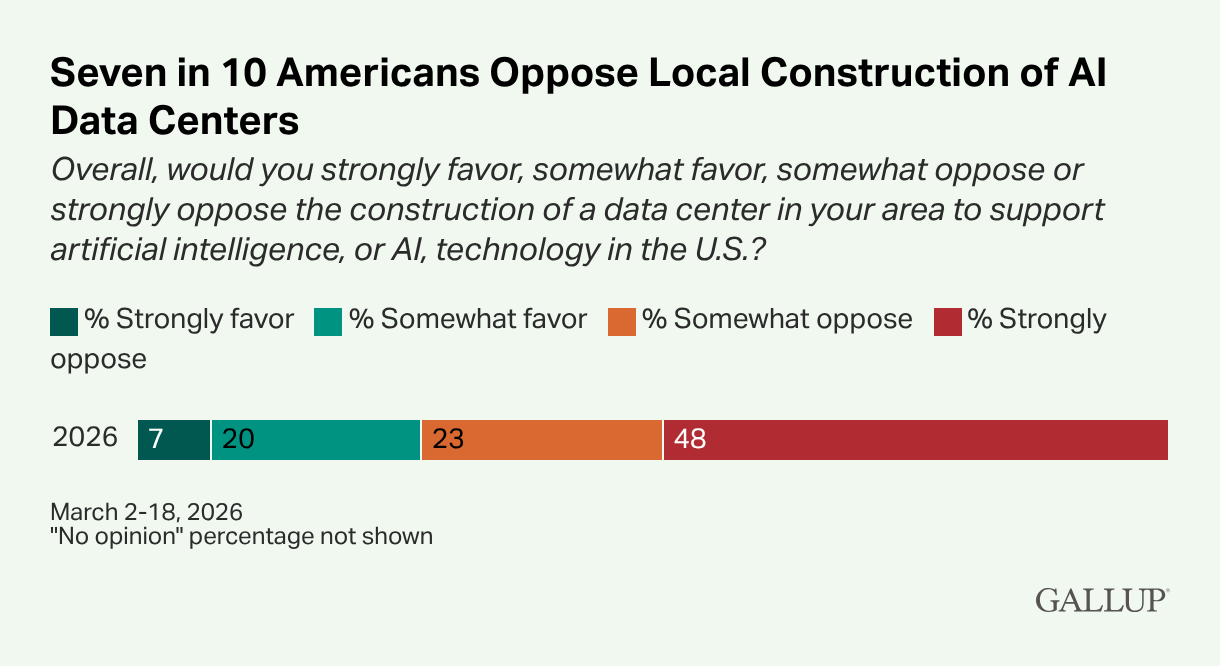
As I mentioned in TT#11, 71% of Americans polled by Gallup in March opposed the local construction of data centers, 73% don’t trust businesses to use AI responsibly, and 79% believe it’ll reduce the total number of jobs in the US within the next decade:
And as Liam Denning observed incisively in his Bloomberg column:
Managing to unite red and blue America in their unease and hostility may well rank as one of AI’s first big achievements. Economic and national security considerations mean outright prohibition of the technology isn’t an option. The period marked by welcoming tax breaks, a free-for-all on the grid and local enthusiasm or indifference is, however, giving way to something slower, where the gating factor isn’t just access to chips or power connections, but also plain political acceptance. Social license is harder to obtain than mere permits.
Even red-state voters aren’t going to put their support behind Republican utility regulators happily enjoying the big donations and secret retreats offered to them by a group of utility industry and big tech companies eager to “educate” them about value of the data center power plants, transmission lines, and other infrastructure they want to build, as reported by the Washington Post’s Evan Halper:
As energy-hungry data centers and rising electricity bills have stoked voters’ anger, some elected but obscure utility commissioners are meeting privately with companies whose fortunes they regulate, according to corporate filings and internal emails reviewed by The Washington Post.
In interviews, commissioners and industry reps said it’s all in the interest of education. But watchdog groups say the industry-funded intermingling is a brazen conflict, as utility and tech companies seek project approvals and elected officials work to keep their seats.
Last month’s all-expenses-paid West Palm Beach retreat was organized by the Regulators Roundtable, an ideologically conservative group whose membership is recruited from the utility industry, tech firms and right-leaning commissioners who tend to support their plans for rapid growth. Major funders have included Google, NRG Energy, the American Gas Association and the Nuclear Energy Institute, according to documents that the Energy and Policy Institute, a utility watchdog, obtained under public records laws and shared with The Post.
“These are companies whose profits are directly affected by decisions made by a remarkably small group of regulators,” said Gabriel Straus, a research fellow at the Energy and Policy Institute. “The last thing you want to hear when you are struggling to make ends meet is your utility commissioner is sipping cocktails at a resort with the utility executives raising your rates.”
The group promises sponsors — several paying $50,000 to be “Inaugural Member Investors” — the chance to “engage directly with these key decision-makers” and provide “insights and expertise that can help steer policy.” Its nonprofit arm flies commissioners to luxury hotels for private meetings with industry representatives, while its political wing contributes directly to campaigns in the 10 states where voters elect these regulators.
Which could explain the Trump administration’s latest effort to preemptively thwart public opposition:
The Trump administration is moving to make it harder for communities to weigh in on proposed data centers, even as a backlash against the behemoth projects grows across the country.
The Environmental Protection Agency plans to eliminate a federal requirement that states publicize and solicit public input on applications for air pollution permits for a range of industrial facilities, including new data centers and the power plants needed to run them.
The move could prevent residents from raising concerns about — or even learning about — data centers before permits are approved and construction starts.
Uncertain outlook for the data center buildout
There are more reasons to be skeptical about how much of the anticipated capacity will actually get built.
In his must-read newsletter for AI watchers, Paul Kedrosky just raised three cautionary notes in his latest post, “The Data Center Buildout Just Hit an Inflection”:
Execution risk is rising sharply. There are new estimates that as much as half of planned U.S. data-center capacity may be delayed or never built. Requiring deposits is causing projects to drop out of the queue in large numbers.
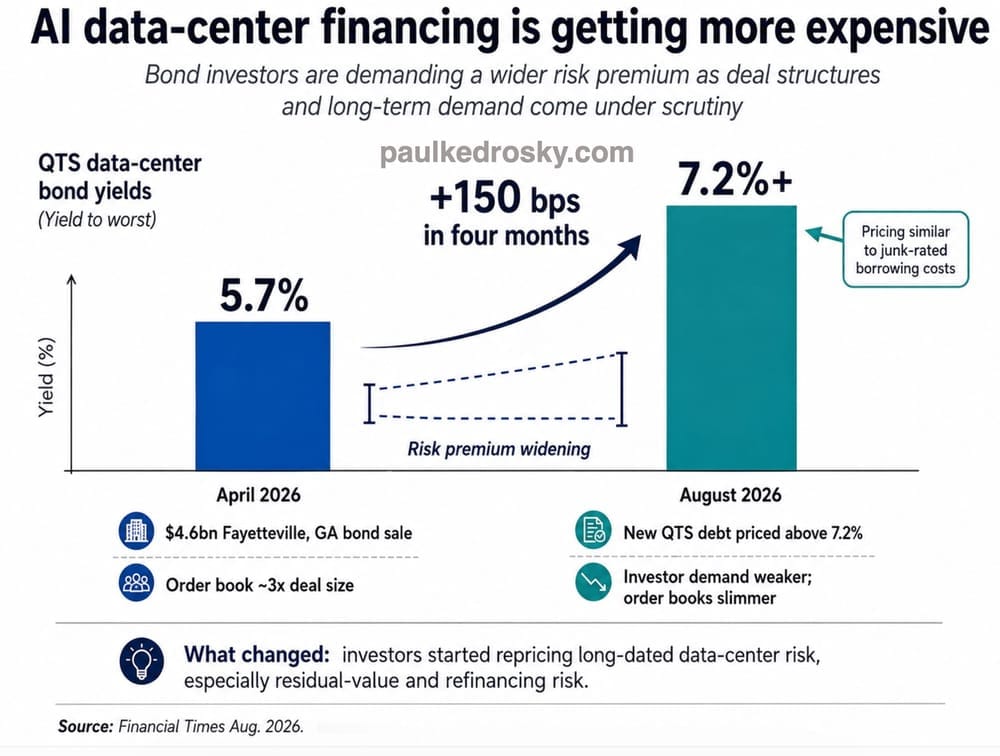
Financing is becoming less forgiving. Lenders and investors are reassessing leverage, residual values, lease durability and the risk that assets financed against long-lived assumptions become economically impaired much sooner.
Political risk has increased sharply. Local opposition is hardening into moratoriums, stricter permitting, politicians are all flipping to more negative, and infrastructure charges are growing as the pipeline brakes come on.
If requiring deposits is clearing out the project queue, then that’s a good sign that phantom projects are going away and we’ll soon start to see how many of the projects are real. Rising finance costs will also flush out the merely exploratory bids, especially in light of the backdrop of rising inflation and long-term bond yields that have recently rattled the markets:
Throwing climate under the bus
As the aforementioned FT article detailed, the data center plans of Amazon, Microsoft, Alphabet and Meta will obviate their previous climate commitments, with little but scattered mumbles of acknowledgement that they are the ones throwing climate under the bus:
Despite corporate climate commitments from Big Tech companies, some have acknowledged in recent sustainability reports that their emissions have increased due to data centre build-outs. […]
All four tech giants have made plans to match their electricity consumption with investments in clean energy, often through the use of renewable energy credits.
Amazon told the FT that it invested billions of dollars in carbon-free electricity and had matched 100 per cent of the electricity consumed by its operations with renewable energy elsewhere. Microsoft said it had continued to invest heavily in carbon-free electricity and other decarbonisation technologies.
Google said the company was one of the largest corporate purchasers of clean energy in the world and that it had matched all of its global electricity consumption with renewable energy purchases for nine consecutive years. Meta declined requests to comment.
“The problem with voluntary reductions is they’re expensive and they reduce profits,” said Michael Greenstone, director of the Energy Policy Institute at the University of Chicago. “Eventually, capital markets are going to force the firms to peel back some of their carbon mitigation efforts.”
I think Greenstone has it right. It’s easy to make plans to buy renewable energy credits, which are a flawed vehicle for decarbonization at best. But those plans and purchases are not binding, and are easy to throw under the bus at the first sign of shareholder pressure, which is exactly what I expect them to do if pressed.
The aforementioned Bloomberg article observes similarly:
That fossil-fuel infrastructure threatens to push Big Tech’s climate goals out of reach. Both Amazon and Microsoft are big backers of clean energy projects, and have said they aim to zero out their contribution to the carbon emissions responsible for a warming planet. Those pledges were made before the artificial intelligence boom, at a time when technology companies were under pressure from employees and outside activists to do more to cut their emissions. Spokespeople for Amazon and Microsoft say their climate goals haven’t changed. Amazon is exploring its options for solar power and battery storage at the west Texas site.
“It has been a remarkable shift in the last three years,” said Drew Wilkinson, a former Microsoft employee who organized his colleagues to advocate for tougher sustainability measures. “The companies who set the bar for corporate climate action are now bringing net new fossil infrastructure online at a breakneck pace. Few of us saw it coming.”
According to the FT, Amazon’s emissions increased 16% from 2024 to 2025, Microsoft’s by 25%, and Alphabet’s by 18% (under its “ambition-based” measure), with all three attributing significant portions of the increases to data-center expansion.
Investors in all four companies have filed resolutions asking them to report on their greenhouse gas emissions and explain how they will meet their previous decarbonization commitments in light of their data center expansion plans, but shareholder support has been weak, garnering only ~18% of the vote at Amazon, and roughly 7% at Meta and Alphabet. (Microsoft appears headed for a similar resolution at its next shareholder meeting.)
Let’s just say I wouldn’t pin my hopes on Big Tech’s shareholders to restrain them.
And lest you think this is entirely a US story: It’s not. The US is home to around half of the total data center capacity, but the rest of the world is building it rapidly.
China is ramping up generation to meet the surging demand for its data centers.
Greenpeace Australia Pacific and independent expert Ketan Joshi have issued a report calling for Australia to implement an “urgent moratorium on data centre approvals until appropriate guardrails are in place,” lest they “derail the renewable energy transition.”
Analysis by the non-profit group Foxglove calculated that two data centers in the UK will use 1.3GW of power and produce more than 4.5 million tonnes of carbon emissions, more than ExxonMobil’s 3.9 million tonnes in 2023.
And so on, right around the world.
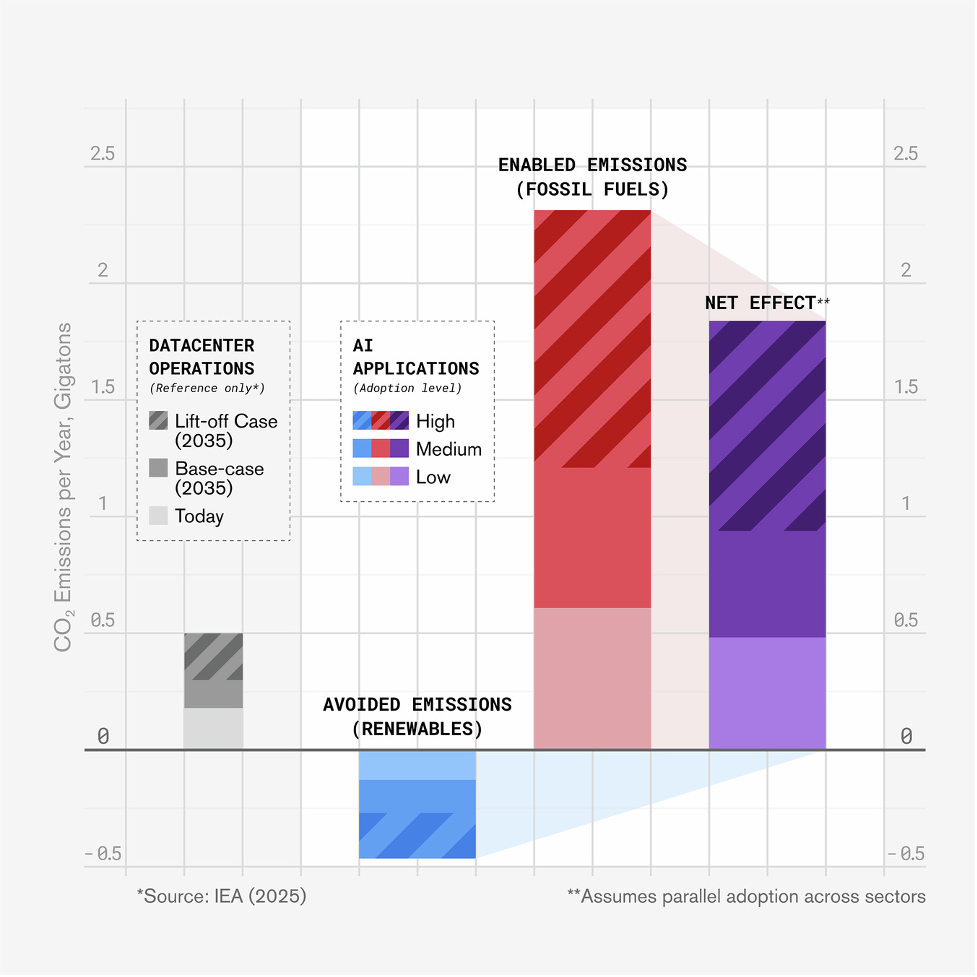
For a final point, some have argued that the emissions produced by AI data centers’ power plants will be outweighed by the emissions that AI can help avoid through innumerable applications of the technology. I have seen very little analysis on this, but Pawel Czyzak’s blog on the subject highlights a new paper by a group of Seattle researchers led by Will Alpine finding that:
Absent policy steering, AI’s modeled effects increase the carbon intensity of the global economy and reinforce fossil fuel incumbency—outcomes that current analytical and governance frameworks do not fully capture […] at current pathways, AI adoption adds more fossil fuel emissions than clean power related reductions. And that’s before we account for giga-projects like the one we’re discussing today.
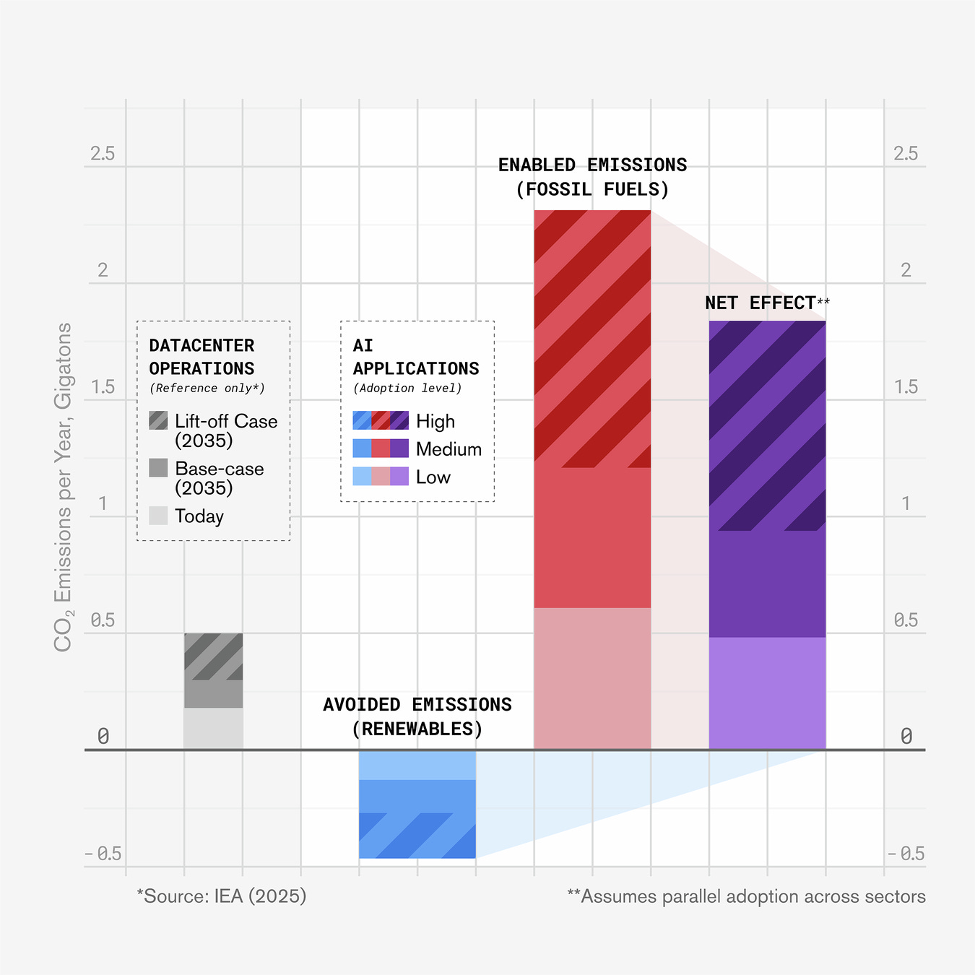
Source: Will Alpine, et al., 10.1038/s44168-026-00411-0
However, I can well imagine the sheer volume of the assumptions that would have to go into such an analysis and how much uncertainty would thus be embedded in the results. I expect this will be a fertile area of research for a long time to come.
How many of the data center power plants in the pipeline will actually get built, and exactly how much emissions they will produce, remains to be seen. But we can be sure of this: Data centers clearly pose a serious additional risk to the climate, but the public dialogue that we should be having about the trade-offs between the potential benefits of AI technology and the carbon emissions they create are not happening anywhere, as far as I’m aware.
That’s a conversation that needs to happen everywhere, right now, before many more plants get built and their emissions get locked in for decades.
Got an item you’d like us to cover?
We’d like Transition Times to help increase the visibility of all the great work that’s being done out there. So if you have an article, report, study, podcast episode, newsletter post, video clip or anything else that you think is worthy of a shout-out in Transition Times, email it to suggestions [at] transitiontimes [dot] net! We welcome all submissions, as long as they’re relevant to the energy transition.
Sources
Episode 226 - Load Growth Shenanigans, Energy Transition Show, June 12, 2024.
Episode 240 - Evolving the UK Energy System Part 1, Energy Transition Show, January 1, 2025.
Episode 244 - Rethinking Industrial Strategy, Energy Transition Show, February 26, 2025.
Episode 253 - Bioenergy Illusions, Energy Transition Show, July 2, 2025.
Jenny Martos, “U.S. gas power proposals tied to data centers nearly double in six months,” Global Energy Monitor (GEM), August 2026.
Matt Day and Mark Chediak, “Data Center Gas Plants to Boost US Power Emissions by 20%,” Bloomberg, August 18, 2026.
Valerie Volcovici, “Gas plants for US data centers to be major source of climate change-linked emissions, report says,” Reuters, July 1, 2026.
Alexandra White and Nolan Shaffer, “Big Tech’s data centre boom poised to drive up carbon emissions,” Financial Times, August 16, 2026.
Michael Thomas, “Scoop: Amazon Is Behind One of the Largest Planned Gas Power Plants in the US,” Cleanview Newsletter, August 7, 2026.
Matthew Gooding, “600MW natural gas-powered data center campus proposed in Hubbard, Texas,” Data Center Dynamics, December 03, 2025.
Robinson Meyer, “The New Era of the Gas Mega-Plant,” Heatmap, August 17, 2026.
Fact Sheet: U.S. — Japan Trade Deal, U.S. Department of Commerce, February 17, 2026.
Press release: “Governor Abbott Directs Comprehensive Data Center Audit,” Office of the Texas Governor, August 3, 2026.
Molly Taft, “New York Governor Signs First Statewide Data Center Moratorium,” Wired, July 14, 2026.
Francisco “A.J.” Camacho, “‘I was not briefed’: Andy Beshear says Trump sidelined him on Kentucky data center plan,” Politico, August 13, 2026.
Siladitya Ray, “Trump Defends AI Data Centers—Says Opposing Them Is A ‘Mistake’ And ‘Smart Ones’ Want Them,” Forbes, August 24, 2026.
Robinson Meyer, “Fracking Was Never as Unpopular as Data Centers,” Heatmap, August 26, 2026.
Jason Ma, “Anthropic CEO Dario Amodei admits AI suffers from a crisis of trust, saying people worry companies or governments are ‘cooking up some new way to screw them over’,” Fortune, August 16, 2026.
Jeffrey M. Jones, “Americans Oppose AI Data Centers in Their Area,” Gallup, May 13, 2026.
Liam Denning, “When Texas Cools on Data Centers, Big Tech Has a Problem,” Bloomberg, August 13, 2026.
Evan Halper, “How utility and tech firms ‘educate’ regulators with big donations, secret retreats,” The Washington Post, August 12, 2026.
Maxine Joselow, “E.P.A. Moves to Curb Public Input on Data Centers,” The New York Times, August 26, 2026.
Paul Kedrosky, “The Data Center Buildout Just Hit an Inflection,” Paul Kedrosky, August 26, 2026.
Simon Jessop, Valerie Volcovici and Supantha Mukherjee, “Investors press Amazon, Microsoft and Google on water, power use in US data centers,” Reuters, April 6, 2026.
Meta Annual meeting and proxy statement, US SEC, May 27, 2026.
2026 Annual Meeting of Shareholders, Alphabet, June 5, 2026.
Amazon Notice of 2026 Annual Meeting of Shareholders & Proxy Statement, US SEC, May 20, 2026.
Climate & Energy Resolutions, As You Sow.
Kai Wilson, “China’s Data Centers to Use More Power Than South Korea by 2030,” Bloomberg, August 25, 2026.
Ketan Joshi, Joe Rafalowicz, Solaye Snider, Simon Bradshaw, Lucy Keller and Kate O’Callaghan, Energy Vampires: the AI data centres draining Australia, Greenpeace Australia Pacific, May 27, 2026.
Pippa Neill, “Two planned datacentres will have higher UK carbon emissions than ExxonMobil, analysis finds,” The Guardian, August 25, 2026.
Pawel Czyzak, “A gas plant the size of a country,” Energy, Extended, August 25, 2026.
Will Alpine, Nathan Geldner, Holly Alpine and Maksym G. Chepeliev, “AI-driven productivity gains enable more CO₂ emissions than they avoid in a global energy–economy model,” npj Climate Action, Volume 5, Article 71, August 4, 2026. DOI: 10.1038/s44168-026-00411-0
We never use AI to produce any of the written or spoken content you find on Transition Times. We do use AI as a research tool (and vet the information so received).
We also occasionally use AI to generate graphics and sounds.