
TT#16 – Iran-ic Energy Dominance
Just as soaring food prices resulted in the Arab Spring, soaring fuel prices today could spell doom for petrostate leaders. In its pursuit of 'energy dominance' through oil and gas production, the Trump administration is giving the world ample reason to transition away from fossil fuels.
IN BRIEF
- The Iran war is turning into a global energy and economic crisis. Months of constrained Persian Gulf oil and gas supplies have driven diesel and other fuel prices to record highs, driving general inflation and contributing to higher interest rates and financial stress.
- High fuel prices are provoking political unrest around the world, with echoes of the Arab Spring. Protests, strikes, rationing and shortages are appearing across Asia, Europe, Latin America and the Middle East as households, farmers and transport workers struggle with soaring energy costs.
- The crisis may ultimately accelerate the transition away from fossil fuels. LNG buyers in Asia are reconsidering their dependence on imported gas and turning toward domestic renewables, while electric-car and electric-truck sales continue to grow rapidly—putting the Trump administration’s “energy dominance” strategy increasingly at odds with global energy-market trends.
Are the chickens of the Iran war finally coming home to roost?
After eight months of heavily restricted flows of oil and natural gas from the Persian Gulf, the world is now truly entering crisis territory according to energy company executives quoted in the Wall Street Journal:
Commercial fuel stocks around the world have been depleting for more than six months, and strategic crude reserves can’t be tapped much further. Attacks last week shut down a crucial crude pipeline in Saudi Arabia that bypassed the Strait, stranding at least 2.5 million barrels a day from an already tight global oil market, analysts estimate.
“All these mechanisms helped to mitigate the price and supply risk,” Chevron Chief Executive Mike Wirth said Friday at an energy conference in Austin, Texas. “Those have largely now played out, and we don’t have nearly the buffers in the system that we did when it began.”
It was frankly unthinkable that tanker traffic through the Strait of Hormuz would still be so limited when I first wrote on the subject back in May (see “NN #1: Protecting yourself from the Global Energy Crisis,” “TT#2: Will the Iran war accelerate the energy transition?,” “TT#4: What’s next for oil?”).
When I wrote the latter piece, the world had only just learned about the biggest reason why oil prices hadn’t spiked to $150/bbl or higher, as every major analyst had expected: China had quietly cut its oil imports by 4-5 million barrels per day (mb/d). They didn’t announce the move; it only became evident when barrel-counters tried to account for missing demand. I’m not even aware of a single public statement that China made about it. But their reduction in imports provided just enough cushion to prevent a global oil-price meltdown.
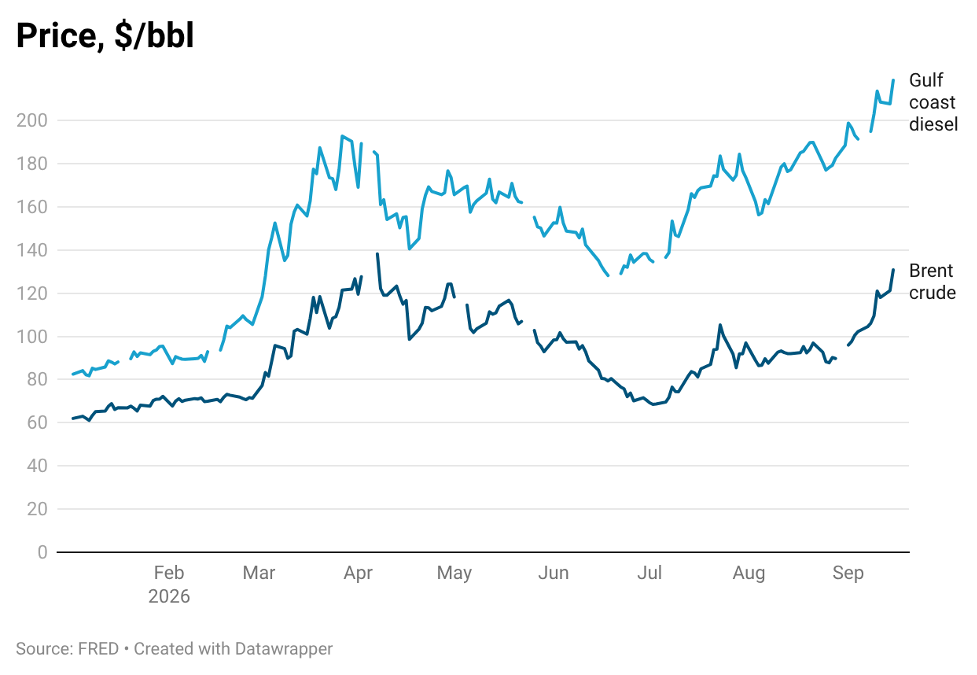
They appear to be slowly increasing the pace of their crude purchases in recent months however, which has helped to push prices back over $100/bbl in recent weeks. More importantly, it has pushed diesel prices to over $6.50/gallon. Because diesel is the lifeblood of the global economy—ultimately, just about everything that goes from point A to point B makes some part of that journey on the back of diesel—that has contributed to general inflation. In his remarks upon announcing a rate hike on September 16, Federal Reserve Chairman Warsh clearly identified that as one of the key drivers of inflation:
And there's no hiding from hot spots around the world, and our judgment about what is the most likely, or least likely of the geopolitical situation has changed […] The situation hot spots around the world are driving long-term yields. [sic] It's not simply spot prices of energy, or spot process for corn or soybeans or wheat, but it's the difference between those spot prices and so-called crack spreads—what that means for products that find their way into stores across the country.
A ”crack spread” is the difference between the price of oil and the price of refined products made from oil, including diesel. As Paul Krugman pointed out, the crack spread for diesel is normally around $20. But since the US and Israel attacked Iran, it has blown out to around $100:
Widespread Fossilflation
That translates directly into higher food prices, because not only does food travel from the farm to the store in a diesel-powered truck, farm equipment also runs on diesel:
In southeast South Dakota, Drew Peterson, a soybean, corn and cattle farmer, expects to spend as much as $1,500 per day to fuel just one of his combines this season, double last year's costs, among the many machines he must use to bring in his crop.
"You can't just say, well, diesel is expensive, I'm not going to harvest," he said. "You've just got to make it work in your budget."
Across the U.S., farmers are confronting record-high diesel prices during the height of harvest season, further squeezing already thin margins. Price hikes seem inevitable at America's grocery stores ahead of November's midterm elections, where cost of living is expected to be a primary voter concern.
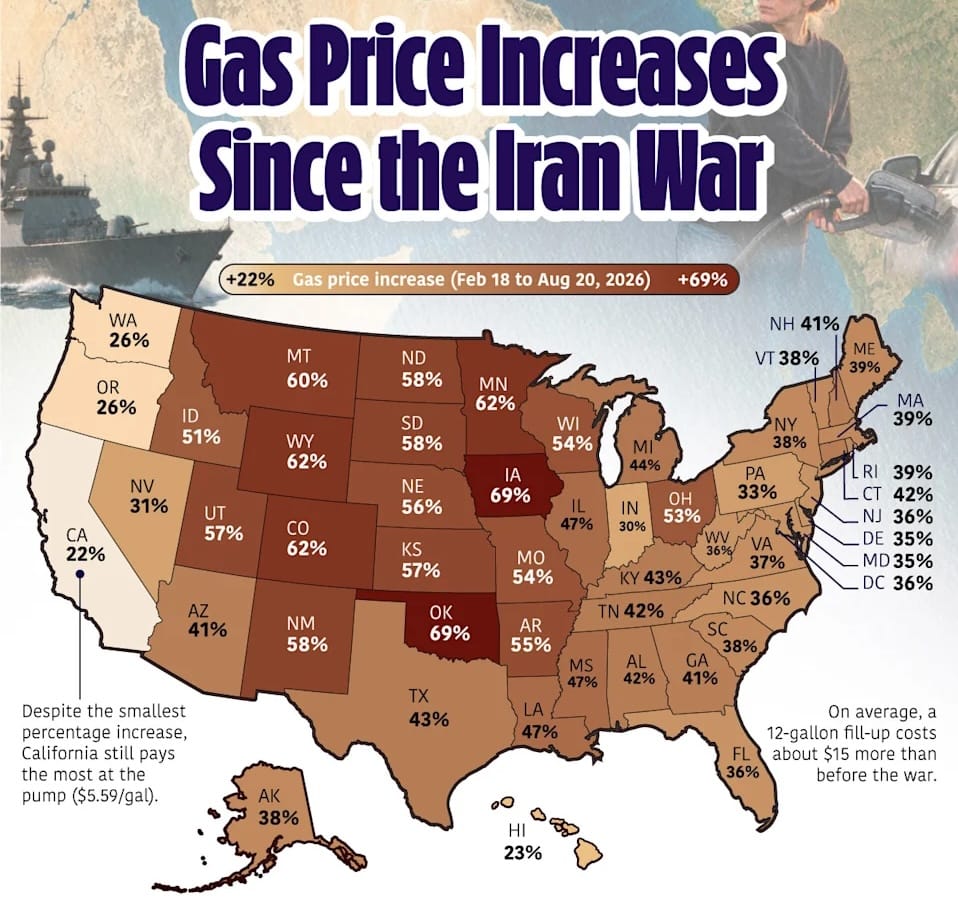
The increase in gasoline prices has hit farming country especially hard too:
Source: Visual Capitalist
That’s not going to help the GOP with the farm vote in the November midterms. Observer John Stoehr expects that higher fuel costs will be the determining factor in a loss for the Republicans, highlighting a viral video featuring soon-to-be-ex Trump supporters:
The US economy is complicated, but the extortionate price of diesel is getting people's attention, and not just any people – Trump's people. Middle-aged white working-class men who might otherwise be trusted to ride-or-die with him are rethinking their loyalty fast.
"This truck is gonna sit and rot now until this idiot president is out of office," said a Trump supporter in a video that went viral. "I voted for him and I'm so sorry I voted for him."
He added: "I never thought I would say this – I miss Joe Biden."
In past crises, the Fed tended to downplay the role of “fossilflation” in driving general inflation, preferring to draw attention to other factors. But other factors are playing minor roles this time, so it’s hard to avoid acknowledging that Trump’s disastrous boondoggle in Iran is directly responsible for the rising costs of everything, globally, no matter how many times he yells at oil companies to “get your Prices DOWN, NOW!” on his social media platform.
With not much more than an interest-rate hammer at its disposal, and an inability to directly address the root cause of inflation, Chairman Warsh’s resignation was palpable. He is acutely aware of how inflation has pushed the 10-year Treasury yield to its highest level since 2007, which in turn has raised the cost of capital across the economy and disrupted stock markets, including the especially rate-sensitive solar complex. The damage that the war is doing to the global economy is now moving well beyond eye-watering prices at the grocery store (I recently paid $20 for a 12-pack of toilet paper) to systemic and structural damage.
And that’s all before we start to count the damage to the oil and gas infrastructure due to Russia’s war on Ukraine, or the inflation caused by Trump’s tariff war on the world. (For a thorough discussion of the many drivers of inflation and the often-overlooked influence of oil and gas prices, see Energy Transition Show Episode 221 with economist Gernot Wagner.)
Industry-wide damage
I don’t think we really know how much damage has been done. Neither the IEA nor regional governments publish a comprehensive current damage ledger, and some operators disclose very little. However, in its September Oil Market Report, IEA estimated that around 10 million barrels per day (mb/d) of Gulf oil output, or around 10% of global oil demand, remains shut in by the conflict.
Damage to pipelines and other facilities continues to cause shorter-term disruptions, like the Iran-backed Houthi drone attacks on Saudi Arabia’s East-West pipeline on September 10-11, which the kingdom had used to bypass the Strait and keep 7 mb/d of its oil exports flowing. Saudi Arabia declared force majeure, adding further upward pressure to global oil prices as European refiners sought alternate supplies. Flows through the pipeline have since been restored to the tune of 4-5 mb/d, depending on whose data you believe, but getting back to the full 7 mb/d flow could take as much as two months, assuming it isn’t attacked again. However, tanker loadings at Yanbu have not yet restarted, so the world is essentially still short around 7% of global supply just from that one pipeline.
Even so, Bloomberg reports that Saudi Arabia has sold almost 100 mb of its crude out through the Strait since the middle of last week, albeit at the cost of promising to shoulder the burden of logistics and transport all the way to Asia.
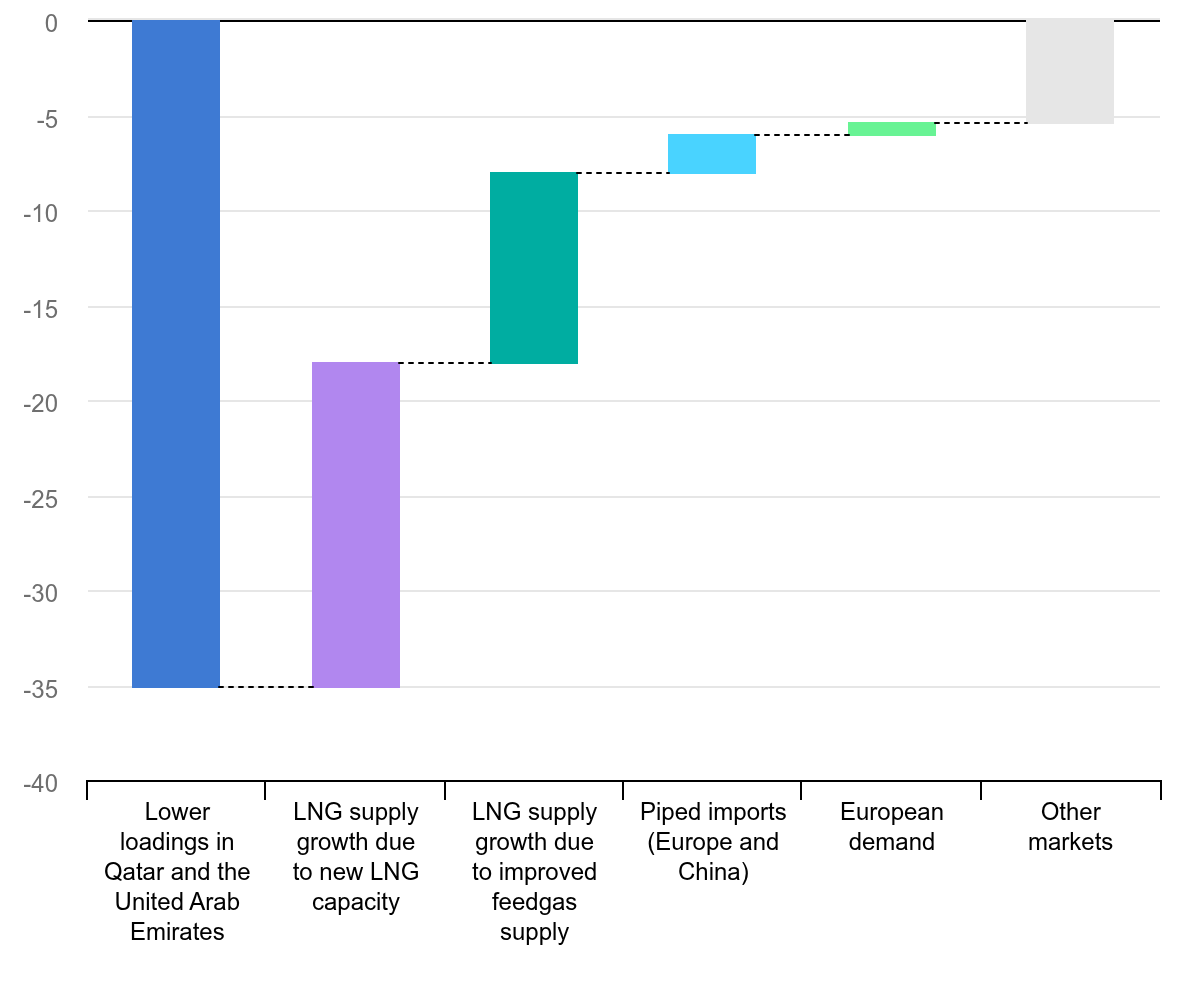
The supply of natural gas in the form of LNG has also been massively disrupted. Before the war, around 20% of the global LNG trade passed through the Strait of Hormuz, and that supply line was all but cut. In the months since, offsetting supplies from North America, Africa and Australia have made up for much of the loss.
Source: Gas Market Report, Q3-2026, IEA, July 2026.
Still, roughly 3% of global LNG trade is likely to be offline for 3-5 years due to damage to Qatar’s Ras Laffan complex.
The increased price of natural gas has produced all sorts of ripple effects, especially in major gas importers. IEA expects gas demand to fall in 2026 as a result:
Global gas demand is expected to fall by around 0.5% (or 20 bcm) in 2026, the third annual decline this decade following previous decreases in 2020 and 2022. The impact of the conflict varies across regions. In the Middle East, where local gas production and processing facilities have been damaged and the output of gas-intensive industries such as fertiliser production has decreased, gas demand is projected to contract by around 4% in 2026 – the region’s first annual decline in consumption since 1993.
In Asia, natural gas demand is forecast to decline by 0.5% in 2026 as higher LNG prices spur gas-to-coal switching in the power sector and lead to lower operating rates across gas- and energy-intensive industries. In Europe, a combination of strong growth in power output from renewables and higher natural gas prices is expected to reduce gas demand by more than 2% in 2026.
Bloomberg analysts note that the higher costs and fundamental uncertainty about the security of supply suggest that major gas buyers, especially in Asia, may be taking a jaundiced view of continuing to depend on LNG, and turning to far more secure domestic renewables instead:
The major non-China emerging-market Asian buyers — India, Pakistan, Bangladesh, Thailand and Vietnam — have spent a collective $7.4 billion since the start of the war on spot LNG, according to a Bloomberg News analysis of purchase tenders. A similar amount of the fuel cost about $3.1 billion under long-term contracts over the same period last year.
The more than doubling of costs threatens to tarnish the reputation of LNG as a reliable energy source, especially as it’s just a few years after another war — between Russia and Ukraine — also led to shortages and a spike in prices. The crux of the problem is that countries need gas today, as they can’t quickly change their energy mix without risking blackouts.
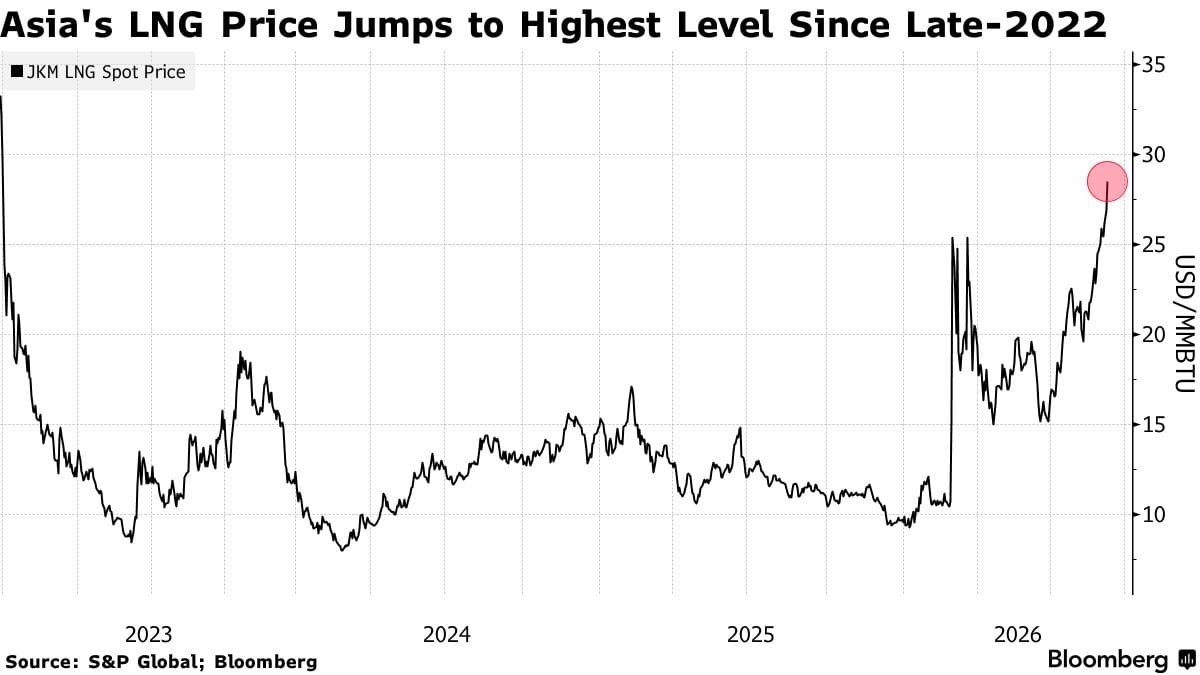
Longer term, though, many of them are now looking for ways to wean themselves off LNG. Renewables like solar and wind, coal, nuclear, or locally produced gas or piped supply are some of the options.
“If prices remain at such levels, we think that LNG will have a problem competing with the alternative fuels,” Fabian Kor, the executive vice president for Asia at SEFE Marketing & Trading Ltd., a German LNG buyer, said at a conference in Singapore last week. […]
Thailand, this year’s host, has just released a long-term energy plan that set a goal of getting a minimum of 65% of its electricity from renewables by 2050, which will come partially at the expense of natural gas.
Solar is becoming an attractive option for some developing Asian countries, especially as battery costs have come down more than 30% over the last four years.
Pakistan, once viewed as a high-growth LNG market, is likely to increase solar and hydropower generation given the direct impact of the Hormuz disruptions, said Akshay Modi, an analyst at BloombergNEF. Bangladesh, which has spent over $2 billion replacing lost Qatari LNG volumes, is rolling out incentives for consumers to install solar panels.
Analysts cited by Reuters are far more bearish than IEA, seeing Asian demand for LNG falling by 3-10% from 2025 levels this year, making the second consecutive year demand has dropped, “as the US-Israeli war on Iran curtails supplies from the Gulf.” Which could actually be a good thing for US consumers. As Justin Gerdes points out in his newsletter this week, the US is exporting 25% of its gas production even as domestic demand for the fuel to power data centers continues to soar, which implies not only a need for more gas, but higher domestic prices for gas, as shale gas drilling is forced to move into less-productive and higher-cost basins.
Diesel disaster
In an effort to dampen voter frustration over fuel prices, Trump is apparently considering a ban on diesel exports, which could drive down domestic prices for the fuel in the short term. But in this globally interconnected economy, any perturbation to the global lifeblood of diesel always comes with ripple effects. For one, it would crush the margins that American refiners have been making on the fuel. And that would have its own cascading effects, as Liam Denning astutely pointed out in his September 23 column:
Nothing comes for free, though, and the ramifications of a ban would be pernicious and lasting.
News alert: Oil refiners are commercial entities that like to make money. If diesel margins collapse, refiners will find ways to produce less of it. One way is to alter their intake of different grades of crude oil and proportions of the fuels that come out of them: More gasoline and jet fuel rather than diesel, say. Or they could simply dial back production altogether. Having run unusually hard this summer, chasing those margins, a ban might herald a bout of maintenance shutdowns. Trump could, in theory, invoke emergency powers to force refineries to run, but at the risk of even deeper damage to his ties to the industry.
So after the initial rush of diesel prices dropping at the stroke of a pen, diesel production would start falling to rebalance things and support those prices, as is the usual way with any traded commodity.
Other forces would be set in motion, too. The ban would create a two-tier market with depressed prices inside the US but soaring prices elsewhere now that critical US barrels were unavailable. (Even as American refiners took a hit to profits, European and Asian ones would get a further windfall as margins blew out.) That would blow back on the US in the form of higher imported inflation, since diesel is the fuel of commerce, and a possible recession in export markets succumbing to even higher energy costs.
As Denning goes on to explain, there would be even larger costs in the form of reputational and diplomatic damage. The effects of sustained high diesel prices would continue to ripple around the world, and ultimately dampen export markets’ enthusiasm for signing long-term contracts for US fossil fuel supplies.
Shades of Arab Spring
With their increasingly concentrated and corporate-owned, Trump-appeasing media, American citizens don’t hear much about the rest of the world unless they go out of their way to look for it. But pump prices hitting record highs across Europe have prompted EU member states to contemplate imposing a bloc-wide windfall tax on energy companies. In the second quarter of 2026, eight large oil companies—Saudi Aramco, ExxonMobil, Chevron, Shell, BP, TotalEnergies, Eni and Equinor—earned nearly $93 billion (or about $1 billion per day) in combined profit, almost double their earnings in the second quarter last year:
Germany’s finance minister, Lars Klingbeil, called on the European Commission at a meeting of EU finance ministers in Dublin on Friday to propose possible ways to tax what he described as the excessive profits of oil companies.
“Several member states have been calling for models for a long time,” Klingbeil said, demanding proposals by next month. “People can see how oil companies are exploiting the situation, overcharging and significantly increasing their profits.”
And as the New York Times reported, surging oil prices are causing an enormous amount of unrest all over the world:
Since the latest surge pushed oil above $100 a barrel, protesters have burned tires and cars in Guatemala and Syria to express their rage.
Portugal’s roads have featured cars crawling in protest with honking horns after diesel reached a record high of more than $9 a gallon. […]
In Makassar, South Sulawesi, residents this week reported shortages of cooking gas, rolling blackouts and a sudden move toward gasoline rationing.
Across the provincial capital, drivers pushed motorbikes with empty tanks or left them in long lines near pumps with nothing to give. […]
Tensions have also been rising in Yogyakarta, in Java. Students demonstrated against surging fuel prices on Monday — only to have their rally broken up by aggressive pro-government organizations. […]
“Many [Filipino fishermen] were raring to go back to fish, but have no money to buy gas,” said Fernando Hicap, the national chairman of a major fishing association. “The new round of price adjustments have been choking many of us to death.”[…] Bus and ride-share drivers have also been marching in Quezon City, and quietly protesting by not working — a trend also popping up elsewhere.
In Vietnam over the weekend, drivers with Grab, a ride-hailing app, called for a boycott to protest low pay caused in part by rising fuel costs. […]
Transport workers and Indigenous activists marched through the streets of Guatemala City recently, demanding more than stopgap measures like price caps and subsidies.
Some groups have called for a suspension of fuel taxes and a shift away from fossil fuels, which critics see as a source for elite enrichment and environmental damage. Farmers across Latin America, heavily reliant on diesel for tractors, have been especially frustrated. […]
A few days later, in Villa Nueva, just south of the capital, videos showed cars set ablaze in the streets. […]
Organizing mainly on social media, Portuguese drivers gathered last week for several “buzinões” — protests with cars driving slowly while honking. They caused traffic jams across several key thoroughfares including the 25 de Abril Bridge in Lisbon. […]
Shortages in the liquid natural gas needed to produce electricity have led to rationing and the temporary closure of garment factories — the main engine of [Bangladesh’s] economy. […]
Just a few hours after the government said that it would temporarily raise prices for gasoline, diesel and other petroleum products by as much as 40 percent, Syrians took to the streets.
Angry crowds in several cities gathered in squares, blocked traffic, and set tires on fire, calling for the price surge to be canceled. […]
Government officials said that they had no choice but to raise prices because of the war.
If your eyes are glazing over and your mind wandering at this recitation, here’s why I bother to detail it: This is exactly the kind of widespread unrest that led to the Arab Spring about 15 years ago. It started with a frustrated Tunisian fruit and vegetable vendor who had been subject to repeated harassment and demands for payments from local authorities, who sought redress from those authorities, was denied a hearing, and then set himself on fire. He died from his burns in January 2011, touching off widespread protests across the region. Major uprisings and riots ultimately led to the overthrow of the leaders of Tunisia, Libya, Egypt, and Yemen.
The Arab Spring occurred against the backdrop of a major global food-price spike. The unrest we’re seeing now is against the backdrop of a major global fuel-price spike. The same combustible elements that led to the Arab Spring are with us in this moment too: unemployment and economic hardship, rising prices for food and other commodities, corrupt officials, police harassment and state intimidation, lack of economic opportunity, and authoritarian governments cracking down on public protest.
Only this time, the unrest is global, not just regional. And I fear it’s going to be with us for a long time to come, because a great deal of damage has been done to the global supply of oil and gas, and it will take years, not months, to repair… if the business case to invest in those repairs even still exists once the missiles stop flying.
Given the threat of demand for its LNG exports drying up as its buyers transition to renewables, it’s no surprise that the Trump administration deployed Energy Deputy Secretary James Danly on a press blitz at the Gastech Bangkok 2026 conference on September 14. In a 14-minute interview with Bloomberg’s Haslinda Amin, Danly rattled off the whole litany of lies and myths about how American oil and gas and nuclear technology can secure Asia’s energy needs (injecting the word “abundance” eight times), and the supposed limitations of the energy transition. I won’t even try to debunk it all here—that would require another entire article unto itself—but it’s a remarkable, textbook example of how the oil and gas industry relentlessly and shamelessly repeats its talking points, no matter how false or unsupported by the evidence, and gets away with it, as I discussed at length last week with Steve McBee in the Nelder Notes #9 podcast.
EV sales surging
As bold as Danly’s defense was, it had a bit of a whistling-past-the-graveyard air about it. Because the data coming in for global EV sales seriously calls future oil demand into question. According to data from the European Automobile Manufacturers' Association (ACEA), new battery electric (EV) car registrations across Europe (meaning the EU, UK, Iceland, Norway and Switzerland) were up a whopping 52.7% in August 2026 over the same month last year. Plug-in hybrids (PHEV) were up 13.5% and hybrid electric (HEV) were up 3.4%. Altogether, electrified models took a 73% share of the new vehicle market, while the market share for petrol (gasoline) models fell to 21.7% and diesel’s share fell to 7.3%.
Electrification is finally coming for the truck segment in a big way as well. According to the new annual Commercial Zero-Emission Vehicle (ZEV) Factbook from BloombergNEF, global sales of ZEV trucks were up 75% in the first half of 2026 over the year earlier. Medium- and heavy-duty electric trucks are likely to exceed 9% of global truck sales in 2026. And although BloombergNEF is careful to maintain the ZEV heading on the category, lest they offend the tiny and continually-shrinking fuel cell vehicle segment, they note that, “Almost all zero-emission trucks sold between January and June 2026 were battery electric.” However, this is a segment still dominated by China, home to more than 90% of all low- and zero-emission vehicle sales globally. Sales in Europe were up 50%, while sales in the US market actually fell 63% to a few hundred units.
All in all, as I suggested back in May (“NN#2: The Trump Paradox”) it appears that Trump’s war of choice against Iran is indeed doing more to accelerate the energy transition than policy ever could.
Got an item you’d like us to cover?
We’d like Transition Times to help increase the visibility of all the great work that’s being done out there. So if you have an article, report, study, podcast episode, newsletter post, video clip or anything else that you think is worthy of a shout-out in Transition Times, email it to suggestions [at] transitiontimes [dot] net! We welcome all submissions, as long as they’re relevant to the energy transition.
Sources
Benoît Morenne and Collin Eaton, “Oil executives say the great fuel crisis is here,” The Wall Street Journal, September 15, 2026.
Clyde Russell, “China's crude oil imports stayed weak in August. Can this continue?” Reuters, September 6, 2026.
Transcript of Chairman Warsh’s Press Conference, US Federal Reserve, September 16, 2026.
Paul Krugman, “Of Donald and Diesel,” Paul Krugman, September 21, 2026.
Leah Douglas, Lisa Baertlein and Nichola Groom, “Record US diesel prices squeeze farmers; food prices may rise,” Reuters, September 18, 2026.
Sofie Gilbert, “Mapped: How Much Gas Prices Have Risen Since the Iran War,” Visual Capitalist, August 28, 2026.
John Stoehr, “Diesel is the new covid,” The Editorial Board, September 22, 2026.
Aimee Picchi, “What the Fed's interest rate hike reveals about Warsh, Trump and inflation,” CBS News, September 17, 2026.
Noel Randewich, “Wall Street ends down as oil prices, Treasury yields rise,” Reuters, September 23, 2026.
Oil Market Report – September 2026, IEA, September 11, 2026.
Devika Krishna Kumar, “Saudi Shuts Oil Pipeline That Bypasses Hormuz After Attacks,” Bloomberg, September 11, 2026.
“Saudi Aramco Force Majeure Rocks European Oil Supply,” PomiNews, September 16, 2026.
Trixie Sher Li Yap, Nidhi Verma and Florence Tan, “Saudi Arabia restarts East-West oil pipeline, sources say,” Reuters, September 22, 2026.
Nerijus Adomaitis, Jonathan Saul and Seher Dareen, “Saudi East-West Pipeline building up volumes, loading yet to resume, sources say,” Reuters, September 24, 2026.
Yongchang Chin, “Saudis Ease Asia Oil Crunch With 100-Million-Barrel Sales Flurry,” Bloomberg, September 24, 2026.
Gas Market Report, Q3-2026, IEA, July 2026.
Stephen Stapczynski and Sing Yee Ong, “A $7 Billion Gas Bill Sees Developing Asian Nations Sour on LNG,” Bloomberg, September 13, 2026.
Emily Chow, “Asian LNG demand set to fall for second year as war shrinks supply,” Reuters, September 16, 2026.
Justin Gerdes, “Trump’s ‘energy dominance’ agenda is only making renewables more attractive – at home and abroad,” Quitting Carbon, September 24, 2026.
Liam Denning, “A Diesel Export Ban Is a Bad Idea. Trump Needs It Anyway,” Bloomberg, September 23, 2026.
Jon Henley and Jillian Ambrose, “Record fuel prices across EU prompt calls for bloc-wide windfall tax on firms,” The Guardian, September 19, 2026.
Damien Cave, “Rising Fuel Prices Set Off Anger and Protests Around the World,” The New York Times, September 15, 2026.
Arab Spring, Wikipedia.
“US Deputy Energy Chief on Securing Asia’s Power Future,” Bloomberg, September 14, 2025. [Video]
“New car registrations: +5.3% in August 2026 year-to-date; battery-electric 21.7% market share,” European Automobile Manufacturers' Association (ACEA), September 24, 2026.
Zero-Emission Commercial Vehicles - Building Momentum, BloombergNEF, September 17, 2026.
We never use AI to produce any of the written or spoken content you find on Transition Times. We do use AI as a research tool (and vet the information so received).
We also occasionally use AI to generate graphics and sounds.