
NN#8: Realistic Modeling
In NN#8, Chris finally invites a guest to join the podcast rather than just sharing his own views. He cordially welcomes Dr. Emily Grubert to the show to discuss their respective complaints about deficiencies in energy and climate modeling, and how they might be cured.
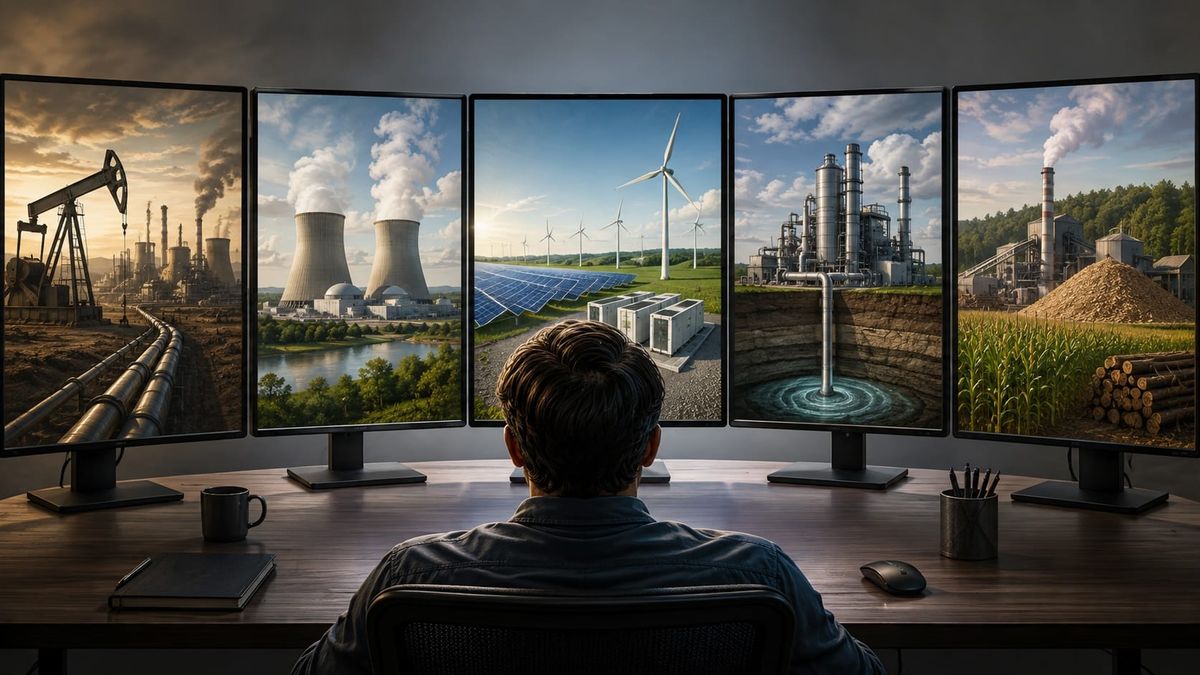
In Nelder Notes #7, I riffed on a perspective piece that Dr. Emily Grubert published in the academic journal Environmental Research Letters, to which she has contributed at least 10 research papers. I compared her piece to Martin Luther nailing his “95 Theses” to the church door in 1517.
In her commentary, Emily admonishes her fellow researchers to clearly and explicitly acknowledge that phasing out fossil fuels is the “dominant strategy for addressing climate change” instead of exploring scenarios with abatement measures, like carbon capture and storage (CCS) or carbon dioxide removal (CDR), that would permit the continued use of fossil fuels. Her conclusion reads:
ERL’s excellent, engaged community of researchers has the skills and the courage to say what we mean, and to address the important questions: a just, effective energy transition requires, at minimum, near-total fossil fuel phase-out. May the next decades of ERL scholarship take this point head on, and produce rigorous, actionable, equitable, and targeted research on how we do it.
I believe the failure to clearly and explicitly make the point that fossil fuels must be phased out is one of the reasons why it’s not more often goal of policy. And that the lack of policy with that stated goal is one of the reasons why we haven’t made more progress in phasing them out.
And that is a failure shared by many parties: By politicians, activists and communicators, as I argued in Transition Times #8; by elected officials, civil servants, and corporate leaders, as I explained in Nelder Notes #6; by media and science communicators, as I detailed in Transition Times #10 and #12; and yes, by climate and energy modelers and researchers, as Emily and I both argued. And Emily’s specific point, about over-emphasizing the potential role for noncommercial CCS and CDR solutions, is something I discussed at length in Transition Times #5 and Nelder Notes #4.
So I thought it would be fun to bring her onto the Nelder Notes podcast to discuss those topics and to give her a chance to share her thoughts in more detail.
Transcript
So, let's welcome her now as the very first guest on the new Nelder Notes podcast. Welcome, Emily.
Very pleased to be here. Thanks for having me.
Alright. So before I get your reactions to my riff on your piece, I wonder if maybe you'd just like to briefly summarize your argument for the benefit of those who may not have read it.
Absolutely. I think one of the things that has been really clear to me reading the energy academic literature over the last, you know, mumble mumble years, I guess, is that we don't talk about fossil fuel phase out as the solution to the climate emissions problem explicitly. And I think in any other research endeavor, it would be pretty obvious that this is the main pathway to eliminating emissions from fossil fuels is to stop creating those emissions. But for a variety of reasons that I think are, some of which are probably pretty reasonable and some of which are probably the result of a lot of political processes. For some reason, we don't really address fossil fuel phase out as this mainline consideration, and I think we should.
I think we've wasted a lot of time not doing so, and I would like to see more research on what that would actually look like.
I mean, you make a very strong call, for your fellow modelers to stop fiddling around with scenarios that involve carbon capture and sequestration, direct carbon capture and so on and just focus on the main line of we have to phase out fossil fuels. And it's been a never ending frustration for me that more people don't say that and don't model it. And furthermore, don't even communicate it in their many stories and articles about things like heat waves and the damage being caused by climate change to the natural world. You know, why would anyone stand in front of a camera for with a microphone and talk for hours about wildfires and never mention what's causing them?
Yeah. No. Really. And I think what's interesting to me too and I I mentioned in my piece, like, have done this too. I I get why it happens, but there's this desire that I think gets trained into us academics to be technically correct and to be precise.
And so this tendency to talk about eliminating emissions from fossil fuels as opposed to, you know, really thinking about just not creating those emissions as one pathway to doing so has I think led to an overemphasis on solutions that address the emissions rather than the the use. And like, that is true. The the issue is the emissions. There are potentially theoretically some ways that you could address those without actually eliminating the fossil fuel use. But that's not the that's not the primary pathway here.
And it's weird that we don't talk about it that way.
I mean, as I said in Nelder Notes number seven, the piece we're talking about here where I was riffing on your article, we've had several decades now of malinvestment in in carbon capture sequestration or c d CCS and carbon direct removal or CDR that haven't even budged the carbon concentration needle. Right? There I mean, there's no point in continuing to pretend like these are real solutions. At this point, I see them as just sops to the fossil fuel industry and its assets and government because I've been tracking the failure of CCS projects for literally decades at this point. Yeah.
And and many times, especially in my freelance journalism career more than a decade ago, I've critiqued the modelers that use things like this to make their decarbonization models work out, especially when those models were coming from major agencies that everyone looks to for guidance. Like, why are they relying on these fantasy wedges to make the math work out instead of just offering at least one scenario that assumes we'll stop burning fossil fuels instead of trying to make burning them acceptable? Why why do you think that is?
I think there's a few reasons and I've I've also been tracking this for a long time and I do think that there were, I think, more legitimate questions twenty years ago about whether this was something that would work. I think it was also a lot less clear that we could, phase out coal to the extent that has kind of happened, which in retrospect is sort of predictable. Like, I I'm on record in a lot of places saying that I think most of the coal phase out, like, with much respect to the people that spent a massive amount of political effort helping this along, a lot of that transition has been because of the facility's age, at least in The United States. But, like, the kinds of transition that we've seen weren't necessarily quite as obvious back then. I think people were also still really enthusiastic about some of the successes of, like, the acid rain program and things like this.
And also, frankly, at the time when it was a little bit, less dire from a carbon budget perspective, the notion of reducing emissions rather than eliminating them was a lot more mainstream and probably feasible at that point. Like, if you look back to the the late nineties, early two thousands, the notion that maybe you could cut emissions by 50% and kind of keep along that line for a while was reasonable in a way that it's not anymore because we've seen emissions go up so rapidly and are indeed still increasing. And so I think there were some times when it actually did make a lot of sense to think about, like, okay. Well, how do we how do we help these emissions go down as opposed to just really recognizing that they need to go away? That has persisted, think, both because we've thought a lot about what that looks like, because there have been, I think, some legitimate advances in what we expect we might be able to do.
But the fact that the underlying conditions of what needs to happen with emissions have changed and our approach to what a feasible strategy for achieving that goal might be hasn't changed that much, think is a pretty big problem.
You make a fair point about how things in fact have changed quite a lot over the past twenty years. And maybe the real phase out of coal and other fossil fuels and replacing with renewables clearly is a lot more feasible now than it might have looked back then. So, you know, that's a fair point. I wanna get back to your commentary. So, in it, you made a very specific point that modelers and researchers ought to be explicitly naming the phase out of fossil fuels as the primary decarbonization pathway that the world must tread.
And I expanded on that to make a much larger point about my pet peeve for many years, which is that I wish climate and energy modelers would actually try to give us a forecast of how the energy and climate systems are likely to evolve instead of dithering about with interesting but unlikely scenarios. And part of what animates my agita here is that the most extreme warming scenario known as RCP 8.5 has been cited in the literature as a central or a quote unquote business as usual outcome well over 10,000 times in the literature by some estimates when we've known for at least a decade already that it's a vanishingly unlikely scenario or at least that the massive reversion to using coal as a primary energy source that that scenario imagined is extremely unlikely. So, treating this outlier scenario as if it were likely has, in my view, massively distorted climate communications with the public for more than a decade. So, whereas you are exhorting your fellow researchers to keep our eyes focused on the main prescription to phase out fossil fuels, I'm exhorting them to eschew unlikely scenarios, especially the ones that are extreme and extremely unlikely, especially if the main reason for including them in the first place is that they make for good clickbaity headlines.
So my point is related to yours, but it's not the same. So I I wanted to give you a chance here to offer any comments on what I said, especially if I said anything that you disagreed with.
Yeah. No. It's an interesting question. The RCP 8.5 discussion, I think, has gotten wild in ways that I didn't really anticipate just, like, looking at RCPs. I will be a little bit of an RCP 8.5 defender here, actually.
And I think one of the ways that, at least in my group, we've used it is to try to test for fairly conservative infrastructure investments. And I think the the defense that I will mount for RCP 8.5 is that it's really a warming scenario. I think you're right that the critique of the notion that, the kinds of assumptions that they make about inputs and energy system structure to produce the that concentration pathway are unlikely. But it's sort of proxy when you look at the endpoint, it's sort of proxying what you might see if the climate is, for example, more sensitive than we thought it was, which does actually seem to be true based on some pretty recent research. So the coal inputs are not likely, but that doesn't really exclude that that warming trajectory in quite the same way that I think it appears to from those of us that are more energy people.
So, yeah, I also started out like, oh, I'm an energy person. This doesn't seem reasonable, but the the climate side of it is really what the output is there. And I think, like, in a lot of ways, this is sort of a similar point to the one that I'm making about energy systems models, which is that we care about the output quite a bit. In the case of thinking about what decarbonization looks like, we would like to get to zero emissions. So a pathway pathway to to do do that that is is to stop producing emissions.
In the case of the RCPs, one of the things we're trying to test is, like, you know, how sensitive is our infrastructure to a particular warming strategy. It doesn't necessarily matter that much how we get there if you're mostly looking at what the impacts are. But in both of these cases, I think we're talking about a need for really fit for purpose models that are very clear about which pieces of it are the thing that you should use and which pieces of it you should assume are stylized. And I guess with the energy models that I tend to look at, I worry a little bit that a lot of the goal is to sort of talk about what we should invest in in terms of which technologies and when and, you know, how much precisely wind we need to build or how much solar we need to build. That is dependent on a lot of what you assume about what's going on in the fossil system, but we don't really ever think about that at the resolution that I think it deserves.
And that question of what do you actually need to believe and what do you actually need to do with the fossil system is something that matters quite a bit for good policy making similar to the way that understanding what the warming impacts of any of these trajectories might be matters a lot to, like, how you build infrastructure and stuff like this. So I think, like, remembering that there a are lot of different kinds of models and checking to make sure that they're actually doing what we need them to is a place where we agree quite strongly.
Okay. Fair enough. So so you see RCP 8.5 useful in that it's sort of a proxy for a worst case warming scenario irrespective of the fact that the reasons why it was originally designed the way it was no longer hold.
Yeah, I think that's right. And I will say, you know, people make fun of civil engineers a lot. I'm a civil engineer. We, we get a lot of flack for saying, well, you know, like we're pretty sure we need the pipe to be six feet big and so I guess we'll make it eight feet just in case. Like, accepted.
I think that actually understanding what your what your peaks are gonna look like. And even with RCP 8.5, even if you don't believe that that's sort of the the average outcome, it might be something that happens every few years. So as an infrastructure person, I appreciate having it, but I do take the point that the communications around it as like, well, you know, if we do this on the energy side, this is what's going to happen as opposed to we're trying to test what happens if this is the kind of climate response we're seeing has been pretty muddy.
Alright. Fair enough. Alright. Well, let's talk about the modeling here. Yeah.
One of the things that makes me just crazy about this subject is that it it just seems so obvious to me that somebody ought to be trying to create an accurate model of how the global energy and climate systems will evolve. But as far as I've seen, no one does. Like, how can we have thousands of researchers out there making tens of thousands of models and doing millions of model runs on them and not one of them is designed to tell us what's actually likely to happen. And and in fact, I've never even heard another person make the same complaint. Like, I seem to be the only one who finds the situation really bizarre and unhelpful.
Like, am I wrong? Am I crazy?
So is this basically like all of the modelers saying that we're making scenarios rather than predictions? Yes. We love talking about projections. But yeah. And I mean, here, I think what's interesting is one of my friends that works on, epidemiology actually made this point to me, and it's kind of stuck with me.
The the way the world unfolds is really dependent on what you do with the information. And so, like, knowing that something bad is going to happen causes you to make changes. And so I think there are a lot of people that would probably say, even if they are sort of socialized into talking about them as projections, they would probably say they are building models that are trying to predict things. It's just really hard to accurately predict. So I think a lot of the, like, business as usual kinds of scenarios that people develop in large part are kinda trying to do that.
It's just we're not that good at it. I guess my take here is sort of like, I'm coming from a very normative position here. I would much rather spend modeling time trying to figure out what we should do as opposed to figuring out, like or basically trying to predict how a bunch of different things are going to evolve. But I think the the way that some of these business as usual models tend to go does make your point, which is basically that nobody's really willing to say, like, we think this is the probability that each of these things happens. I can see arguments both ways, but I personally would rather see something that tells me exactly what I need to do to get to my goal.
Yeah. But we don't really do that either so.
Well, yeah. And again, I'm I'm I'm only asking for one. Just just one.
Asking for one correct one.
No. I'm asking for one model that attempts to to forecast what's gonna happen.
I'm actually kinda curious what you think about the EIA projections, which again, they they are probably at the forefront of saying that they are not predicting. But they do actually theoretically try to model what's going to happen.
And and so does IEA. But, no. Both of them rely on their own sort of black box modeling systems that the EIA system is just an absolute disaster on the inside. It's got so many things that are hardwired over here and hardwired over there to avoid the model doing what it's supposed to do. And IEA has its own extremely complex internal modeling system which is designed to explore a lot of questions, but it's not designed to tell us what's gonna happen.
And, again, I just feel like in a world where we have tens of thousands of researchers out there doing tens of thousands of models, can I just can I just have one? Just one.
This is your winter project, Chris.
Maybe the rest of my life project. Alright. Well, I'll set that aside. Alright. So look, in the spirit of of that, one thing that I mentioned in my piece is my keen interest in the approach that Doan Farmer and his colleagues at Oxford University are using.
Instead of basing their modeling on assumptions or policy, as all the models we've been discussing do, they base it on what's happening in the real world. Now, there's some very advanced math underneath it based on Wright's Law along with some incredible computing power, so I don't wanna, you know, make it sound like this is simple. But, I think that by being able to model the current trends accurately and then project them into the future, their approach actually stands a much better chance of telling us something that's actually helpful than a model based on unlikely scenarios or non commercial technologies like CCS. So, I'm curious what you think of that approach and and I wonder if there are any others that you like.
Yeah. It's interesting because I think that's not as much of the space that I tend to play in because I am more normatively interested in what do we actually need to do and what do we need to fight for to get to zero carbon. I do agree that I think there are more of the models that are out there are using the same kinds of underlying structural assumptions than I would prefer. I would like to see a bigger diversity of objective functions. I would like to see a bigger diversity of, just assumptions about what the incentives look like.
I think one of the things that my group has kind of pushed on a bit sometimes is a cost minimizing strategy in a model, even one that's trying to represent what's actually going on is going to lead you to very different projections of what might happen than a profit maximizing one, for example. There are lot of other things that you could do, but I do think that the the notion of having models that are actually structurally quite different from each other is something that I would love to see more of. And I would love to see even existing models trying to mess with their objective functions a bit and just see like, you know, how how robust are some of your predictions to the extent that we're willing to call them that, to changes in the way that you think the the world around you is changing, whether that's the politics, whether that's the cost, whether it's technology availability, like there's a lot of uncertainty in a lot of these things. But if you kind of lock yourself into one way of thinking about what's actually driving change in the world, you're going to end up in places that don't necessarily spot some of the really big trends.
So I do think that there is a huge space for models that are just structurally different from each other and it would be, very cool to see how that goes. At the same time, like, I I I do a disservice to my industry perhaps by saying I think we need less data on some of the stuff. But to some extent, this kinda comes back to my point about fossil phase out. I don't really actually need to model very much to know that that's what I need to do. I do need to model maybe what what should I do first, those kinds of things.
But, like, I don't really need a model to tell me that emissions are going to change in a particular way if I don't do that because it if my goal is to make emissions go down, like, I I have all the information that I need basically already. Already. So I think there's also kind of an interesting question about what kinds of things we need to know to make better decisions. Some of that is distributional. Like, if we go down one particular path, is that likely to cause really dire problems for particular groups of people?
Like, that kind of stuff, I think we need more attention to. But just the, like, can we actually meet this this emissions pathway if we try something fancy? Like, I'm I don't know how valuable that is at this point, But I'm also kind of on record as being a I don't know, not a hater exactly, but like, I'm not sure how much it makes sense to continue to absorb so many people's volunteer labor on things like the IPCC reports and things like that. Like, we already basically know what we're talking about here and maybe there's time better spent doing other things.
Other things like?
Like actually figuring out what you do first.
Or telling the world what's gonna happen?
Yeah. Maybe but like that I would rather people spend time trying to change what happens towards something that would be better. And like I know again, I'm being super normative here, but to some extent, I think the the period of time where research is most valuable as an observational activity as opposed to one that really is trying to say like this is an emergency and we need to do something different. Like, I'd rather see people talking about how you do something different.
It is asking a dog to learn new tricks, ask them to focus on prescriptions.
One of the nice things about researchers is that we are always making more of them though. So we have some new new tricks and new folks which yeah. But I do think like there's some cultural elements to this and retaining the the really good pieces of the culture, while also being a bit nimble and recognizing that the world is very, very different from a, an emergency level than it maybe was twenty or thirty years ago, I think is actually, you know, this this is a call to myself as well. Right? Like, I'm a professor.
This is my fault and my job, so I will try to take my own advice. But, yeah, I I think there are some things that are just, like, systematically quite different than when a lot of us that are sort of the the, working professionals got into this field.
Well, so we've we've sort of naturally migrated into a conversation that's more about communications here, which is good because that's my next question.
Amazing.
We've been mainly talking about modeling so far, but I think the same critique broadly applies to how climate change is covered in the media. In my twenty five years of studying these subjects and watching how they're covered in the media, I don't think I have ever, like, not even once seen a journalist ask a politician anything like, so what's your plan for phasing out fossil fuels? Most of the time, it seems like a miracle if they even attempt to connect the disasters they're all too happy to cover for hours and hours floods and wildfires and heat waves with what's causing those things. And, if it's You know, it's it's as if it's somehow in bad taste to point out that this is all a consequence of climate change for which the obvious prescription is to stop burning fossil fuels. It's like a secret pact that nobody is gonna talk about the real story or something.
Yeah. It's like a good track to getting your mic cut off, I think.
Right. Like, you know, I just wonder how you see the media and general communication side of all this sort of outside of the scientific community.
Yeah. No. It's a really good question. It's something I've been thinking a lot about lately because I think one of the one of the things that I care about quite a lot is that especially because I work in The United States where we have quite a mature fossil fuel infrastructure system. We're talking about stuff that is getting old and is sort of fundamentally explosive and flammable and all of those other things that come along with having, like, something that you have there because the whole point is that you're gonna light it on fire.
Like, we have done a lot to make that as safe as we can. We've failed in a lot of ways, but also I think there's a lot of hazard here that is really worth talking about in addition to some of the climate stuff. And so from that perspective, I think in communicating what kinds of things we're worried about and why we are taking measures and stuff like that, like, think really talking pretty clearly about the kinds of things that could happen if we don't phase these out in addition to the kinds of things that we might face when we do starts to become really important. But I think there's a little bit of a tendency say, well, you know, if we started to shut this down, you know, these are the consequences of that. Those are all these bad things that could happen as a result.
And we don't spend that much time talking about why not shutting them down is going to also lead to some really serious problems that we're gonna need to grapple with. And so I think making it clear that this isn't a choice between, like, everything is fine or we accept this sort of hard thing for no reason, but much more clearly saying, like, in addition to climate change, which I agree with you, like, we should talk a lot more about what that actually looks like and what the fact that we're seeing quite a lot of it. But really trying to explain that, like, business as usual is not and I actually wrote a piece called business as usual is not the status quo, which was a very very undergrad title. But I think I wrote this maybe my first year as a master's student or something like that. But just making the point that, like, I think we tend to expect that a business as usual case where we don't intervene is just, like, about as good as it is right now.
And, you know, there's things that are bad. There's things that are really bad about that, but it's familiar in a way. I think we don't do enough communicating about the fact that the business as usual case, depending on what you think you're maintaining is actually likely to lead to much worse outcomes than we're experiencing right now, and you have to do something to prevent those things from happening. And that applies to the climate stuff. It applies to air pollution.
It applies to ground and water pollution. It applies to hazard. Like, there's all kinds of things that we know are likely to happen if we don't do something about it. And it would be nice to explain why that means it's worth doing something.
Well, how can we do better? Is there a model that we can hold up for researchers to follow and say, here, do it like this or are there any particularly good papers that you would point them to as exemplars of how to do it right? Or do we need to create some templates for people to follow? I mean, what's your prescription for how we can do better?
Right. I think one of the things just from a training perspective, and this this is coming again from somebody who is trained as an engineer, and I think that this does look a little different depending on where you're coming from. But there are some things that we kind of assume are rigorous to to care about some things that we assume are not rigorous to care about. I think the example that I use in my own context a lot is that we, as engineers, are not not too fussed about assuming that a normative goal of having something be cheaper is okay. Like, you don't actually get somebody being like, oh, well, you're, like, injecting your own politics around this if you're trying to have something be cheaper.
But if you start talking about a goal being, you know, to have lower, lower distributional impacts or, other kinds of things that don't tend to be as foregrounded in and I'm using this in as technical a way as I can, instead of in a pejorative way, but, like, sort of the the neoliberal turn in terms of what we're allowed to expect from policy. When you start to go outside of that, then you get sometimes quite a bit of pushback about, you know, you're you're injecting your own value systems here, these kinds of things. And I think being a lot clearer about where we are making value judgments and where some of those normative claims are actually not just okay, but actually actively desirable, I think would be a helpful thing to remind people of. Like, I've always really appreciated the fact that in The United States, least, engineering training requires that you take an ethics class. I wish that we did a bit more of that, but really trying to understand, like, you are your goal here is to enact change in the world.
And the goal, I think, should be to enact change that makes things better. And I think we do actually have enough information to have a pretty grounded set of things that we can claim are better. It's not purely just like anyone's opinion can have equal weight here. Like, we assume that a safer climate is better. We assume less poverty is better.
Like, these kinds of things, I think we're on pretty solid ground on assuming. So having a clearer sense, I think, of what we're actually trying to do and what we're actually trying to achieve at sometimes maybe, you know, higher costs or more challenge or whatever it might be. But like these things are worth doing and it's okay to say that. I would like to see more of that.
Yeah. Okay. So beyond asking researchers to focus on the main pathway, you set an even higher bar actually. You asked them to quote produce rigorous, actionable, equitable and targeted research. That's quite a tall order.
I'm not asking for much here.
I mean, I I think I know what all that means, but to make it a bit more concrete, maybe you could give us a few examples of what research kinda meets that criteria and what doesn't.
Yeah. And, you know, I I really don't think there's a lot out there that takes the process of going down the phase out pathway seriously. I've seen a few papers that really start to talk a little bit about where you might have particular infrastructure opportunities to intervene. So there's some stuff on steel that kind of focuses on the point that at the point of blast furnace relining, that's a really good time to think about whether there's something else that you should be doing. But a lot of the time, the work that does focus on how do you change your base infrastructure is kind of focused on this, you know, finding opportunities where you could save some money while you're doing it.
I think there hasn't been a lot of work that sort of assumes, like, yeah, you actually do have to shut stuff down before it's actually broken. See some of it in the committed emissions literature, but not much of that actually really gets into, like, yeah, like, these three plants are the ones that you need to maintain system stability from a voltage perspective. So you can't shut those down, but these other ones, like, here's the pathway that you could go down. I think you sometimes with, like, fuel replacement network questions, there are a few papers out there that start to look at how would you maintain, deliverability and flow through pipelines if you started substituting, like, hydrogen blends in for natural gas and stuff like that. I'm not a huge fan of that kind of work because I think it doesn't fundamentally acknowledge that you do need to get rid of the the methane part of it eventually.
But there are things like that that really actually take the system itself as the unit of analysis and start talking about, like, how how could you rearrange this? How could you actually make this into something that looks quite different and quite a bit smaller in a way that minimizes harms? But I think, like, the work that I would really like to see people do is stuff that thinks about things like, you know, which sites do you actually really need to remediate urgently because they're active health hazards and so therefore you want to shut those down quickly versus which sites are maybe not super profitable but because of where they are in the system, you shut it down, it would be a really big problem. Like those kinds of things, I think, do have solutions. And I think that we have people that know how to do that kind of analysis.
It just hasn't really come up, think, because it gets seen as pretty political.
I'm reminded now of some of the work that you've done elsewhere on the mid transition. I did a brief recap of all that in Transition Times number three, actually, including your appearances on the Energy Transition Show in episodes one forty, one forty five, one eighty five, and two fifty two. And and that last one was mainly prompted by the UK government finally taking over operation of that last primary steel plant in Britain, the Scunthorpe plant
Yep.
Which we had discussed in episode two fifty two. And in addition to that, you and your postdoc student, Josh Lappin, published a paper back in January this year, which looked at the, quote, minimum viable scale of fossil fuel systems, in which you call on the industry to recognize minimum viable scale, mitigate it in advance so that we don't have these sudden collapses in legacy fossil systems that endanger lives and provoke political backlash or otherwise stall the energy transition. I wonder if you could give us kind of a a brief overview of that research because that seems seems really relevant here.
Yeah. No, for sure. And I think this is one of the things where I do want to see more asset specific and more kind of engineering mindset, I guess, in thinking about what phase out looks like. Because I think one of the things that we've really been pushing on is just this notion that you can't actually run stuff below a certain size. That's a hard thing to represent in models a lot of the time because it does kind of demand that you have a lot of information about individual assets.
I think the point that we make sometimes is that the good news here, especially if you're only looking at one country at a time is that in an entire industry, you might actually only be looking at, you know, well, The UK's case, one facility, but sometimes you're looking at sort of tens to hundreds, not millions of things that you need to represent. That's computationally tractable even though the data collection piece of it is kind of difficult, but the point that we make I think is just that you can't really assume that you can run things at whatever scale that you need because of demand. There are restrictions that you have just because systems are designed to be efficiently operated or effectively operated at particular scales. But, you know, this is not a great example I think because the minimum scale is, quite a bit lower than what we see in the fossil industry. But if you think about like how much of the shampoo can you actually get out of the bottle and like stuff like that, I think this is a familiar concept to people that you can't actually do tiny tiny little increments of change with everything that we're looking at when you have a physical system.
With fossil stuff, generally, we've looked closely, we see that that collapse point tends to come closer to maybe 60 or 70% of capacity rather than, like, the last five or 10%, which is I think what people sort of assume. And what we take away from that is that this is actually a problem that's sneaking up on us much faster than I think people realize. This is actually in some ways very good from a transition perspective because it means that the the potential for actually successfully transitioning is maybe easier than we expect because you don't really have to contend with these sites being super profitable and super powerful all the way until the last drop. At the same time, if it's coming faster than you expect and you haven't put something in place to take over its services, the possibility of collapse is pretty scary. And so thinking very, very carefully, and this is I think, again, where my sort of exhortation to the community comes in, thinking very carefully about what analysis we need to consider those kinds of dynamics, you know, irrespective of the, you know, precisely what emissions pathway are we on necessarily.
But, like, if I'm just thinking about physically, what do I need to do? What do I need to shut? What do I need to make sure it doesn't explode? Like, those kinds of things I think is something that we're, as I say to people all the time, these are solvable problems, but we haven't solved them yet.
Yeah. Related to this, a longtime supporter of my show, David Hamilton, responded to my argument in Nelder Notes number seven, which was again about your call for more explicit modeling of the phasing out fossil fuels. By noting that the stranded asset risks for oil majors due to falling demand for their product and maybe even climate damage lawsuits resulting in significant financial costs is something that we really need to keep in mind here. And he points out the inflexibility of of the current refining fleet and how difficult it might be for them to make gasoline and diesel demand at say 50% of the historical average or even 10%. And then there's questions about the the kind of cracks that refiners do historically where there's out of a barrel of oil, there's a certain percentage of it that typically gets produced as into gasoline and then middle distillates and then think including like jet fuel and then the other, you know, heavier components.
As demand for petroleum products anyway winds down, how are how are refiners going to manage that? Right? I I know this is an area that you and Josh were looking at very closely, and I just kinda wanted to get your thoughts on that because this seems to me like, a very specific case of that minimum viable operational level that you're talking about.
Yeah. I think it's one that we come back to a lot because it is one of the ones that I think is more obvious or not more obvious necessarily, but easier to understand once you understand how refineries work. But exactly, like we expect that probably demand for different services that are currently provided by oil based fuels is going to change at different rates. So what we might see in terms of decline for gasoline demand, particularly as we see electric vehicles becoming more common, things like this, that may change much faster than demand for jet fuel. What you tend to see in deep decarbonization scenarios is this notion that maybe you address the easier to decarbonize stuff first.
So switch over road transit to non non gasoline and non diesel based methods, but then something like aviation is actually quite a bit more difficult. And so you assume that that sort of persists for a while. What that ignores is, yeah, precisely as you're mentioning David's point is essentially that the way that refineries are built presumes that they're making one barrel of crude oil that you're taking out of the ground into a suite of refined products that has a pretty specific split. Like, it's actually quite hard to just change how much diesel you're making relative to jet fuel overnight. This is something that is, I think, pretty well known by people that are around refineries a lot.
But the implications of it for something like decarbonization are not necessarily super, super obvious unless you understand refineries pretty well. And so that kind of thing where not only do we know that just the scale of a refinery means that they can't actually run low levels of throughput, but also the fact that they can't easily shift their products to suite without really massive investments. That means that you actually do kind of have to take account of that kind of thing and really trying to recognize which services are being provided by which facilities, I think is something that we talk a lot about. Refineries are also sort of an interesting one from a bunch of different perspectives, but I think particularly in thinking about what you want to stay online last. And I think one of the things that we've been talking about in the context of minimum viable scale and managed transition is just that the the traditional sense that you probably want your lowest cost producer or your most profitable producer to be the one that's producing the longest might not be true in these cases where you have very particular service needs that are difficult to meet by other means, especially in situations where you're really talking about quite an inelastic demand.
But you might actually want your expensive smaller refinery to be the last one to close because it's capable of making the small amount of fuel that you still need rather than your cheap but very large refinery that's going to be making a lot more than you need and can't actually meet those small levels of demand. So like stuff like that where you really do need to think pretty carefully about the physical infrastructure and in some cases, maybe whether you actually do need to build something new for a very short amount of time, recognizing that it's not going to reach the end of its potential, useful life. Like, those kinds of dynamics, think, are the things that we need to be a little bit sharper on.
Yeah. I mean, especially when you contemplate, you know, a really big change, like the whole world's, you know, getting to a point where we're consuming half of, you know, the existing level of of oil. Which refineries get shut down and where? Yeah. It's it's been widely talked about by many administrations in The US that, you know, America is so called energy independent, but you and I know that that's not how it works at all.
We export a lot of the crude we produce and we import a lot of the refined fuels that we consume, and we're very much connected to and and dependent on the global refining system. And so, you know, when a refinery in, I don't know, Venezuela or somewhere else, you know, the islands shuts down, that has an immediate impact on on the availability of gasoline and diesel in The US.
Yeah. And I think the analogy that maybe is a little bit more familiar to people is just the the global food system where maybe you're even producing enough food to meet demand, but you're unable to move it to the places that you want it or it's the wrong kind. Like, my problem right now, this is we're recording this in August for other gardeners, but, like, I have way too many cucumbers. So maybe I, you know, I I technically have the right number of pounds of food, but it's not the right amount of food, and I can't get it to the people that need cucumbers right now. So, like, those kinds of things show up in the refining system very directly as well in ways You're
gonna have to set a Saturday aside to make pickles.
Exactly. Exactly. And then I'm gonna need to put my pickles somewhere. But this is this is the SPR, I guess. But like Right.
The strategic
Yeah. Pickle reserve.
Exactly. Exactly. I'm glad you're you're with me with my pickles. But but I think it is a really important point that, like, you can end up in a situation where on paper, it looks like you have everything you need. But in practice, because of deliverability constraints and linkages and just like maybe you like sweet pickles and I like spicy ones or something like that, it's actually not going to be fulfilling the needs that we have in ways that if you abstract the specifics away a little bit too far, you might not notice these really big problems.
And so that's I think we're actually spending a lot more modeling attention would be immediately quite helpful to I mean, and it's possible. I would like to be wrong about this and I would like to find out that actually this is all fine. So it would be great to check and if I'm wrong, amazing. I don't think I am. So having a little bit more resolution on, like, what is it that we're actually needing to preserve and how do we make sure that we don't lose the stuff we need while also sort of carefully phasing out the stuff that we don't need anymore.
I think that's the kind of question that really really would do a lot of good to be working on right now.
Yeah. And as we've discussed in our previous conversations about the transition, there aren't really a lot of national government plans or anything like it to to approach that kind of a a task. Alright. Well, just to wrap this up, I wanna take this back to the communications domain and ask why you think the so called climate hushing is suddenly vogue in democratic politics and how can researchers help overcome that and maybe stiffen the spines of politicians a little bit to actually talk about why the whole damn world is suddenly on fire and what we need to do about it.
Yeah. I mean, if I knew the answer to that question and was good at capitalizing on it, I think we would be maybe in a better place. But it's it is a problem, I think. And I think one of the things that has really been on my mind a lot lately is, I'm trying to remember what year about this was, but sort of a few years into when I was really starting to do this, there were a bunch of climate scientists who essentially came out pretty explicitly explicitly saying, like, we really wish that we'd been clearer about how big of a problem this was, and we wish we had been more emotional about it. And we wish that we had been more explicit about how bad this could get, basically.
And I think that that warning has not necessarily been easy to to take up in the research community. I think people learn that on their own. And then by the time we learn it, it's a little bit too late sometimes. So I hope that we can think about ways of really trying to be clear about what we're saying here in a lot of different situations. On the the politics side, yeah, I think the climate hushing is, I don't know, understandable.
I think people are scared right now. I think there's a lot of fear that just because we've talked about something in a failed campaign, or a failed policy effort to do something about it, that that means that that was the problem and that talking about it was the failure. I think that there's a lot that we really need to grapple with in terms of what we're actually trying to deliver. And my general feeling is that we're trying to deliver a more just world in general that also happens to be decarbonized, and I I personally think that that's something that we should talk about a little bit more explicitly. Otherwise, we get very stuck in these very technology oriented conversations, and people don't really understand why we're trying to do this.
But this is, more in the realm of how do you talk about it in ways that I I hope that there are people who are better at it than me are doing it, but we we muddle on.
I mean, dispassionate communications is fine when you're writing a research paper. And and in fact, it's absolutely expected. Right? Yeah. But when you're trying to persuade someone to do something, especially something difficult or something very different from what they've done in the past, especially if that someone is a voter or a politician, you have to have a little passion.
You know, you you have to share how you feel about it because that's what actually moves people.
Yeah. And I think like just from the research perspective, I do really understand why people are like, you know, it's it's not my role to be the persuader. It's my role to be the provider of data. But I do also think that in some of these cases, we are taking that line further in the energy and climate space than people would tend to in other research spaces where people are equally focused on trying to be rigorous and providing factual information. Like, at some point and I look to medical research about this a lot of the time.
No one thinks that a doctor is being unrigorous when they say, look, it looks like this drug actually works really well. I think you should prescribe it. And we, I think, the energy and climate side tend to be pretty wary of those should statements in ways that I I think we could lean into them harder at this point and I think we should.
Yeah. Alright. Well, on that note, I think we can wrap this up. Thank you very much, Emily, for being the very first interview on the new Nelder Notes platform and, always a pleasure.
Yeah. My pleasure to be here and glad to inaugurate it.
The Nelder Notes podcast and newsletter is free today. But if you appreciate them, you can support my work by becoming a Premium subscriber now. If enough listeners do, I will keep them free to all.
Sources
Emily Grubert’s personal website
Emily Grubert, “The state of energy transition research and the need for fossil phase-out: evidence from Environmental Research Letters,” Environmental Research Letters, Vol. 21, No. 14, July 20, 2026. DOI: https://doi.org/10.1088/1748-9326/ae8610.
Joshua Lappen and Emily Grubert, “Fossil Energy Minimum Viable Scale,” Science, Vol. 386, No. 6734, January 29, 2026. DOI: 10.1126/science.aea0972.
TT#8: Fixing Climate Communications, Transition Times, June 19, 2026.
NN#6: Backsliding on Climate, Transition Times, July 2, 2026.
TT#10: The Heat is On, Transition Times, July 7, 2026.
TT#12: A Failure to Communicate, Transition Times, July 31, 2026.
TT#5: CCS in the spotlight (again), Transition Times, May 29, 2026.
NN#4: Carbon Capture Follies, Transition Times, May 29, 2026.
Van Vuuren, D. P., O'Neill, B. C., Tebaldi, C., Sanderson, B. M., Chini, L. P., Friedlingstein, P., Hasegawa, T., Riahi, K., Govindasamy, B., Bauer, N., Eyring, V., Fall, C. M. N., Frieler, K., Gidden, M. J., Gohar, L. K., Högner, A., Jones, A. D., Kikstra, J., King, A., Knutti, R., Kriegler, E., Lawrence, P., Lennard, C., Lowe, J., Mathison, C., Mehmood, S., Nicholls, Z., Prado, L. F., Zhang, Q., Rose, S. K., Ruane, A. C., Sandstad, M., Schleussner, C.-F., Seferian, R., Sillmann, J., Smith, C., Sörensson, A. A., Panickal, S., Tachiiri, K., Vaughan, N., Vishwanathan, S. S., Yokohata, T., Zecchetto, M., and Ziehn, T.: The Scenario Model Intercomparison Project for CMIP7 (ScenarioMIP-CMIP7), Geosci. Model Dev., 19, 2627–2656, https://doi.org/10.5194/gmd-19-2627-2026, 2026.
Zeke Hausfather, Glen Peters, and Piers Forster, “On the death of RCP8.5,” The Climate Brink, May 18, 2026.
Robert McSweeney, Cecilia Keating, Zeke Hausfather, “Factcheck: Trump’s false claims about the IPCC and ‘RCP8.5’ climate scenario,” Carbon Brief, May 19, 2026.
We never use AI to produce any of the written or spoken content you find on Transition Times. We do use AI as a research tool (and vet the information so received).
We also occasionally use AI to generate graphics and sounds.