
TT#10: The Heat is On
The summer of 2026 is bringing the most compelling argument yet for the energy transition: Intolerable, deadly, damaging heat.
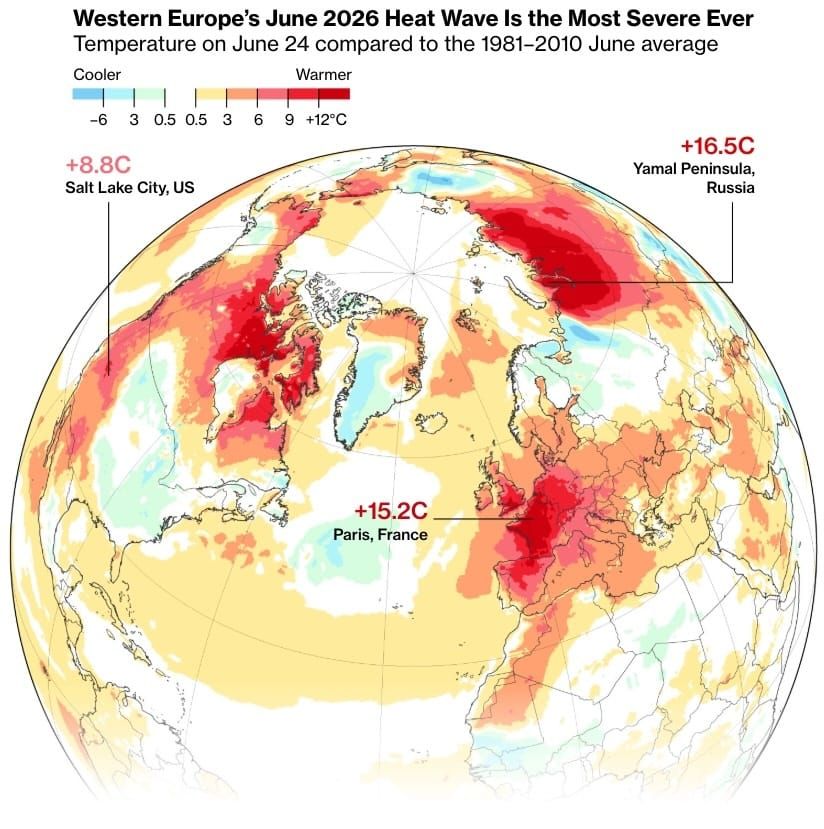
Summer has just barely begun and already Europe is seeing the most severe heatwave ever recorded, with temperature records broken all across the region. As Eric Roston and Hayley Warren detail in their excellent, infographic-rich story, the signature of climate change is clear:
There were four times as many new heat records set from 2016 to 2024 as there would have been without climate change. Unprecedented rainfall occurs 40% more often than it otherwise might, and record dryness, 10% more. Meanwhile, record cold is on an extinction pathway, according to a 2025 review of extreme weather.
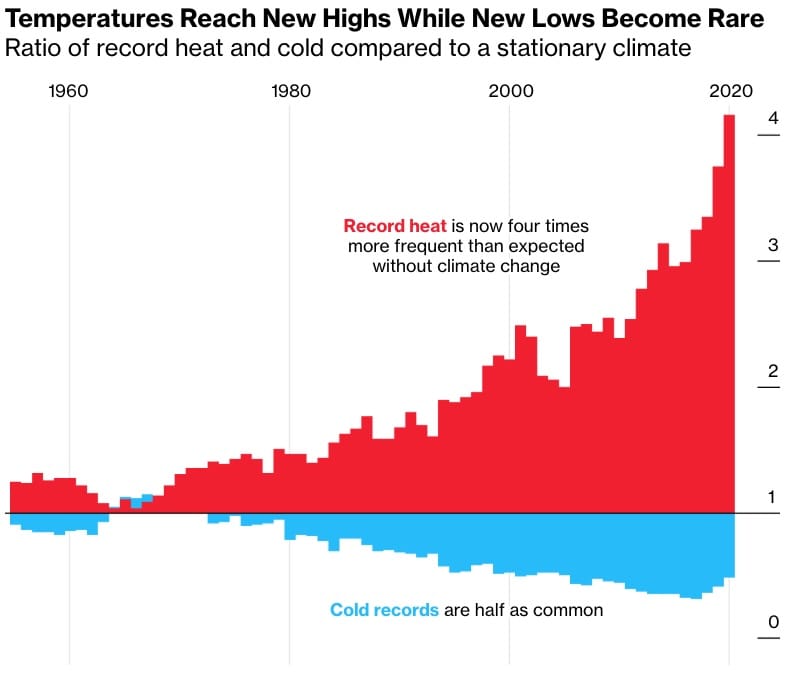
Source: Fischer, Erich M. (2025). Record-breaking extremes in a warming climate, Nature
And while no state or national records were broken in the US during this heatwave (so far), numerous local records were broken. Record-breaking temperatures in Washington DC canceled the Fourth of July parade and partially closed Trump’s Great American State Fair on the National Mall. At least 25 deaths in the US were blamed on the heat as more than 20 states saw temperatures over 100F (38C) over the holiday weekend.
A new study from World Weather Attribution shows that human-caused climate change increased the frequency and intensity of the June heatwave across Europe. Of its numerous findings, I’ll highlight just a few and add my own emphasis:
· Heatwaves cause more deaths in Europe than all other natural hazards combined. As temperatures continue to rise, ageing populations, growing prevalence of chronic illness, and uneven access to cooling and heat-resilient housing are increasing vulnerability, placing mounting pressure on health systems.
· Over the region studied this heatwave is the most severe ever recorded.
· In 1976, when some of the previous European records were set, the 2026 temperatures would have been virtually impossible to occur in June, while also highly unlikely at any time of the year. In 2003, the first major heatwave of this century, daytime heat like this would still have been very rare, about 10 times less likely than today, while nighttime temperatures such as this June would have been more than a hundred times less likely in 2003.
· Across large parts of Western Europe, June is warming faster than any other month. In addition, daily maximum temperatures are warming faster than night time temperatures, though both are warming much faster than global warming. The hottest daily temperatures are warming at about triple the rate of global warming and night time temperatures at about twice the rate.
· This means that a similar heatwave in June would have been about 3.5°C cooler during the day in 1976 and about 2°C cooler in 2003. The nighttime temperatures would have been about 2.4°C cooler in June 1976 and about 1.3°C cooler in June 2003.
· As the combination of heat and high humidity is especially dangerous for human health, we also analysed WBGT [Wet Bulb Globe Temperature]. [i] During this heatwave (18th – 29th June), 45% of European cities are breaking indoor-WBGT thresholds.
· Heat risk is concentrated in cities, where urban heat island effects, ageing building stock, and socioeconomic inequalities combine to intensity exposure. Many homes, schools, transport systems, and energy infrastructure were not designed for prolonged extreme heat, highlighting the urgent need for equitable adaptation, building retrofits, passive cooling measures, and heat-resilient urban design.
· This summer shows that at 1.4°C of global warming, extreme heat is already reaching the limits of our societies’ ability to cope. Our analysis here shows that intense heat is increasing rapidly even in living memory, with such events tens to hundreds of times more likely since only 2003 and virtually impossible just 50 years ago. A rapid phase-out of fossil fuels is critical if we are to avoid even higher temperatures and their consequences in the future.
And as Zeke Hausfather pointed out on Mastodon and on Bluesky:
Europe has been warming at a much faster rate than the world as a whole: roughly twice as fast as the global average, and 40% faster than the global land average.
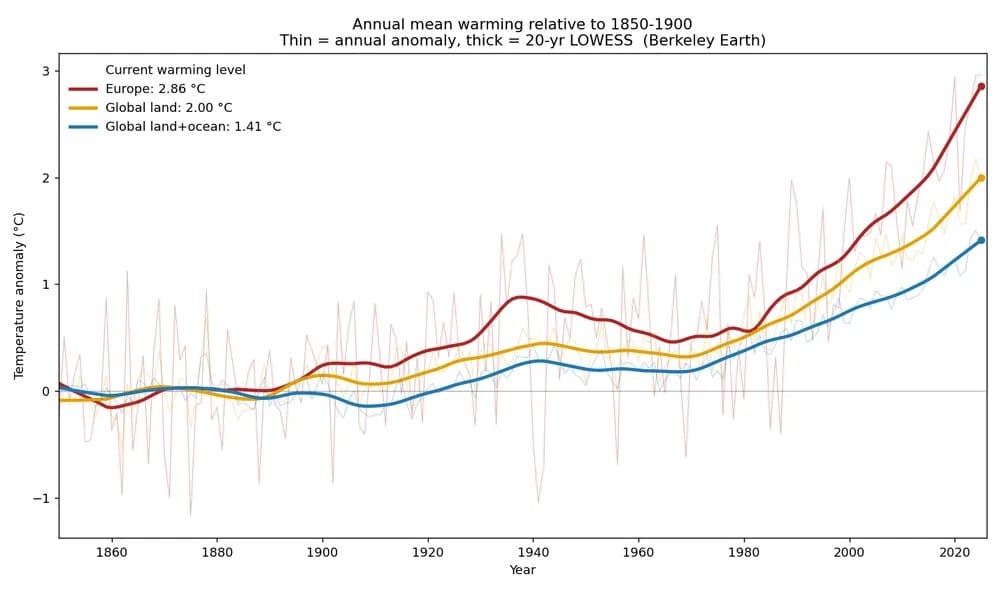
Source: Zeke Hausfather
At least 3,700 excess deaths have been attributed to the late-June heatwave in France, Belgium, and the Netherlands. However, a continent-wide modeling analysis by Christopher Callahan estimates the number at closer to 20,000. Since summer just started, that suggests that 2026 may rival the previous heat-related death tolls of over 70,000 for the summer of 2003 and around 62,000 for 2022.
Callahan teamed up with climate scientist Andrew Dessler on a very helpful explainer for Carbon Brief showing that the extreme temperatures in France outpaced what has been predicted by climate models, concluding [emphasis mine]:
Adaptation options, such as air conditioning, heat action plans and social support for isolated people, will be crucial as the climate moves away from the typical conditions that people are used to.
Our previous research showed that France made a lot of progress reducing heat-related mortality after the deadly 2003 summer heatwave by taking many of these actions.
Adaptation can reduce deaths, but it cannot eliminate the risk created by continued warming.
Without a move away from fossil fuels, future heatwaves will keep testing the limits of public health systems and more people will die.
The heatwave has led to some extremely stupid arguments for and against air conditioning. As Jan Rosenow pointed out on Bluesky, it’s apparently become the latest front in the energy culture war. But deploying heat pumps, which are the best technology we have for energy-efficient heating and cooling, remains the first-best choice for dealing with rising heat.
Temperatures on land were not the only ones broken. Global ocean temperatures were also broken in June, with the average daily sea surface temperature on June 28 at nearly 21°C (70°F). Scientists described the amount of heat being added to the oceans as equivalent to 11 Hiroshima explosions per second. But annual temperature peaks usually come in July and August, not June:
But Carlo Buontempo, Copernicus director at the European Centre for Medium-Range Weather Forecasts, warned it could indicate the beginning of a new phase, leading, once more, to uncharted territory: “With ocean temperatures at these levels and El Niño on the horizon, we are likely to see more temperature records fall in the coming months.”
D.C.-based climate strategist and independent journalist Brad Johnson tersely summarized the situation in his July 4 post:
In the Pacific Ocean, Super Typhoon Bavi is a fossil-fueled monster, a Category 5 storm with 160 mph winds. It is expected to grow stronger before it strikes Guam, Rota, and Saipan. The fossil-fueled European June heat wave killed thousands; the extraordinary heat has set Spain and Portugal ablaze.
About forty large wildfires are burning throughout the American west. The Aspen Acres Fire southwest of Denver exploded to more than 100 square miles yesterday, forcing thousands to evacuate. Hundreds of fires are burning in Canada, sending deadly plumes of smoke into the United States.
Again, this is just the beginning of summer. Another heatwave is already forming across Europe, including “very extreme fire weather conditions.” Wildfires have already forced the evacuation of thousands of people across southwest France.
Apart from the toll in human health, the extreme heat has caused enormous disruptions across the US and Europe, including major rail disruptions as the extreme heat causes rail tracks to expand and become unstable; disruption to overhead power lines; heat-stressed wildlife; water reservoirs coming under pressure; reduced output from nuclear power plants in France due to a lack of sufficiently cool water to cool the plants; and many other effects.
The bad news is that none of this is temporary. It’s “the new normal”:
Extreme heat could be a mark of many Independence Days in the future, experts say. Climate change, caused primarily by burning fossil fuels, is making heat waves hotter and longer. The average number of heat waves in the U.S. has doubled since the 1980s.
"It's not an anomaly. It's a preview," said Michael Rawlins, associate director of the Climate System Research Center at the University of Massachusetts Amherst. [..]
Cohen said extreme weather events reflect the "new normal," and many cities are preparing. He sees changes like keeping public buildings with air conditioning open longer, improving local emergency response services, and real estate developers taking climate change into account.
Still, the planet will continue to get hotter, he said. "We're learning how to adapt to it. But there's a limit to how much we can adapt," Cohen said.
As all of these studies and commentaries correctly observe, the only way to stop the increasing heating of the planet is to stop burning fossil fuels. And the primary way to do that is to accelerate the energy transition.
The good news is that we’re not starting from zero. As Roston and Warren observe, the energy transition is already well under way, although we still have a long way to go in implementing mitigation measures such as building retrofits, passive cooling measures, and heat-resilient urban design.
But the transition still faces political resistance from the fossil fuel lobby, and especially the fossil fuel lobbyists in the White House:
Solar is the fastest-growing power source worldwide, making up 75% of new demand growth last year. BloombergNEF expects solar to produce more power than any other source by 2032. Solar and wind power, batteries, electric vehicles and heat pumps are gradually making regions and countries less dependent on oil, gas and coal. Price spikes from the wars in Ukraine and Iran are helping to make the case.
The data suggest a global energy transition with strong momentum, although not without headwinds. A solar supply glut combined with trade barriers means panel production has fallen for the first time in 20 years. The Trump administration has reversed policies that supported renewable power and EV adoption and is cracking down on climate observation and research as well.
Even with more ability to tame warming than ever before, a hotter, more extreme future is guaranteed, and the next phase of climate change is likely to be marked by learning how best to respond.
All of which serves to highlight the widening disconnect between what climate scientists are telling us, as Sammy Roth helpfully rounded up in his July 2 post, and what social scientists are telling us, as I explored in Transition Times #8. Because as I mused in Nelder Notes #6, we’re now getting onto the real horns of the dilemma, where the world needs to move from merely setting targets to actually achieving them...with trillions of dollars of assets on the line, much of which is invested in fossil fuel infrastructure.
Perhaps the old frames of brown energy vs. green, or short-term profits vs. sustainability, or climate action vs. climate denial, are no longer doing the job. How about their assets vs. your health?
We’ll give the last word to America’s greatest songwriter, Irving Berlin:
Got an item you’d like us to cover?
We’d like Transition Times to help increase the visibility of all the great work that’s being done out there. So if you have an article, report, study, podcast episode, newsletter post, video clip or anything else that you think is worthy of a shout-out in Transition Times, email it to suggestions [at] transitiontimes [dot] net! We welcome all submissions, as long as they’re relevant to the energy transition.
Sources
Eric Roston and Hayley Warren, Extreme Heat Isn’t the Only Climate Impact Shocking Scientists, Bloomberg, July 6, 2026.
Sonya Gugliara, “Washington DC’s iconic 4th of July parade canceled due to record-breaking temperatures,” The New York Post, July 4, 2026.
Lucy Campbell, “At least 25 people die in US as record heatwave scorches swaths of country,” The Guardian, July 5, 2026.
Zeke Hausfather on Mastodon and on Bluesky, June 26, 2026.
“Fossil fuel emissions have rapidly worsened European heatwaves in just a few decades,” World Weather Attribution, June 26, 2026.
Sudip Kar-Gupta and Inti Landauro, “At least 3,700 excess deaths reported during heatwave in France, Belgium and Netherlands,” Reuters, July 3, 2026.
Christopher W. Callahan, “Death toll exceeds 20,000 across Europe in June 2026 heat wave,” Zenodo, June 30, 2026. DOI: 10.5281/zenodo.21083732 [preprint]
Joan Ballester, Marcos Quijal-Zamorano, Raúl Fernando Méndez Turrubiates, Ferran Pegenaute, François R. Herrmann, Jean Marie Robine, Xavier Basagaña, Cathryn Tonne, Josep M. Antó, and Hicham Achebak, “Heat-related mortality in Europe during the summer of 2022,” Nature Medicine 29, 1857–1866, July 10, 2023. DOI: https://doi.org/10.1038/s41591-023-02419-z
Christopher W. Callahan and Andrew Dessler, “Guest post: France’s June heatwave caused more than 2,700 heat-related deaths,” Carbon Brief, July 7, 2026.
Camille Knight, Elina Baudier Kim and Lisa Courbebaisse, “Too ugly, too noisy, too… American? France’s great air con debate,” CNN, July 7, 2026.
Jan Rosenow on air conditioning debates, Bluesky, July 7, 2026.
Jonathan Watts, “Ocean surface temperatures hit a record high for June,” The Guardian, June 30, 2026.
Brad Johnson, “The Scorch of July,” Hill Heat, July 04, 2026.
Nazaneen Ghaffar and Natan Odenheimer, “Europe Is Heating Up Again, Posing a Big Fire Risk,” July 6, 2026.
Natan Odenheimer, “Wildfires Force Evacuation of Thousands in Southwest France,” The New York Times, July 6, 2026.
Ava Berger, “Extreme heat on Independence Day will be America's new normal, experts say,” NPR, July 6, 2026.
Sammy Roth, “Enough climate hushing, more listening to scientists,” Climate Colored Goggles, July 02, 2026.
[i] Wet-bulb temperature is the lowest temperature your body can cool itself to by sweating. When the wet-bulb temperature gets too high, sweating stops working, and even healthy people can overheat.
We never use AI to produce any of the written or spoken content you find on Transition Times. We do use AI as a research tool (and vet the information so received).
We also occasionally use AI to generate graphics and sounds.