
TT#14 – Booming Batteries
Batteries are being deployed at a record pace all over the world, helping to soak up wind and solar generation instead of curtailing it, while helping to stabilize the grid and push fossil fuels off it. But the boom is really just beginning.
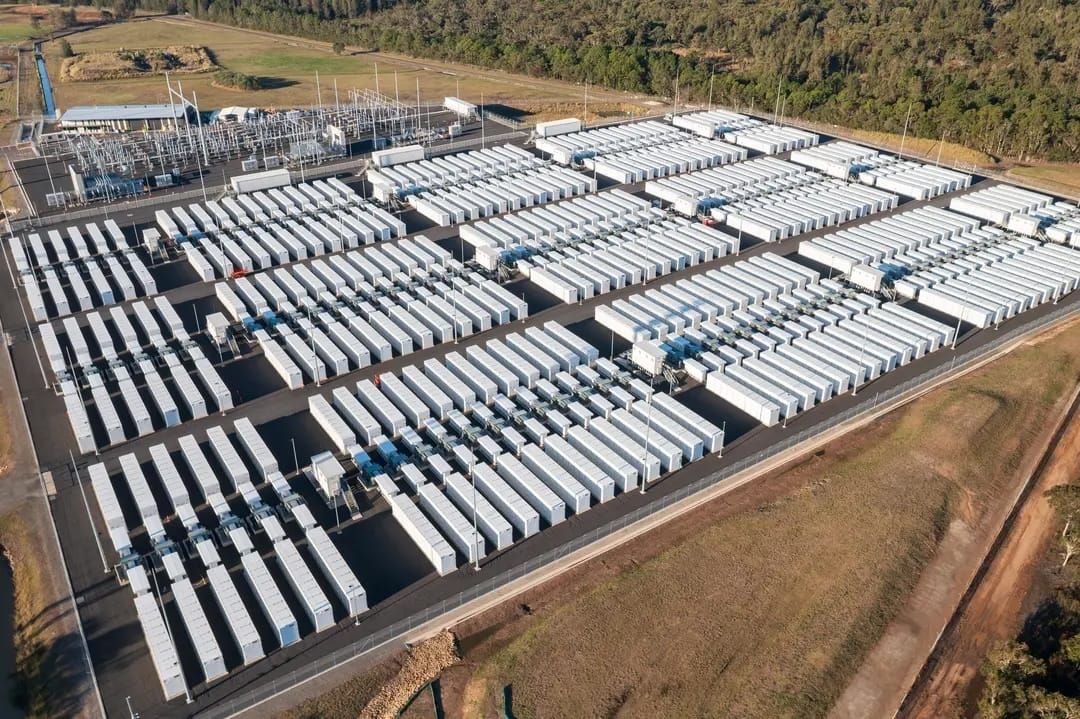
According to a recent study from the Lawrence Berkeley National Laboratory, over 2,060 GW of total generation and storage capacity was stuck in a queue waiting for connection to the grid in the US at the end of 2025. About 750 GW of that was for battery storage.[1] The other roughly 1,312 GW was for generation, of which 76% was for solar and wind:
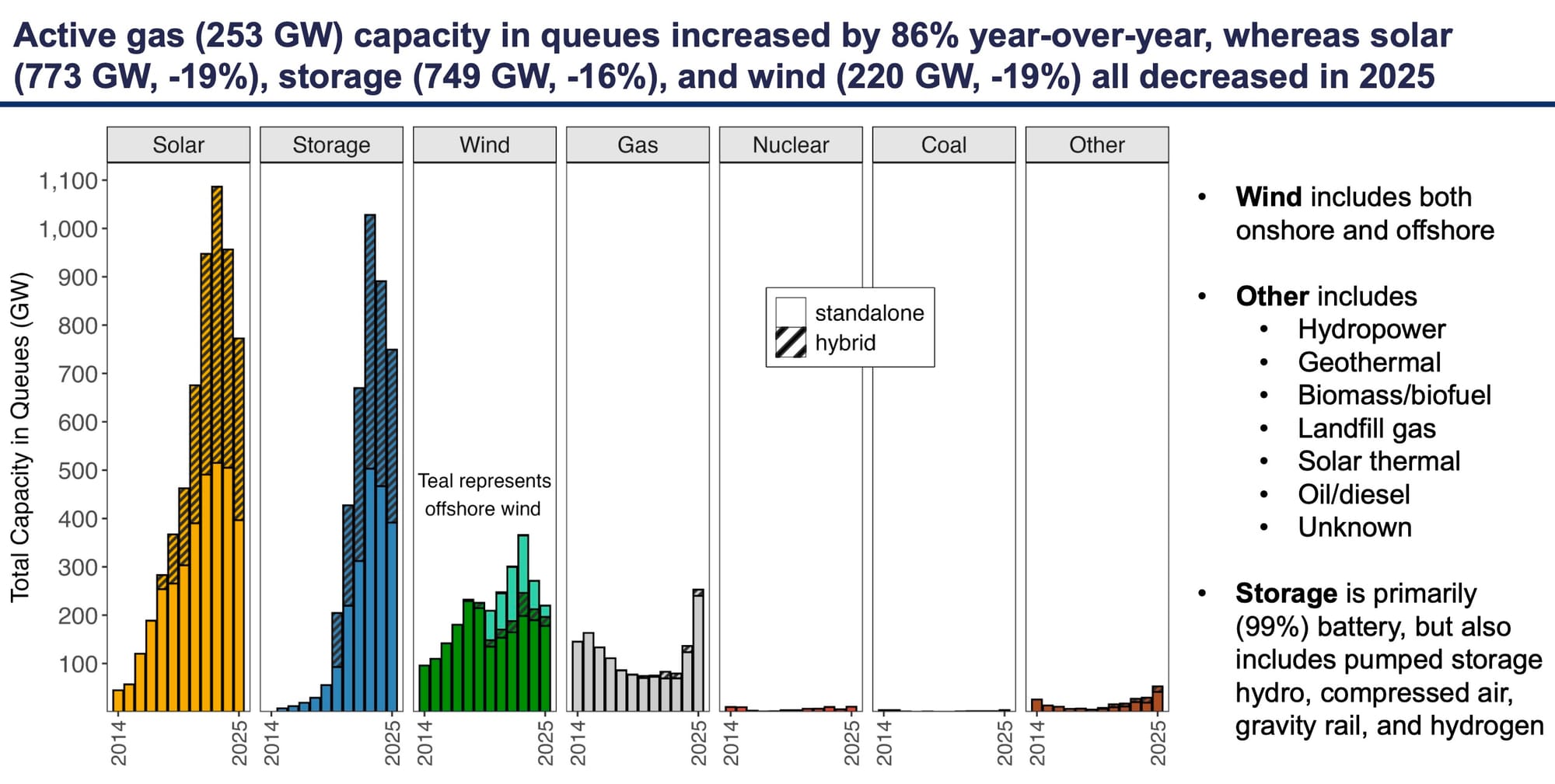
Source: LBNL
Together, the solar and wind capacity sitting in a queue waiting to connect to the grid is equivalent to 72% of the 1,374 GW total existing generating capacity in the US. Add in the storage, and the queue is equivalent to 1.5x the entire existing US power plant fleet.
Not all of that will be built. But as Steve McBee points out in Amped:
Not all those projects are viable, and many will never be built. But that is partly the point. Looking historically at interconnection requests submitted between 2000 and 2020, only 13% of the requested capacity had reached commercial operation by the end of 2025. Seventy-five percent had withdrawn. Even after projects secure an interconnection agreement, withdrawal rates remain above 40%.
On a sheer capacity basis, the US could be much farther along with its energy transition than it is. As Steve notes, there are three main barriers standing in the way:
An interconnection system designed for another era;
Permitting and siting processes that make new infrastructure painfully slow to build;
And the financial risk created by both.
Slow utility processes and a whole slew of permitting hurdles—“federal environmental reviews, state and local siting requirements, zoning and land-use approvals, rights-of-way, community opposition, and litigation”—add up to slow execution, increased project risk, and as a result of both of those things, higher financing costs. In turn, higher financing costs make it harder to develop the next project.
According to Joseph Rand, the lead researcher for the LBNL study, a storage project’s wait for a grid connection has increased from around a year and a half in 2015 to five years in 2025.
Another factor adding to the delays is a sheer shortage of grid equipment. Transformers, in particular, have seen chronic backlogs for several years now, but specialized circuit breakers and other components are also in short supply. The rapid build-out of data centers to support AI applications is only adding to the competition for key components, and the big tech companies building the data centers are willing and able to outbid others and try to jump the queue for the kit they need.
The challenges facing the transformer supply chain are particularly intractable, as Christopher Cox detailed in his excellent feature for the New York Times this week. These critical components are still largely made by hand in a painstaking process, partly because there are so many different sizes and specifications. And they’re only made by a handful of major manufacturers:
Already, domestic manufacturers can produce about only 20 percent of the transformers purchased in the United States; a half-dozen other countries, including Mexico, South Korea and China, supply the rest. The shortage has become bad enough that hyperscalers have begun paying to cut in line, ensuring that their transformers are built next. Even so, data centers, factories and solar farms have all faced delays coming online for want of transformers.
It’s a bottleneck and a choke point for the whole economy, with no relief in sight. Holt, from Siemens Energy, told me that wait times for large power transformers were still increasing. His hope was to one day return to prepandemic delivery times — of two to three years.
Cox’s article was about the grid’s vulnerabilities to physical attacks, like the one in 2013, in which a small group of shooters who knew exactly what to target disabled Pacific Gas and Electric’s Metcalf electrical substation, 15 miles southeast of San Jose, by shooting high-powered rifles at key components. Cox worries about the apparently paucity of solutions to those vulnerabilities, but an important one he overlooks is actually storage—just not utility-scale battery arrays that rely on the kinds of transformers used in substations. Distributed batteries, as I discussed in TT#13, are arguably the best line of defense against attacks on key chokepoints (like substations) on the grid, especially when tapped along with other DERs like rooftop solar and coordinated in a virtual power plant (VPP) or a microgrid.
Fortunately, the residential battery sector is finally starting to show significant growth in the US. According to the Clean Investment Monitor: US Q2 2026 Update published last week by Rhodium Group and the MIT Center for Energy and Environmental Policy Research, in the second quarter of 2026, investment in distributed generation and storage clocked its best quarter ever in the US, at nearly $12 billion—up 128% over the $5 billion invested in the first quarter.
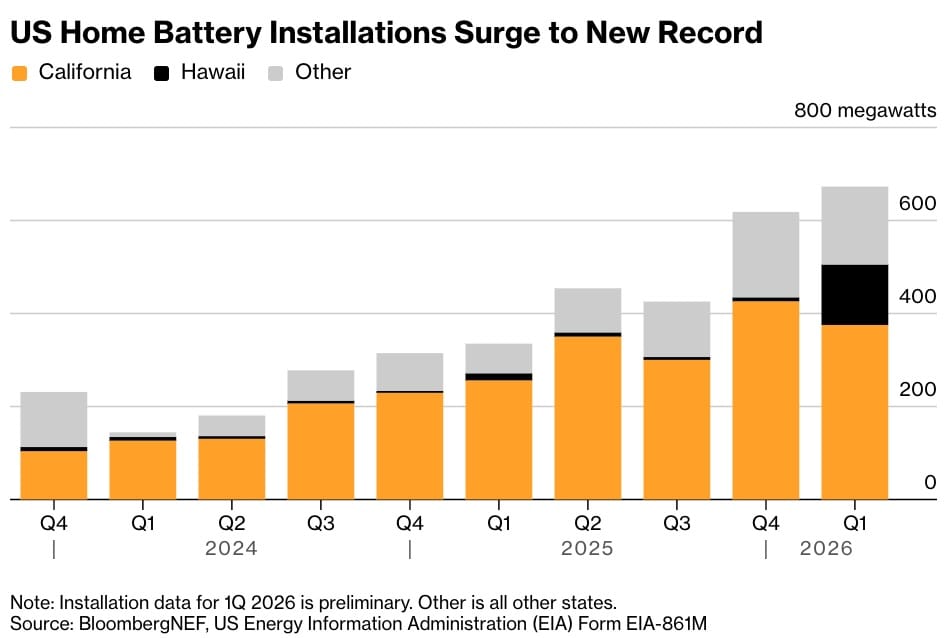
And that was on top of the record 673 MW of residential battery storage installed in the first quarter, driven by high electricity prices and policies that encourage battery installations, especially in California and Hawaii, according to EIA data compiled by Bloomberg:
As discussed in TT#13, state policies are now providing leadership in the energy transition while Trump’s federal government is actively opposing it. However, there are some exceptions, as Dan McCarthy noted for Canary Media:
Adoption is highest in the states where these factors — high electricity costs and supportive policy — coincide. California has since 2023 incentivized households to pair storage with solar, and in both 2024 and 2025 the state accounted for around three-quarters of home battery installations nationwide. Meanwhile, Hawaii, which has the highest electric bills in the country, created a new storage incentive program last year that resulted in a surge of installations in Q1 of this year, per BNEF. […]
The stubborn growth of residential energy storage is another reminder that batteries are fast becoming a critical part of the U.S. electricity story. Large-scale batteries, for which Republicans actually preserved tax credits in last year’s law, are being built at a blistering pace. Expect home battery adoption to keep climbing, too.
Notably, the Clean Investment Monitor report pointed out that retail investment in residential battery storage installations surged to $9 billion in the second quarter, surpassing residential solar installations for a second consecutive quarter:
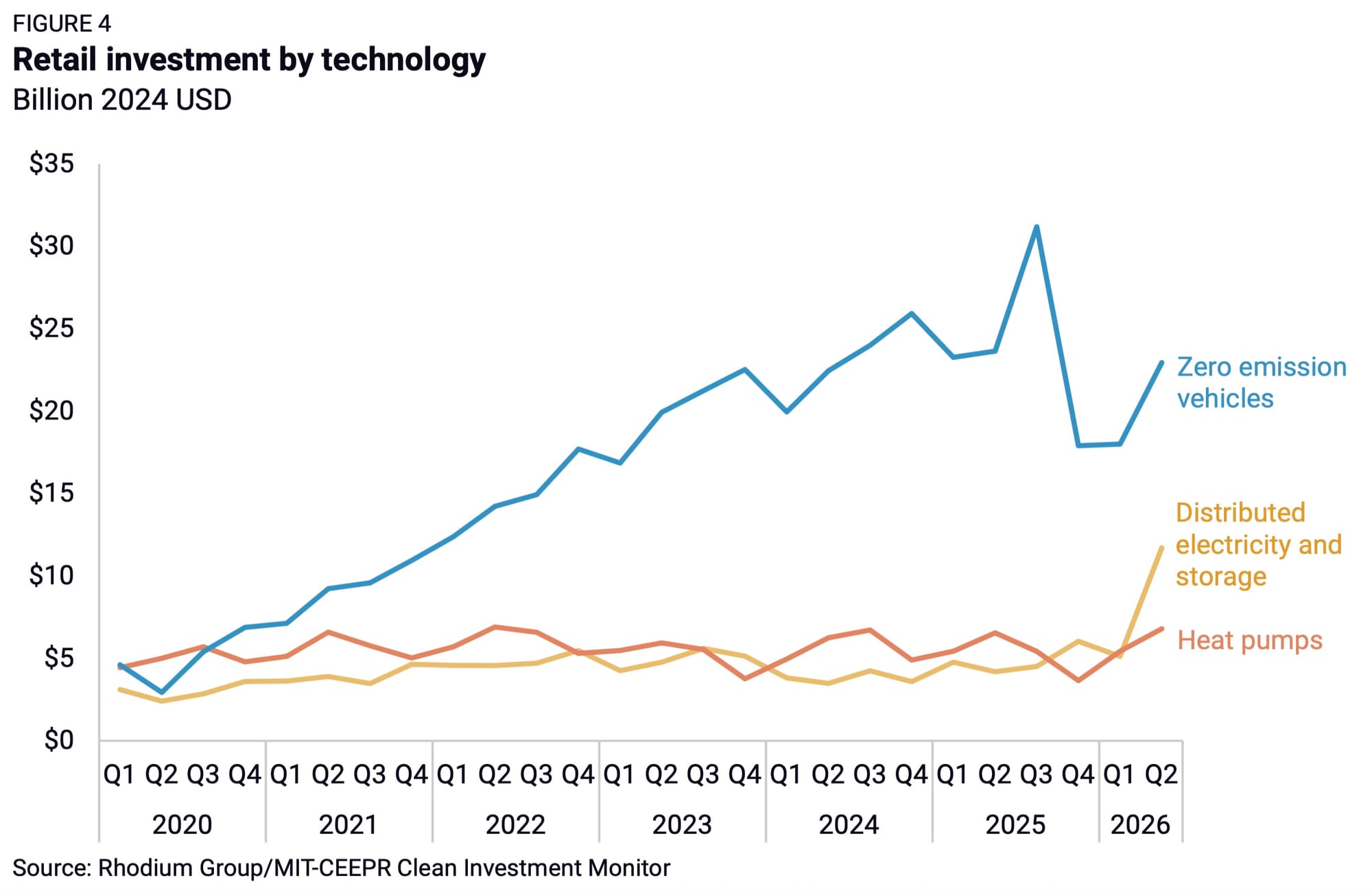
As Elisa Wood observed in her Energy Changemakers blog, residential solar and batteries have been building momentum for awhile, even if it doesn’t look like it in the chart above:
The shift can be traced back to the federal government’s decoupling of incentives for batteries from solar in 2023, opening the door for batteries to be marketed independently as backup power, electricity-price management and grid services — not merely to store solar energy.
The new approach to battery marketing had runway to take hold before the 30% homeowner credit expired at the end of 2025.
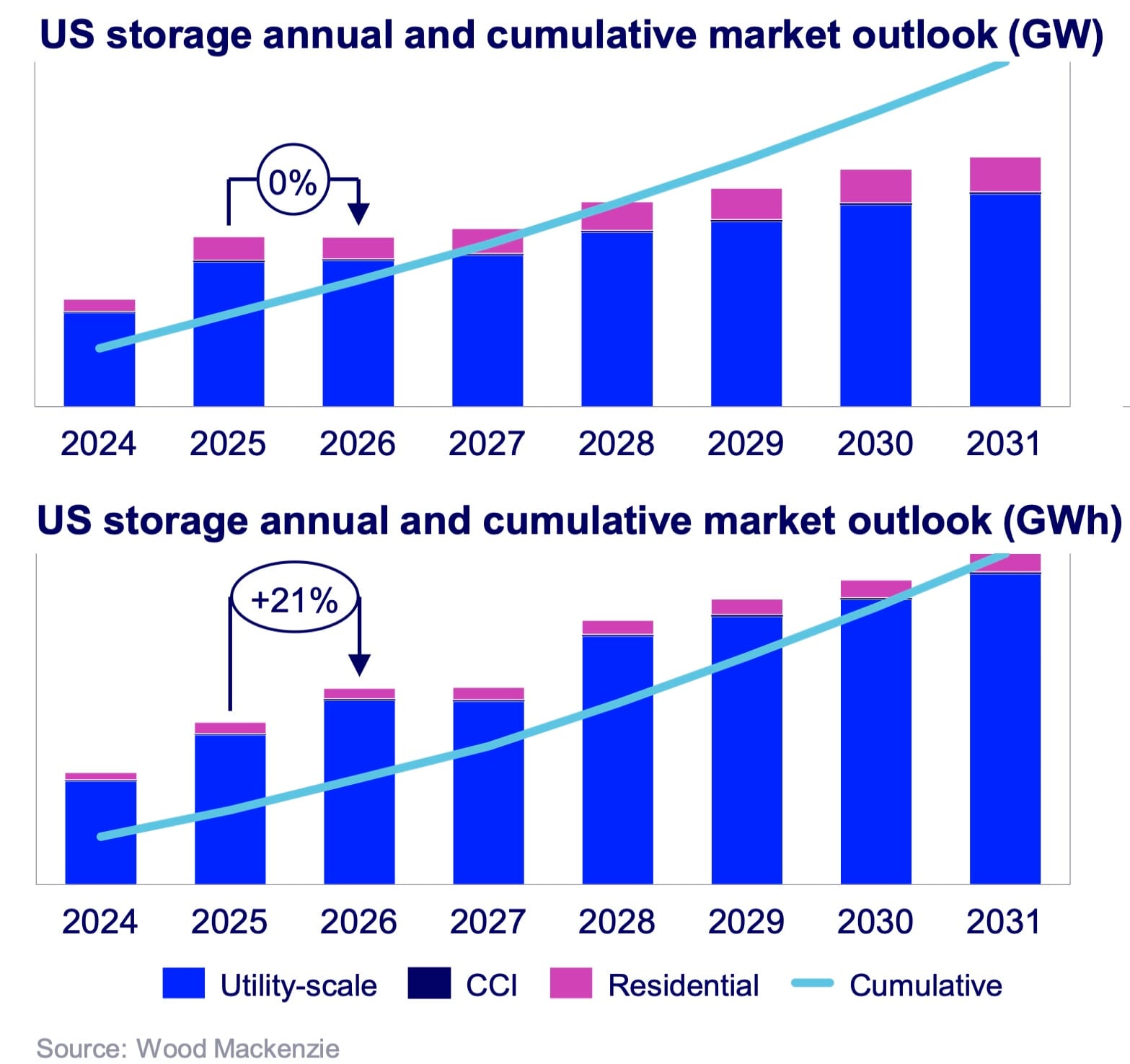
The latest forecast from Wood Mackenzie sees significant expansion for the US storage market ahead, albeit with a 5% dip in the residential segment for the full year due to “Freedom Forever’s bankruptcy,[2] constraints in tax equity availability, and updated permitting data.”
The US storage market will almost quadruple over the next six years, reaching 200 GW/655 GWh of cumulative installed energy storage capacity by 2031. The utility-scale segment will account for 85% of installed storage capacity between 2026 and 2031, strengthened by continued access to the ITC and co-location or contracting with large loads. The CCI segment will grow 26% between 2026 and 2031; sustained C&I growth in California and a 215 MW community storage pipeline will support this expansion. After a 5% contraction in 2026 based on MWh deployed, the residential storage segment will return to growth at an average annual rate of 12% between 2027 and 2031.
Batteries booming abroad
Turning our gaze abroad, we see that batteries are rapidly getting deployed all over the world.
As with distributed and especially residential solar, Australia is one of the key bellwether markets to watch in distributed battery systems. As mentioned in TT#13, Australia has experienced a major boom in residential batteries thanks to a very popular federal rebate program. According to new reporting by Rob Verdonck and Keira Wright for Bloomberg, half a million Australian homes, or about 4% of the total, have installed a residential battery under the program in the past 14 months. Together they add up to 14 gigawatt-hours (GWh) of storage, far more than the 9 GWh now installed in the US, which has 12 times the population of Australia. They are not just giving homeowners some insurance against the next blackout; they are increasingly being integrated as essential assets helping to maintain a reliable grid:
“Reaching 500,000 installed solar batteries is a massive moment for Australia’s energy transition,” David McElrea, chief executive officer of renewable energy industry lobby group Smart Energy Council, said in a statement. “Every single one of these 500,000 batteries represents a household taking control of their energy future while strengthening our national power network.”
Meanwhile, utilities are looking to benefit from the increase in household batteries to coordinate them into so-called virtual power plants that can help balance the grid. Origin Energy Ltd. said on Thursday that it has connected more than 400,000 homes and businesses into its Loop VPP, increasing its size to more than 1.5 gigawatts.
The near-tripling of batteries on the Australian grid from 2024 to 2025 has made them influential enough to actually push wholesale grid power prices down, according to a new report from the Australian Energy Regulator (AER):
One of the key contributors to lower prices has been the jump in installed battery capacity from 2.2 GW in 2024 to 6.1 GW in 2025, which has added flexible supply during evening peak, when demand increases and solar starts to retreat from the mix. […]
“New battery capacity also reduced concentration during peak times, with new entry more than doubling since mid-2024 and a more diverse set of owners entering the market.”
AER board member Jarrod Ball says batteries are becoming an increasingly important source of competition, shaping wholesale prices and strengthening competition during evening peaks, when demand remains high and solar output is lower.
Batteries on the Australian grid are about evenly split between distributed and utility-scale now, which says a lot about how much distributed capacity there is. Because the country is about to boast the third-largest battery storage array in the world: the Quinbrook’s 3 GWh Supernode project near Brisbane. It took another step forward last week when it achieved Stage 2 commercial operation and reached financial close on A$469 million in financing for Stage 3. Chinese battery titan CATL is providing the batteries for that project.
Turning to India now, while starting from a much lower base, the opportunity for batteries there is enormous and is being driven by explicit policy support. Under the Energy Storage Obligation (ESO) introduced by the Ministry of Power in July 2022, regulated utilities and certain large consumers must procure an increasing percentage of their electricity from battery storage systems, rising up to 4% in FY2029-30. That is further supported by the National Electricity Plan 2023 targets, which call for 47 GW / 236 GWh of battery storage by FY2031-32. Those mechanisms are leading to a proliferation of business models and battery system developers.
Altogether, the Indian battery storage market is expected to help accelerate the country’s energy transition by displacing applications that currently run on fossil fuels, as well as to support grid stability… if the winners of nearly 100 GWh of capacity awarded in recent tender auctions can deliver on the projects. (Less than a tenth of that is now operational.)
For example, although India is adding renewables at a record pace, a significant amount of that electricity still can’t get to market due to limited storage, transmission and dispatch flexibility. An estimated 470 GWh of renewable energy was curtailed in the first quarter of 2026 alone. A full suite of storage solutions, including battery storage, could go a long way toward closing that gap.
China, the world's top producer of solar power, rejected 360 terawatt-hours (TWh) of clean power from January to June, up 49% from the same period a year earlier, according to a report this month by Global Energy Monitor (GEM) and the Center for Research on Energy and Clean Air (CREA).
The report's estimates for curtailments far exceed figures given by the Chinese government.
Insufficient transmission infrastructure and supply contracts that guarantee operations of newly built coal-fired power plants in China are forcing the rejection of abundant renewable output, analysts say.
"Curtailment in China is structural, not a temporary bottleneck. We expect curtailment pressure to continue through the rest of this decade," said Yuan Ren, analyst at consultancy Wood Mackenzie.
As the article notes, 360 TWh is about as much power as Mexico consumes in a year. In China, the lack of offtake capacity for their burgeoning clean power generation (along with the removal of a guaranteed fixed price for renewables) contributed to a 66% drop in new solar installations in China this year. Even worse, consultancies S&P Global Energy and Wood Mackenzie expect coal-fired power to rebound by 1.5% to 2% in China, after the country recorded its first drop in coal-fired power in 2025.
So not only does a lack of offtake capacity, in the form of transmission and storage, make curtailment of clean power generation more likely, it also leads to increased fossil fuel use. Conversely, deploying more batteries can soak up excess wind and solar generation and help push fossil fuels off the grid while making room for even more wind and solar, and making grids more reliable at the same time. Batteries are booming now, but the boom is still young.
[1] The report refers to “storage” but explains “Storage is primarily (99%) battery, but also includes pumped storage hydro, compressed air, gravity rail, and hydrogen.” For our purposes here, it’s “batteries.”
[2] Freedom Forever was the second-largest residential solar installer in the United States, which went bankrupt in April 2026 due to a compounding combination of unfavorable circumstances, as Bianca Giacobone detailed for Latitude Media.
Got an item you’d like us to cover?
We’d like Transition Times to help increase the visibility of all the great work that’s being done out there. So if you have an article, report, study, podcast episode, newsletter post, video clip or anything else that you think is worthy of a shout-out in Transition Times, email it to suggestions [at] transitiontimes [dot] net! We welcome all submissions, as long as they’re relevant to the energy transition.
Sources
Joseph Rand, Anna Cheyette, Chris Talley, Steven Zhang, Will Gorman, Ryan Wiser, Joachim Seel, Seongeun Jeong, Fritz Kahrl, Queued Up: 2026 Edition, Lawrence Berkeley National Laboratory, June 2026.
Steve McBee, “Stuck in the Queue: Why Cheap Power Can’t Get Onto the Grid,” Amped, August 13, 2026.
Summer Maxwell, “Big Batteries to Bolster the Grid Are Stuck Waiting to Plug In,” Bloomberg, August 15, 2026.
Christopher Cox, “What if America Went Completely Dark?” The New York Times, August 18, 2026.
Rob Verdonck and Keira Wright, “Australian Homes Lead the World on Home-Battery Installation Thanks to Subsidies,” Bloomberg, August 13, 2026.
Sophie Vorrath, “’Significant shift:’ Batteries are capping electricity prices and helping to bust the energy market cartel,” Renew Economy, August 20, 2026.
“Quinbrook’s Supernode Battery Project Reaches Major Milestones,” Energy Reporter, August 15, 2026.
Prabhat Ranjan Mishra, “3 GWh Supernode battery energy project achieves key milestone to accelerate energy transition,” Interesting Engineering, August 17, 2026.
Clean Investment Monitor: US Q2 2026 Update, Rhodium Group and the MIT Center for Energy and Environmental Policy Research, August 11, 2026.
Summer Maxwell, “More Americans Are Installing Home Batteries. Here’s Why,” Bloomberg, July 1, 2026.
Dan McCarthy, “Home battery installations climb despite loss of federal incentives,” Canary Media, August 14, 2026.
Elisa Wood, “Record Quarter for Distributed Electricity and Storage in the US,” Energy Changemakers, August 13, 2026.
US Energy Storage Monitor, Wood Mackenzie, June 2026.
Bianca Giacobone, “Why did residential solar installer Freedom Forever go under?” Latitude Media, June 1, 2026.
Shivanshu Thaplyal, Shivang Sinha, and Disha Jain, “India's Battery Storage Gap: 98 GWh Auctioned, Just 8.5 GWh Operational,” NDTV, August 15, 2026.
Shailesh Haribhakti, “India’s Unused Power Crisis: A Scholarly Strategy for Storage, Grid Renewal and Energy Independence,” Solar Quarter, July 2026.
Colleen Howe and Sudarshan Varadhan, “China leads wave of clean power wastage as grids globally hit limits,” Reuters, August 17, 20261.
We never use AI to produce any of the written or spoken content you find on Transition Times. We do use AI as a research tool (and vet the information so received).
We also occasionally use AI to generate graphics and sounds.