
TT#8: Fixing Climate Communications
Climate and energy transition campaigners are softening their language and avoiding confrontation when they should be increasing their ambition and vigorously delivering messages that are proven to work.
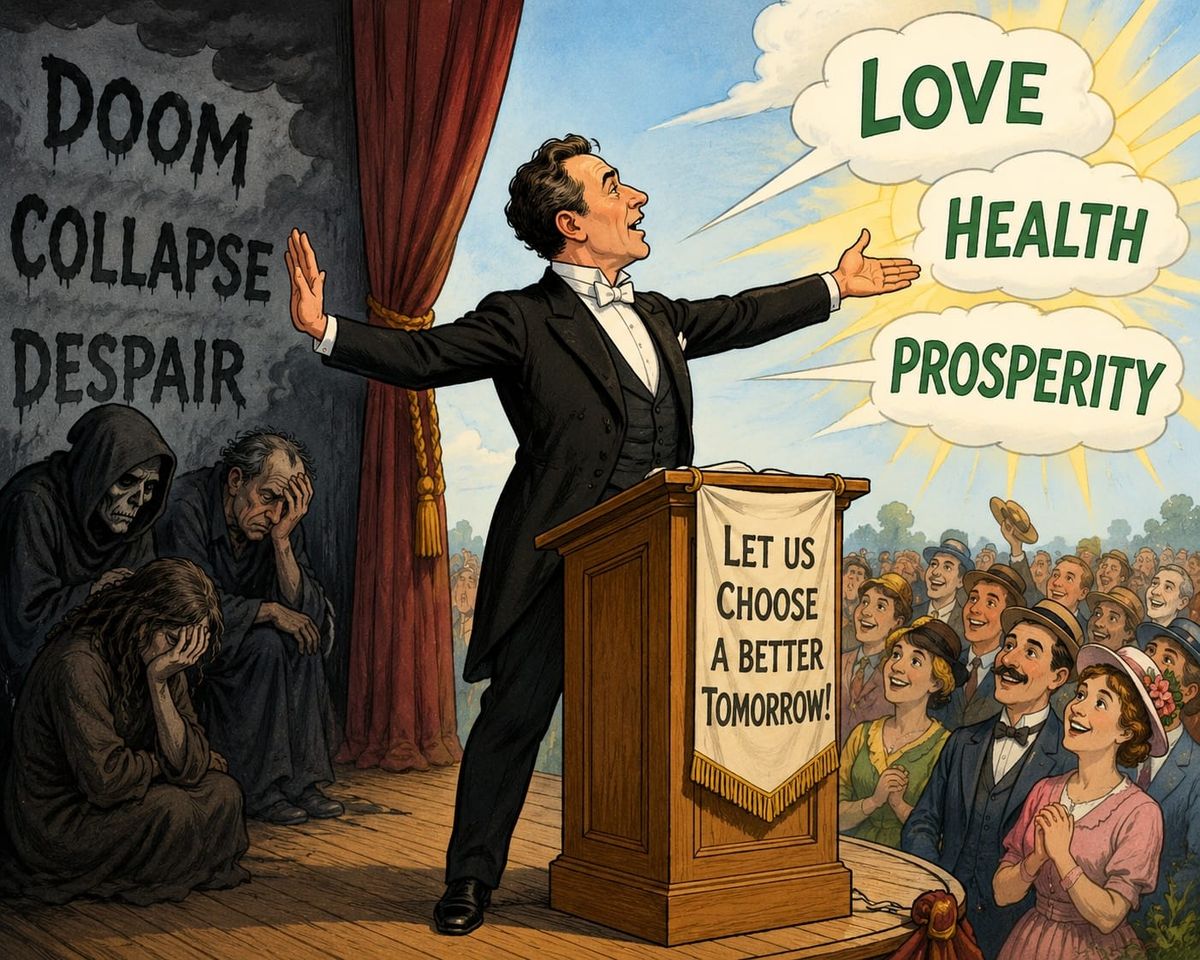
When it comes to climate messaging, as the kids like to say, “the vibes are off.”
Policy messaging based on climate science, data, or even a sense of social responsibility are sooo 2022. Now it’s all about economics, as the stalwart NY Times climate reporters Lisa Friedman and Brad Plumer explained:
Now many Democrats argue that the path back to power means abandoning some of their most aggressive stances on climate change. When they do promote renewable energy, they frame it as a way to lower electric bills and avoid the gas pump, not because of the effects on the planet.
Some environmental activists are muting their demands to keep fossil fuels “in the ground,” a rallying cry that had defined the climate movement for more than a decade. […]
Democrats are trying to figure out how to talk about a problem that many voters still say they want to see the government tackle, but without opening candidates to attacks from Republicans calling them out of touch.
But there’s really no evidence that tiptoeing around potential attacks or pursuing climate objectives as unobtrusively as possible is a winning strategy. Nor that avoiding naming your opponents gains you anything.
“We shouldn’t be against the domestic oil and gas industry, but we have to be for the energy transition,” said Simon Rosenberg, a Democratic strategist. “Democrats should be running toward that instead of away from it.”
Indeed they should.
Instead, they wage picayune battles over framing and language that have no measurable impact on persuasion. Shifting from “global warming” to “climate change” and now “global heating” has accomplished nothing; the opposition merely resumes its attacks using the new language. Communications around climate are rife with such tweaks and fiddling around the edges.
Sadly, too much of the Democratic leadership that ought to be voicing full-throated support for the energy transition are proving too craven for the challenge:
The shift has opened up a rift in the Democratic Party. While some leaders, including Representative Alexandria Ocasio-Cortez of New York and Senator Ed Markey of Massachusetts still rail against oil and gas interests, many of their colleagues are becoming more accommodating to fossil fuel companies. And some activists are even no longer using “keep in it in the ground” as a rallying cry.
Accommodating a determined and ruthless foe does nothing but cede ground to it. And avoiding conflict with the cutthroat and shameless fossil fuel lobby in hopes that the markets will magically make the progress that policymakers fear to make is mere magical thinking. As Lindsay Hooper, CEO for the Cambridge Institute for Sustainability Leadership, wrote in a recent op-ed for Reuters, what’s needed is urgency and clear messaging, and tackling head-on the most difficult parts of the persuasion challenge:
Honest, evidence informed public debate, acknowledging the full trilemma of economic, energy security and climate challenges, rather than the politically convenient subset, is a precondition for effective decision-making.
This requires tackling climate disinformation directly, as the EU has begun to do. It requires engaging directly with the real delivery constraints of electrification: integration costs, critical mineral supply chains, grid investment requirements, workforce transition, land use, and public consent under cost-of-living pressure.
CISL research shows that across the G7, citizens broadly support transition in principle but withhold support for specific policies when they believe the cost falls unfairly, when they doubt the policy will work, or when they sense their concerns are being managed rather than answered. Rebuilding that credibility requires credible answers to legitimate questions about cost, fairness and efficacy.
Business has a specific responsibility here that is not being consistently discharged. Many companies whose long-term competitiveness depends on transition have retreated from public positions under recent political pressure, leaving the field to those with the strongest interest in delay.
We should know by now that changing language to avoid attacks doesn’t get you very far.
What works is advocating strongly for what you want. And the messages you choose can make you a more effective advocate.
Identifying those messages is the specialty of the Potential Energy Coalition (see Energy Transition Show Ep. 228 for a detailed look at their methods and early findings). They just released the findings from their new report, Fixing Climate Communications, which was supported by The Rockefeller Foundation. Founder John Marshall, who turned his decades of experience in branding and marketing to climate advocacy, offered some highlights in his excellent “That’s Interesting” newsletter accompanying the report:
Climate communication is at a crossroads.
Critical voices are going quiet. Both private sector companies and public sector leaders are shying away from talking about climate change, and total media coverage has declined significantly since its peak in 2021.
The world is turning inward. As economic insecurity mounts, geopolitical tension rises, and the infosphere fragments, people's circles of attention are shrinking, keeping focused on their own finances, families, communities, and trusted sources.
Today’s most common climate messages aren’t connecting. “Achieving net zero” ranks near the absolute bottom on people’s list of concerns. Anytime the word “ban” or “mandate” is mentioned, public support drops as much as 20%. “Green jobs” sound more like a promise than a reality, a “massive energy transition” sounds difficult and expensive, and the scolding “shoulds” and “sacrifices” of traditional environmental communication increasingly turn people off to the cause.
What their research shows is that many climate advocates are doing it wrong. You advance climate action not by ducking opposition, but by getting on the front foot and being actively persuasive. By choosing messages that have been tested and proved effective and then relentlessly hammering away at them, not abandoning them the minute the opposition starts counter-attacking.
It turns out that messages about protecting the ones you love and protecting human health are more persuasive than messages about money (or fear).
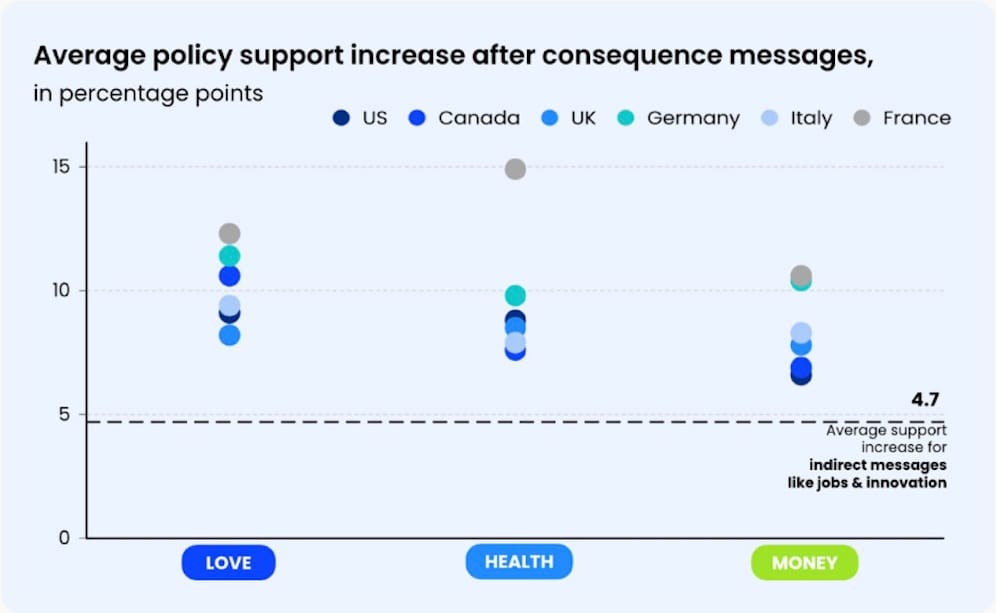
Source: Potential Energy, Fixing Climate Communications
Not the fraught debate within the Democratic camp in the 2024 election about whether or not to say “no more drilling” or “no more fossil fuels,” but:
The sun, wind, and water are unlimited, boundless, sources of clean energy. The more we harness them, the less we rely on drilling and burning fossil fuels–which means the less we pollute.
It boils down to a very straightforward story that any policymaker or elected officials or message strategist ought to be comfortable endorsing: Not “no more fossil fuels” but “more renewable energy!” Not just “The AMOC is dying ermagerd!” but “Let’s make sure the AMOC stays intact by building more renewable energy and decarbonizing the grid!”
Any communication about climate risk that fails to connect it to a positive call to action has failed in its mission. To change human behavior, as I wrote in 2013 for Nature, you have to tell a positive story:
Fear- and threat-based messaging about climate change and energy has not mobilized responses. Let’s learn from this and try a positive tack. As the old sales saw goes: “Sell the sizzle, not the steak.”
I’m amazed and horrified at how many people working in climate communications still haven’t gotten that message. But I hope the ones who haven’t fully internalized it will really explore the aforementioned report from Positive Energy Coalition. It’s some of the best guidance on climate messaging I have seen.
It’s now a tired trope but it’s still true: Global warming is our reality, no matter what our attitudes toward it are. CO2 concentrations are stubborn facts, not fluid perceptions to be manipulated through weaselly language and “side door” messaging, as the Positive Energy team put it.
It also doesn’t help that in general, people are tuning out on the news altogether:
Since 2021, the proportion of people saying they are ‘extremely’ or ‘very’ interested in the news has fallen by an average of 13pp across the markets we survey. A quarter (25%) of respondents are now casual or passive news users who typically only consume news once a week and say they have little to no interest in it, up from 16% in 2021.
Or that climate coverage in news media is still barely detectable:
Over four decades, climate change comprised just 0.55% of all news coverage—one-thirty-sixth the attention devoted to sports and entertainment. […] the integration of climate change across news domains remains highly uneven. Climate references are concentrated in environmental reporting while nearly absent from domains such as health and social justice—topics through which the public experiences climate impacts in daily life. […] These findings suggest that despite gradual progress, climate change has yet to achieve the cross-domain media presence commensurate with its significance as a societal challenge.
Climate references are nearly absent from reporting on health. The very domain that the Positive Energy Coalition has identified as one of the most persuasive.
We don’t win this war by reacting to vibes. We win it by creating vibes, positive ones that lead to climate action. We win it by making it plain and clear that the fossil fuel lobby wants to continue burdening us with health damage, environmental damage, and economic damage not because there is any need for it, but simply because it is in their financial interest. And by continuing to remind the public that the clean 'electrotech' solutions are available now, that they are better and cheaper, and that they leave consumers with better health and more wealth.
They winning messages are not hard to understand or create, and they don’t need any D.C. messaging experts to craft them for maximal centrist appeal, or whatever the political establishment sorts think is needed.
All we really need is the courage to deliver them plainly, directly, and relentlessly.
Got an item you’d like us to cover?
We’d like Transition Times to help increase the visibility of all the great work that’s being done out there. So if you have an article, report, study, podcast episode, newsletter post, video clip or anything else that you think is worthy of a shout-out in Transition Times, email it to suggestions [at] transitiontimes [dot] net! We welcome all submissions, as long as they’re relevant to the energy transition.
Sources
Lisa Friedman and Brad Plumer, “Democrats Once Vowed to Stop Oil and Gas. Now They’re Not So Sure.” The New York Times, June 11, 2026.
David Gelles, Climate Forward newsletter, The New York, Times, June 11, 2026.
Lindsay Hooper, “We’re having the right debate about the energy transition, but missing the urgency,” Reuters, May 13, 2026.
Episode #228 – Public Persuasion, Energy Transition Show, July 10, 2024.
Fixing Climate Communications, Potential Energy, June 18, 2026.
“Fixing Climate Communications, a New Global Report,” That’s Interesting, Issue 34, June 18, 2026.
Saffron J. O’Neill and Sophie Nicholson-Cole, “Fear Won’t Do It: Promoting Positive Engagement With Climate Change Through Visual and Iconic Representations,” Science Communication 30, No. 3, March 2009. DOI: https://doi.org/10.1177/1075547008329201
Press release: “New Potential Energy-Rockefeller Foundation Study: Climate Support Strong Across Leading Democracies, But Words Matter,” The Rockefeller Foundation, June 18, 2026.
Damian Carrington, “Critical Atlantic current significantly more likely to collapse than thought,” The Guardian, April 15, 2026.
Chris Nelder, “Communication: Positive energy,” Nature 498, 293–295, June 20, 2013. doi:10.1038/498293a
Jim Egan, “Overview and key findings of the 2026 Digital News Report,” Reuters Institute for the Study of Journalism, June 16, 2026.
Sanguk Lee, Anthony Leiserowitz, Lara Briggs2, Huong Ha, and Matthew H. Goldberg, “From silence to whisper: climate change in U.S. news media, 1984-2025,” Center for Open Science, June 9, 2026. DOI: 10.17605/OSF.IO/TGXQE
We never use AI to produce any of the written or spoken content you find on Transition Times. We do use AI as a research tool (and vet the information so received).
We also occasionally use AI to generate graphics and sounds.