
TT#12: A Failure to Communicate
Most media organizations are still failing to make the critical link between climate change and the wildfires, record heat, and other climate disasters we are witnessing, but a few are getting it right. And new research offers further guidance on effective climate messaging.
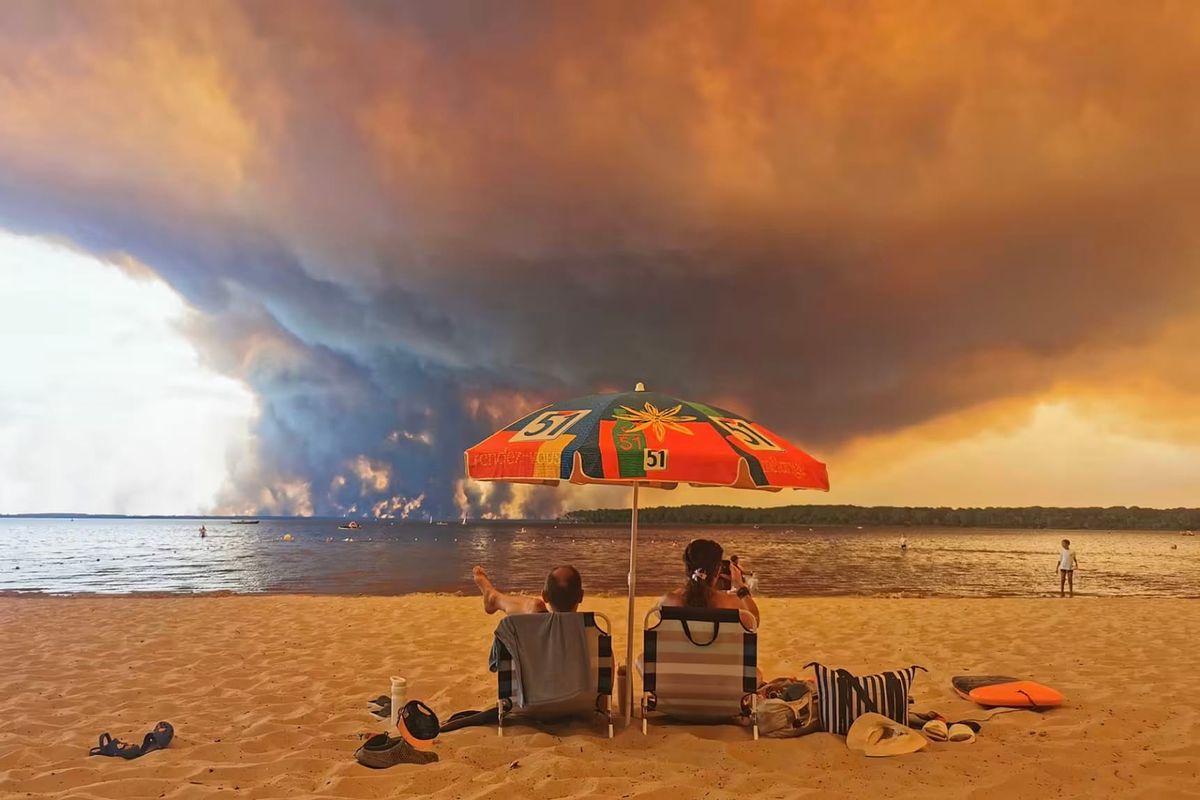
Reading the coverage of the manifold climate disasters unfolding all around us at the present moment, I keep thinking back to that classic line from Cool Hand Luke:
You might think that at a time when oil and gas prices are soaring due to their supply chains being choked off at key transit routes in the Persian Gulf, and the whole world is sweltering and dying under record high temperatures, and massive areas of the globe are going up in wildfire smoke, and the fossil fuel companies that sold the fuels that produced the carbon emissions causing global warming are looking increasingly vulnerable to being held responsible for their actions, that advocates of climate action and the energy transition would be capitalizing on this moment in the biggest possible way.
But you’d be wrong. Instead, as I detailed in NN#6, we see a lot of backsliding on climate commitments, and media platforms shutting down their climate coverage.
Climate is out of fashion in politics as well, as Kate Yoder writes for Grist:

A hush has fallen over the Democratic Party — a “climate hush,” to be precise. The phrase captures the push within the party to focus more on the high cost of living and less on the planetary crisis, in hopes of addressing a popular diagnosis of why Democrats lost the 2024 presidential election to Donald Trump. Since then, Democratic politicians have been mentioning the subject less on social media and in their press releases. Candidates in this summer’s primaries might have it in their platforms, but it’s the rare candidate who campaigns on it.
That’s because it’s an election year in the United States, and in the estimation of many astute political observers, an extraordinarily important one. If it is decisive one way or the other, the outcome of the midterms could reverberate for decades in American politics. And the Democratic establishment is dominated by centrist tacticians who are far more interested in minimizing risk than they are in capitalizing on the present opportunity to advance climate action.
But according to the findings of recent voter surveys Yoder highlights, their caution is ill-advised. The UC Santa Barbara researchers who did the surveys found that the “climate hush” admonition promulgated by several well-publicized sources are wrong about its sway with voters. While it’s true that climate change is not a top issue for voters, climate action is actually a winning issue.
Even with voters open to voting Republican, motivated climate supporters outnumber motivated opponents by nearly 4 to 1. […]
Across all respondents, making climate action a priority increased the candidate’s likelihood of being chosen by 2.7 percentage points. Making climate a top priority increased the likelihood by 4.5 percentage points. […]
For those open to voting Republican, prioritizing climate change had little to no measurable effect. The only group that penalized climate was committed Republicans, whose votes are not winnable by Democrats in the first place.
It turns out that (as has been shown repeatedly in voter surveys for many years now), clean technologies are actually popular across the political spectrum.
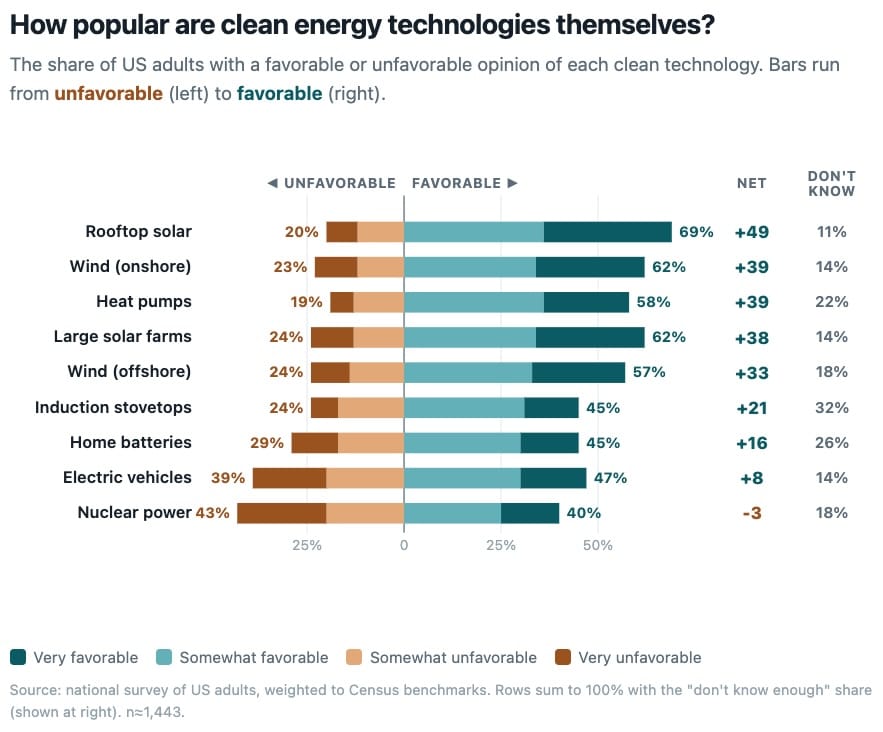
Source: The 2035 Initiative
Further, as I expounded on in TT#8, trying to sidestep words like “climate” doesn’t actually accomplish anything, because voters are smart enough to realize that it’s about the thing, not the words used to describe it. The researchers were blunt on this point:
The framing did not measurably move support. Differences between the groups were statistically insignificant. The pattern held for Democrats, Republicans, and Independents. Framing a policy around climate action does not decrease support for that policy. Saying climate is not as politically toxic as the hushers claim.
Further, the researchers found, “Voters prefer expansion over restriction, regardless of the goal.”
I feel like I’ve been hammering away at this point forever. For example, in this article from 17 years ago:
If we really want to motivate capital to address the climate change problem, and motivate people to apply their entrepreneurial energies, then we need to incentivize the solutions, not penalize the problems. […]
Decarbonizing solutions to the peak energy problem will also solve the climate change problem. But the focus should be on shifting the primary energy loads to renewables, not chasing a fuzzy and much-debated concept like global warming. If we can solve the peak oil, peak gas, and peak coal problems—all of which are likely to occur by 2025—by switching to an all-electric infrastructure increasingly powered by renewable energy, the CO2 problem will take care of itself.
I wrote that in 2009, in the immediate aftermath of the peak oil story having gone boom and bust, and related a public speaking event where “I outlined the peak fossil fuel concept and suggested that given the infantile state of renewable energy, we are in a race for BTUs, not a race against CO2.” But the steep decline in the costs of energy transition solutions, and the massive scaling-up in their manufacture since then, have only strengthened the case. Renewable energy has grown up into mature technologies since then, and clean energy now meets all new demand for electricity globally, as Aditya Lolla and Euan Graham of Ember recently shared in Energy Transition Show Ep. 280.
If you can’t take the heat…
But these insights haven’t yet been absorbed by most of the commentariat.
The wildfires raging around the world are making the front pages everywhere, as Carbon Brief’s Simon Evans helpfully compiled:
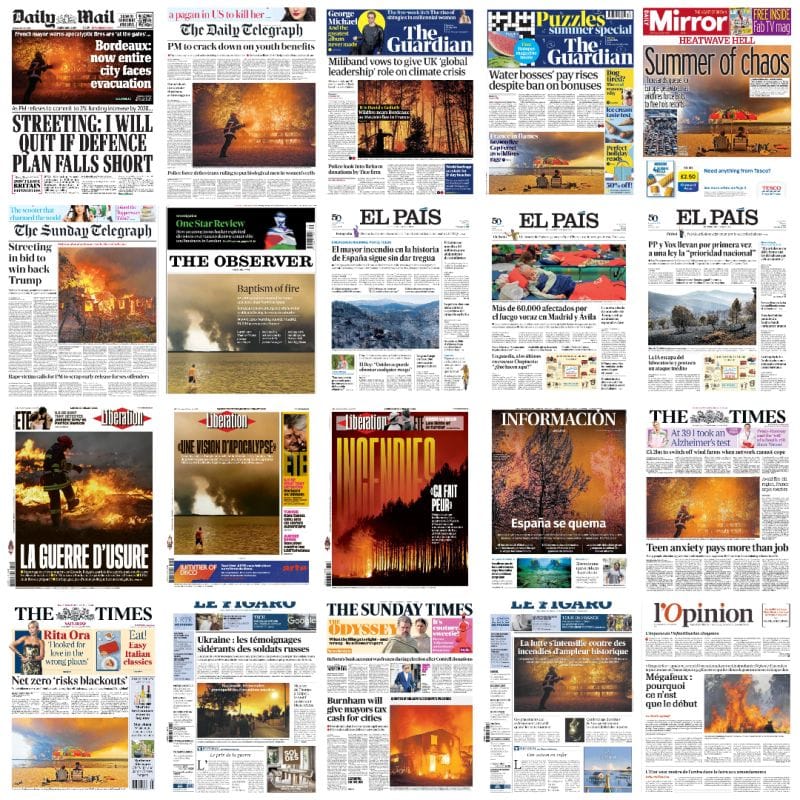
Source: Simon Evans, LinkedIn
This year has the additional warming influence of the El Niño, but it isn’t an anomaly. It’s a harbinger of a horrifying new reality that is not going away. As an excellent report from Bloomberg put it yesterday, we’re now in an “age of unstoppable wildfires”:
Climate change has made this “fire weather” more common, and more extreme. Europe is warming faster than any other continent, meaning that blazes of the kind that tore across Gironde are likely to become a new normal, pushing the boundaries of firefighters’ ability to stop them, and threatening urban areas and critical infrastructure, with enormous consequences for businesses, societies and economies.
“It’s not a matter of money. It’s not a matter of investment. It’s not a matter of how heroic the firefighters are,” said Raul Cordero Carrasco, a climate researcher at the University of Groningen. “You just cannot stop a fire when the conditions are so extreme as we have seen in recent days in Europe.”
But of the dozens of news stories I have read and watched about them, with an eye and ear keenly alert to any suggestion that the fires are largely a consequence of global warming, I have been mostly disappointed. At best, the speaker mumbled something about climate or fossil fuels at the end of a long segment that merely documented the damage. Not one story I have seen made the only point worth making, as I argued last week in NN#7: Climate change is the result of burning fossil fuels, and if we want to stop the world from burning, we have to stop burning fossil fuels.
It's a very simple message. Undoubtedly one that every commentator knows. So why won’t they just say it?
Obviously, fear of political backlash is a big part of it, and well it should be, given the Trump administration’s penchant for just abducting and detaining people for saying things if it doesn’t like.
Paul Krugman offered a bracing perspective on that in his post yesterday about the GOP’s “war on reality”:
What’s clear is that the war on reality is exacting a high price on America as a whole. […]
Climate denial and hostility to renewable energy will mean more pollution even as it consigns the U.S. to energy and economic backwardness. […]
But anyone pointing out the obvious is, of course, a Communist.
The politics around climate have also become intertwined in complex ways with the politics around many other social and religious issues, as the Conspirituality podcast detailed this week:
Climate reality keeps colliding with denial, erasure, and rebranding — across media, politics, and religion. Temu conspiritualists weave melted stories about the origins of wildfires, while the high-class guys run meditation-and-regenerative-farming spectacle backed by Exxon money. […]
Are religious institutions doing any better? In 2015, five world religions — Jewish, Catholic, Islamic, Hindu, and Buddhist — independently issued climate statements ahead of the Paris COP21 talks.
Fortunately, there are a few in politics, science and media who are not afraid to speak the plain truth.
In its coverage of the more than 800 wildfires burning across Canada, CBC News quoted University of Michigan climate scientist Jonathan Overpeck, who was refreshingly candid:
"When people talk about a perfect storm for something bad, that's what we're dealing with," Overpeck said.
"And the best way to solve it is to just stop burning fossil fuels."
Even better, the Ministers of Foreign Affairs of the United Kingdom of Great Britain and Northern Ireland and the Kingdom of Spain just issued a joint statement on wildfires and action on climate change, which pulled no punches:
Both parties agreed that tackling the climate crisis was an urgent policy priority for all countries- to tackle the cost of living, protect health and wellbeing, and to ensure European economic and energy security. The two Ministers noted that climate action was essential to protect not just current generations, but our children and grandchildren too. […]
The two Ministers emphasise the importance of adopting the necessary measures to drastically reduce our dependence on fossil fuels, strengthening cooperation on clean energy and supporting countries of the Global South in their energy transition. Both parties reaffirm the importance of international solidarity in addressing climate change, highlighting the need to tackle the disproportionate effects that climate change has on developing countries.
Communication breakdown
But we still have a lot of work to do in correcting misinformation and disinformation about climate change and its influence on record heat and wildfires.
The same CBC article cited a new post by climate scientist Zeke Hausfather, in which he explained that the nature of the forests and the fires burning across Canada is fundamentally different from the kinds of wildfires we have out West, and the challenge of communicating the science accurately while not downplaying the role of climate change:
So next time someone tells you Canada’s fires can be solved by raking the forests, you can point out that the thing filling their sky with smoke is a lightning-struck, drought-primed boreal forest doing what a warming climate is making it do more and more often.
Zeke was responding to the GOP’s reality-deniers who saw this not as an opportune time to have an adult conversation about climate change, but rather as a chance to blame Canada and demand to know “what they are going to do about [the smoke].” And to their credit, the authors of that Politico article did make the essential connection, albeit not as a statement of fact, but of assertions by “climate and health experts.”
But climate and health experts say climate change is behind the conditions that are making blazes like the ones in Ontario and northern Minnesota more likely and damaging.[…]
Scientists also say the extreme heat North America has experienced from coast to coast this summer has been worsened by climate change.
One would normally frame it as the opinions of experts and not simply facts if there were some sort of genuine scientific uncertainty about the reasons for these unprecedented wildfires.
But there isn’t.
And in case you happened to have come across a post on social media like this one, purporting to show that there were more hot days in the 1930s than there are now, especially from a self-declared “Politically incorrect” “Anti-Greta Thunberg”:
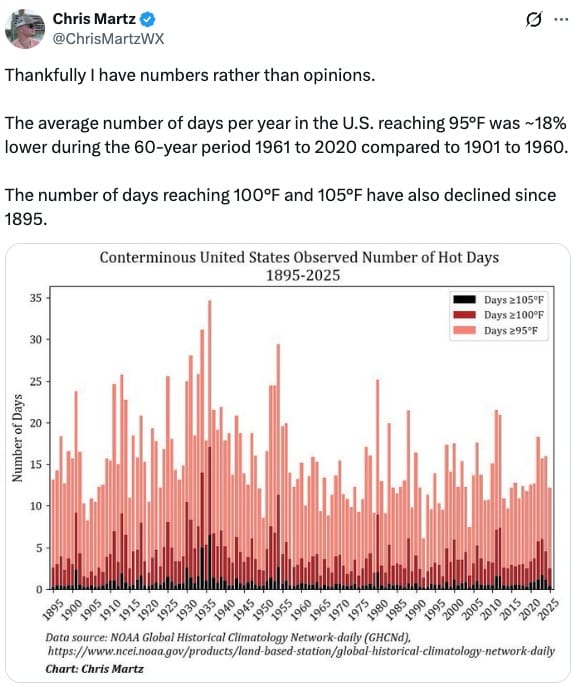
Source: X
…Zeke and his co-author, climate scientist Andrew Dessler, have you covered with a detailed explanation of what’s wrong with that data and what it actually shows when corrected:
So: next time you see a plot focusing on:
1. The U.S.
2. In the 1930s
3. Using raw, unadjusted GHCNd data
The argument is most likely a scam. Please hit the “share” button below and send them a link and use the hashtag #1930sScam.
And while we’re on the subject of what works and what doesn’t in climate messaging (again, do read TT#8 if you haven’t already), yet another new study shows what has been demonstrated again and again: Doom-focused messaging doesn’t work. This study looked at the dialogue about climate on social media, and explored “whether psychological inoculation, i.e., preemptively forewarning people of manipulation and exposing them to weakened dose (examples) of misinformation techniques alongside refutations, helps to build resistance against climate doom.” Their conclusion:
Overall, our results should lead climate communicators to reconsider doom messaging as a mobilization strategy and demonstrate that inoculation is an effective tool for increasing recognition of, and critical engagement with, climate doom across the political spectrum. […]
Further, given the potential adverse effects of doom content, improved discernment of climate doom may buffer the relationship between perceived manipulation and lower behavioral intentions. [..]
Inoculation significantly improved participants’ ability to distinguish doom from standard headlines. Critically, this improvement stemmed from increased skepticism toward doom messaging rather than heightened skepticism toward climate change communication overall. In addition, higher perceived manipulation of doom predicted lower behavioral intentions.
And if that’s all still a bit wonky, try this: If you teach people how to recognize when they are being manipulated by misinformation on social media about how we’re headed for climate doom, they’ll develop a resistance to it and become much more discerning in their understanding of what’s real and what’s not.
They might even start thinking about how they can respond to what’s real. Which is a good place to start, when that reality is up your nose, burning your eyes, destroying your villages, killing your people, flooding your streets, and generally wreaking havoc on all that you hold dear.
But there’s nothing to respond to if nobody tells them why it’s all happening.
Got an item you’d like us to cover?
We’d like Transition Times to help increase the visibility of all the great work that’s being done out there. So if you have an article, report, study, podcast episode, newsletter post, video clip or anything else that you think is worthy of a shout-out in Transition Times, email it to suggestions [at] transitiontimes [dot] net! We welcome all submissions, as long as they’re relevant to the energy transition.
Sources
Zeke Hausfather, “State of the climate: Rapidly developing El Niño raises chance of record-warm 2026,” Carbon Brief, July 26, 2026.
Damian Carrington, “‘Extremely scary findings’ show climate crisis is supercharging Europe’s wildfire weather,” The Guardian, July 31, 2026.
Kate Yoder, “As climate lawsuits advance, the oil industry enters ‘panic mode’,” Grist, July 24, 2026.
Kate Yoder, “‘Climate hushing’ has swept the Democratic Party. New polling suggests it’s a mistake,” Grist, July 27, 2026.
Gabriel De Roche, Matto Mildenberger, and Lucas Boyd, “Polling: Politicians Shouldn’t Hide From Climate,” The 2035 Initiative, University of California, Santa Barbara, July 2026.
Chris Nelder, “Rethinking Climate Policy: Incentivize, Don’t Penalize,” Energy and Capital, July 10, 2009.
Episode 280 – Statistical Review of World Energy 2026, Energy Transition Show, July 15, 2026.
Nayla Razzouk, Clara Hernanz Lizarraga, Sabrina Nelson Garcinuño, Olivia Rudgard, Joe Wertz, Raeedah Wahid, and Vivien Ngo, “The Age of Unstoppable Wildfires Has Reached Europe,” Bloomberg, July 30, 2026.
Sam Levin, “The professor facing prison in ‘antifa’ case: ‘They want to scare all who oppose ICE’,” The Guardian, July 28, 2026.
Paul Krugman, “Reality is a Communist Plot,” Paul Krugman, July 30, 2026.
Episode 319: Climate Conspirituality, Conspirituality, July 30, 2026.
Kenton Gewecke and Ivan Pereira, “Raging wildfires spread through Canada; smoke to hit US Midwest, East Coast this week,” ABC News, July 14, 2026.
Inayat Singh, “'Just stop burning fossil fuels.' Scientists stress that our smoky skies have only one true fix,” CBC News, July 18, 2026.
Zeke Hausfather, “Canada's boreal wildfires aren't just bad forest management,” The Climate Brink, July 17, 2026.
Jean Chemnick, Amelia Davidson and Chelsea Harvey, “Trump threatens Canada over wildfire smoke choking U.S. cities,” Politico, July 17, 2026.
Andrew Dessler and Zeke Hausfather, “Raw Data, Wrong Answers,” The Climate Brink, July 27, 2026.
Press release: “Joint Statement by the Ministers of Foreign Affairs of the United Kingdom of Great Britain and Northern Ireland and the Kingdom of Spain on Wildfires and Action on Climate Change,” Foreign, Commonwealth & Development Office and The Rt Hon Ed Miliband MP, July 29, 2026.
Rachel O’Boyle, Tyler Shores, and Sander van der Linden, “Psychological inoculation against climate doom”, Proceedings of the National Academy of Sciences of the United States of America, Vol. 123, No. 31, July 28, 2026. DOI: https://doi.org/10.1073/pnas.2609074123.
We never use AI to produce any of the written or spoken content you find on Transition Times. We do use AI as a research tool (and vet the information so received).
We also occasionally use AI to generate graphics and sounds.