
TT#13 – Unlocking DERs’ Potential
The bulk of renewable energy and storage capacity added to the grid thus far has been from large, utility-scale systems. But the potential for smaller distributed energy resources (DERs) is enormous, and some regions of the world are figuring out how to unlock it.
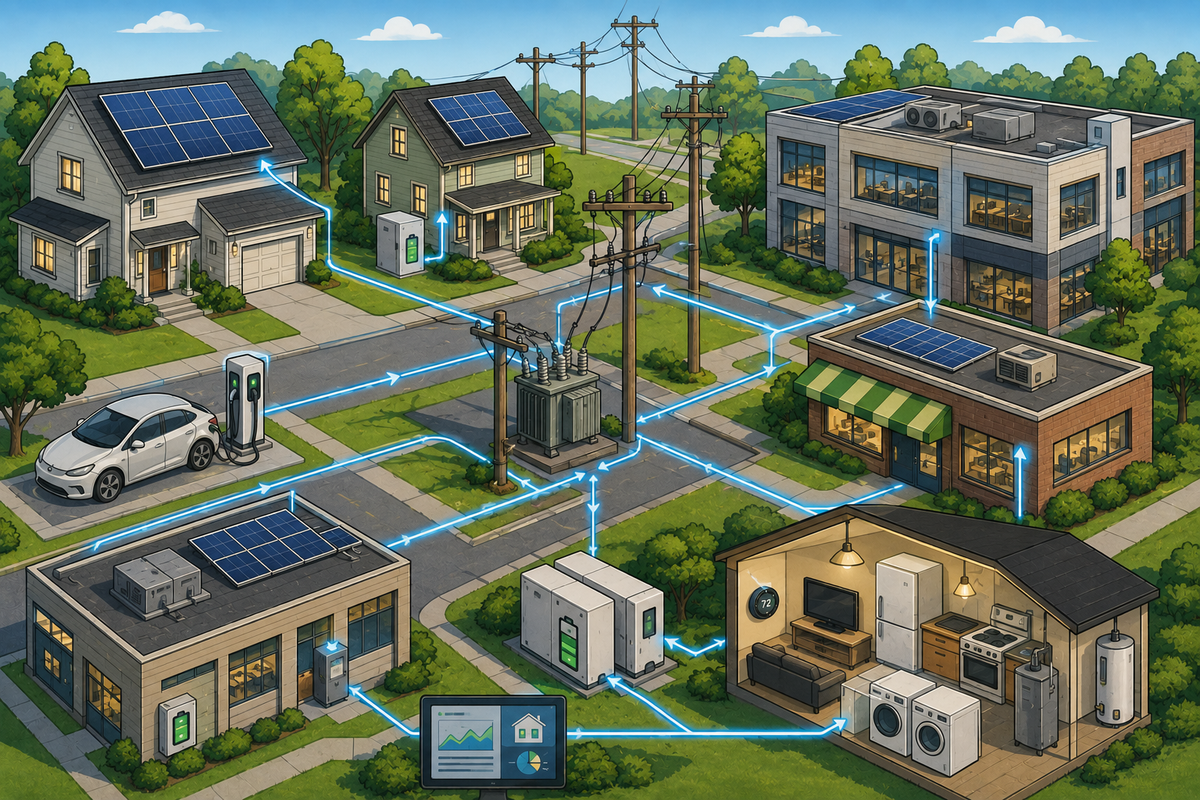
Distributed energy resources (DERs) are gaining fresh attention globally, driven by both ends of its market. On the supply side, they are increasingly seen as fast and cost-effective ways to get more renewable energy onto the grid. And on the demand side, they’re being recognized as a way to manage grid stress and make it easier to integrate everything from EV chargers to residential battery systems and heat pumps.
In New York City, the Comptroller has just issued a report recommending that the city deploy DERs on its own buildings and other facilities, noting that “Power disruptions, volatile energy prices, and delayed infrastructure investments impose significant costs on taxpayers, while strategic investments in DER can reduce long-term operating expenses, attract private capital, and strengthen the City’s energy security.” From the report [emphasis mine]:
This report recommends that New York City adopt a comprehensive distributed energy strategy. The City should treat parking lots, fleet depots, public buildings, and other municipal properties as a coordinated portfolio of energy assets capable of generating electricity, storing energy, supporting electric vehicle charging, participating in energy markets, and strengthening neighborhood resilience.
The City is well positioned to lead. City analyses have previously identified approximately 400 MW of battery storage potential on City-owned parking lots and vacant land, with roughly 300 MW already passing initial agency review[1].
By treating DER projects as a coordinated portfolio rather than a series of stand-alone installations, the City can attract long-term institutional investors, lower financing and procurement costs, and deliver greater value for taxpayers. […]
A recent analysis by Synapse Energy Economics found that expanding distributed solar and storage across New York could generate approximately $1 billion in annual avoided energy costs by 2035, including nearly $481 million in downstate benefits. The study estimated average annual bill savings of approximately $46 for downstate residential customers, regardless of whether they personally own solar or battery systems.
Those not inclined to dig into the whole report may prefer the short summary offered by Elisa Wood on her Substack:
To overcome these hurdles and leverage the energy potential in these properties, the report makes several recommendations:
Build a citywide solar and storage portfolio. […]
Streamline permitting and interconnection. […]
Advance clean-energy legislation. […]
Capture available federal and state funding. […]
Support the clean-energy workforce. […]
Appropriately, Elisa’s summary offers a shout-out to Lorenzo Kristov, who received a very nice tribute for his many years of DER advocacy on Jigar Shah’s blog in June. On my previous platform, the Energy Transition Show, I had the privilege of interviewing Lorenzo four times, in Episodes 10, eLab Extra #3, 94, 150, and 205.
The Comptroller’s strategy is very ambitious, and frankly exactly the sort of city-wide embrace of DERs for which advocates (including me) have been waiting for what feels like decades. The report is richly detailed, so if you’re in any way connected to city planning somewhere else in the world, I encourage you to check it out and see what ideas can be adapted to your local context.
Helpfully, the report points to several other regions that are exploring similar strategies:
A useful model comes from Austin, Texas, which recently launched a 30 MW municipal solar portfolio across City-owned properties. The initiative combines City-owned projects that generate direct energy savings with third-party-owned projects that leverage private capital and community solar participation. Austin estimates the portfolio will generate more than $20 million in net value over 25 years, illustrating how municipalities can use public assets to advance clean energy goals while creating long-term fiscal benefits.
Across the Atlantic, in 2023, France enacted legislation requiring most large outdoor parking lots with at least 1,500 square meters (approximately 16,000 square feet) to be covered with solar canopies over a phased implementation period. […] The highest profile project completed near Paris is the parking canopy at Disneyland Paris covering 11,200 parking spaces across 49 acres with total installed capacity of 36 MW.
Finally, the Croton-Harmon Train Station in Westchester County demonstrates how publicly owned parking facilities can be transformed into revenue-generating clean energy assets. Seeking to increase revenue without imposing additional costs on taxpayers, the Village of Croton-on-Hudson partnered with a private developer to install solar canopies over portions of the station’s commuter parking lots while retaining ownership of the underlying property.
New Mexico has also received accolades for its DER integration strategy. It was the only state to earn an “A” for its DER interconnection practices according to the latest update to “Freeing the Grid,” a joint analysis and scorecard by Vote Solar and the Interstate Renewable Energy Council.
“Freeing the Grid” highlights that state-level interconnection bureaucracy has an important role to play in helping or hindering the deployment of distributed energy resources. It examines statewide interconnection policies using more than 50 criteria across 10 categories covering general interconnection rules, review processes, timelines, costs, energy export provisions, data sharing and dispute resolution.
And if all that sounds bureaucratic and technical and incredibly boring… yep. And that is exactly where the actual work of improving interconnection practices in order to bring more DERs onto the grid must happen. There are no shortcuts, especially in these blessed United States, where every state has its own set of policies and processes and interconnection rules and utility system governance.
That is also, incidentally, a big part of the reason why other parts of the world, like Australia, are able to build a residential solar system for as little as one-third to one-half the cost of an equivalent system in the US. Darren Miller, the CEO of ARENA, an Australian investment fund for early-stage renewable energy technologies, explained it to me this way in my interview with him in Energy Transition Show Episode 247 (part of my Australia miniseries based on my research trip there in 2024):
It's always puzzled people why it's so cheap in Australia, relative to say the US for example, in terms of rooftop solar, you can go online and look for a 10 kilowatt system for under $10,000. So less than a dollar a watt fully installed and grid connected. And you can probably get that done within a month. Like if you wanted a solar system within 30 days, I imagine it would be working on your roof. Like it's just really quick. And I actually ran the asset finance side of the US business called Sungevity back 10 years ago... So I remember the contrast that Australia was just this amazing place for them because just the speed of installation and the low cost nature of it, we've just done really well at removing all barriers. We've just never put up barriers to solar penetration at the rooftop level in Australia, the way it is elsewhere and every electrician can easily get their solo license. So you've got 17,20,000 electricians who could easily be licensed to be solar installers. So it's just been democratized if you like amongst the trades to get that done. And I'd say if the world is sitting there wondering how do they get their solar costs for roof to solar down just come to Australia and study the way we do it here. I imagine it's world leading. It's a phenomenon really. So that's the one side of it. And surely we all want the rooftop solar market to grow to as big as it can be. You're not interfering with land. You've got grid connection ready to go. There's a lot of good reasons why... you're in the distribution network already.
Australia just issued another policy that could result in an absolutely huge expansion of its distributed solar energy production: It expanded eligibility for the government’s marquee rooftop solar incentive, which offers roughly 20% discounts on installations of rooftop solar systems, from systems up to 100 kW in size to systems up to 1 MW in size. In one fell swoop, this new policy could finally make it feasible to install very large rooftop solar systems on huge commercial and industrial rooftops (like warehouses). That is something that really hasn’t taken off anywhere in the world to my knowledge, and has frustrated me for decades, every time I have flown in or out of somewhere and looked down at all that unused rooftop space. Climate Change and Energy Minister Chris Bowen, who leads the program (and who I interviewed in Canberra for Energy Transition Show Episode 246), apparently shares that frustration [emphasis mine]:
The upgraded solar scheme is directly linked with a government push to accelerate the renewables rollout and utilise larger rooftop space outside residential homes and apartments. Supporting a broader rollout is expected to lower both network costs and power bills for businesses less reliant on the grid.
Institute for Energy Economics and Financial Analysis [IEEFA} data says businesses have installed about 5.6 gigawatts of solar systems compared with 22 gigawatts installed on residential rooftops.
Mr. Bowen on Wednesday will say that while estimates vary, “the technical rooftop potential for solar on commercial, industrial and agricultural rooftops could exceed 80GW”.
Under Labor’s shake-up, the government will commit to improving network connection processes for mid-scale solar projects through targeted rule change requests and improvements to existing frameworks. […]
The expanded solar program, lowering upfront installation costs for commercial, industrial, and agricultural buildings by about 20 per cent, is expected to deliver savings of almost $200,000 for some businesses. The impact of compliance costs on bills is expected to be small, in the order of $1 to $2 a year, which the government says is designed to reduce each year to 2030. […]
“When asking what more we can do, the key is identifying gaps in progress. Utility scale solar is going well. Rooftop household solar continues to break records. But, to be very frank, there is a missing middle in Australia’s energy transition.
“Many of you in this room have to spend plenty of time on aeroplanes for work. You might have noticed when you come in to land the prevalence of solar on residential rooftops – you’d see more solar panels than backyard pools.
“But have you also noticed that many warehouse and factory roofs are devoid of solar panels, or only have panels covering fairly small percentage of the roof space?
“The missing middle is mid-scale solar. Factories, warehouses, farming sheds and large industrial premises – big empty roof space ripe for solar generation.” […]
(For more on the “missing middle,” check out my interview from October 2025 with CEO Marc England of Ausgrid, the distribution utility serving Sydney, in Energy Transition Show Episode 263.)
The cited IEEFA analysis is definitely worth a look as well. Not only does it estimate the potential for various kinds of installations, it also identifies the key barriers to commercial and industrial (C&I) solar and storage systems:
Distorted business-level investment barriers: Businesses often rent their premises, making investment in long-lived assets more complex, and businesses often have many competing priorities in terms of capital allocation. Solar and storage projects in businesses are often too big to qualify for residential incentives and too small to qualify for utility-scale incentives.
Patchwork network tariffs: Complex and inconsistent network tariff structures make it difficult for businesses to model investment returns, develop software and control systems to manage batteries, and scale up business models.
Grid connection issues and delays: A fragmented, slow and unpredictable grid connection process adds to costs and delays for solar and storage projects in businesses, which can take anywhere from a few months to a year or more with numerous studies and revisions.
Uneven playing field for network services: Regulatory processes hinder business solar and storage providers from competing with networks to help address identified network needs.
If you find your eyes glazing over and your brain turning off at that, I get it. But if you want some sausage, then come on into the sausage factory and put on some gloves, because this is how it’s made.
Although this is another technical bureaucratic tangle to sort out, I am hugely excited about the new policy. If Australia is able to sort this out and unlock the potential for C&I installations, it could become a model for the rest of the world (just as their residential solar and storage policies have been) that could unlock a massive amount of new distributed solar generation globally.
IEEFA has also just issued another briefing that draws on a comparative analysis of policies in India, Australia, and Bangladesh to explore the potential for DERs. Titled “Role of distributed resources in energy transition: A multi-country perspective”, finds that rooftop solar has emerged as the single biggest driver of DER growth [emphasis mine].
Government-led schemes have driven India's DER growth, particularly solar. Subsidies, concessional finance, and supportive policies have accelerated rooftop solar and agricultural solarisation, increasing distributed solar capacity from 1.8GW in financial year (FY) 2018 to 31.5GW in FY2026.
In Bangladesh, rooftop solar has grown faster than other DERs. While government data reports 418.1 megawatts (MW) of rooftop solar capacity till June 2026, IEEFA estimates it has reached 667MW in 239 establishments, including groups of companies. If the assessment were to include units below 0.15MW, Bangladesh’s rooftop solar capacity might already be around 1,000MW. This growth has contributed to a slight decline in daytime power demand, based on comparisons between 16 April–11 June 2024 and the same period in 2026.
In Australia, solar panels are now installed on 40% of homes. Supported by early feed-in tariffs and government rebates, rooftop solar grew from near-zero to 13% of total electricity generation in the country’s largest electricity grid between 2014 and 2025, while coal’s share declined from 75% to 52%. Australia is now experiencing a boom in residential batteries, with nearly 10 gigawatt-hour (GWh) capacity installed less than a year since federal rebates were introduced.
Meanwhile, in the US, Trump’s Department of Energy has canceled or stalled funding for thousands of projects that would improve the country’s stressed grid, reports Jeff St. John for Canary Media:
Across the country, hundreds of such projects to improve grid reliability and make electricity more affordable face a highly uncertain future — the result of Trump administration actions that have slowed the outflow of billions of dollars of DOE funds to a trickle. […]
According to an April report from the DOE Alumni Network, a group of former agency employees, the DOE has announced the termination of 356 awards totaling $12.5 billion since January 2025, and has threatened to terminate 303 additional awards worth $12.2 billion. […]
“DOE both overtly canceled a set of projects, then had this pattern of behavior where for 15 months they stopped actively managing projects,” said one former DOE official. “Projects can’t proceed to the next stages and get their next tranche of funding.”
The former official, who asked not to be named, described a pattern of stalling, stonewalling, and “ghosting” utilities, state governments, energy companies, and nonprofit groups awarded grants under the Biden administration.
But that’s just one of a set of new attacks that the Trump administration has launched on the energy transition. The FCC also just classified foreign-produced power inverters as national security threats, which will make it much more difficult and expensive to buy and install inverters, which are the heart of a solar and battery system [emphasis mine]:
Adding to the complexity, the FCC defines a “foreign produced inverter” as any inverter that does not meet Buy America Act standards—meaning not only must the final product be made in the US, but 65% by value must consist of US components.
That means inverters currently being manufactured in US factories could still be classified as “foreign produced” and therefore prohibited from sale under the new rule.
According to industry forecasts, the US domestic inverter market will likely meet only 40% of combined solar and battery demand for 2027. Any significant disruption to imports could have a chilling effect on both markets.
Not content merely to wreck the grid-improvement pipeline and chill the market for solar inverters, Trump also just unveiled new tariffs, effective December 4, that will make it more expensive to import solar modules made in China while benefitting a tiny group of vertically integrated US solar module manufacturers:
Domestic semiconductor manufacturing depends on solar because the solar industry's larger demand for polysilicon helps support production of the material required for chips. The chip industry accounts for 2.4% of global polysilicon demand, according to the Semiconductor Industry Association.
U.S. solar manufacturing has expanded since Congress created tax incentives in 2022. Much of that growth, however, has been concentrated in panel assembly, leaving manufacturers dependent on imported wafers and cells, which require longer investment timelines.
Companies with U.S. solar factories, including T1 Energy (TE.N), opens new tab, First Solar (FSLR.O), opens new tab and Qcells, the U.S. solar arm of South Korea's Hanwha (000880.KS), opens new tab, applauded Trump's move.
And that’s the flip side of the 50-state topography of DER policy and utility regulation: Even when the federal government is leaning on protectionist trade policy instead of investing in capacity, and doing all it can to stifle the energy transition in the US, the states—like New York and California and New Mexico and Texas—are still able to move the ball forward.
Got an item you’d like us to cover?
We’d like Transition Times to help increase the visibility of all the great work that’s being done out there. So if you have an article, report, study, podcast episode, newsletter post, video clip or anything else that you think is worthy of a shout-out in Transition Times, email it to suggestions [at] transitiontimes [dot] net! We welcome all submissions, as long as they’re relevant to the energy transition.
Sources
“Meeting New York City’s Energy Demand Challenge — How Local Distributed Energy Can Strengthen Energy Security, Lower Costs, and Improve Resilience,” New York City Comptroller Mark Levine, July 22, 2026.
Elisa Wood, “New York City Discovers the Financial Logic of Bottom-Up Energy Planning,” Substack, July 31, 2026.
Jigar Shah, “A Tribute to Lorenzo Kristov: Designing the Grid From the Community Up,” Energy Empire Podcast, July 13, 2026.
Lorenzo Kristov on Episode 10 – Grid Architecture of the Future, Energy Transition Show, February 10, 2016.
Lorenzo Kristov on eLab Extra 3 – Grid Modernization and DERPs, Energy Transition Show, January 4, 2017.
Lorenzo Kristov on Episode 94 – Integrated Decentralized Power Systems, Energy Transition Show, May 1, 2019.
Lorenzo Kristov on Episode 150] – Resilient and Reliable Power, Energy Transition Show, June 23, 2021.
Lorenzo Kristov on Episode 205 – Rebuilding the Grid from the Bottom-up, Energy Transition Show, August 23, 2023.
Brian Martucci, “New Mexico has the nation’s best DER interconnection policy: report,” Utility Dive, May 28, 2026.
Freeing the Grid, Vote Solar and the Interstate Renewable Energy Council.
Darren Miller on Episode 247 – Resilient and Reliable Power, Energy Transition Show, April 9, 2025.
Geoff Chambers, “Businesses offered 20 per cent solar discount to help fix faltering renewables target,” The Australian, August 4, 2026.
Peter Hobson, “Australia cuts cost of rooftop solar for businesses,” Reuters, August 4, 2026.
Marc England on Episode 263 – The Role of Distribution Utilities, Energy Transition Show, November 19, 2025.
“Businesses left behind in Australia’s rooftop solar and storage stampede,” IEEFA, June 9, 2026.
“India's distributed renewables hold vast potential, with rooftop solar leading the way,” IEEFA, August 04, 2026.
Shafiqul Alam, Jay Gordon, and Gaurav Upadhyay, “Role of distributed resources in energy transition: A multi-country perspective,” August 4, 2026.
Jeff St. John, “Trump is blocking billions of dollars of grants that would fix the grid,” Canary Media, August 6, 2026.
April Bonner, “Concerns over lack of clarity, transparency as US bans foreign power inverters,” Energy Storage News, August 3, 2026.
Nichola Groom and Alexandra Alper, “Trump unveils trade actions to compete with China on solar and chips,” Reuters, August 6, 2026.
We never use AI to produce any of the written or spoken content you find on Transition Times. We do use AI as a research tool (and vet the information so received).
We also occasionally use AI to generate graphics and sounds.