
TT#18 – EVs Are Dusting ICE
After many years of slow market penetration, electric vehicles are finally hitting their stride in 2026 thanks to soaring oil prices, a more robust selection of affordable options, and favorable policies. Even V2G is finally off the starting line. Oil-burners are getting left in the dust.
IN BRIEF
- Electrified cars took a 69% market share in the EU for the first nine months of 2026.
- Sales of fossil-fueled ICE cars crashed across Europe to just a 28% market share.
- V2G is finally getting the green light in Europe and Tesla is enabling it for some of its vehicles.
If you appreciate my work, please support it by becoming a Premium subscriber now.
One of the key themes we’ve explored this year is how EV sales are accelerating globally in response to the soaring cost of fossil fuels due to the wars in Iran and Ukraine.
We could see some early indications of that starting in the spring, after the first few months of the Iran war and the closure of the Strait of Hormuz (see TT#2 and NN#2). We updated that story in June, in TT#6.
But now with a few more months of data behind us, the response from the automotive sector is unmistakable. Reuters reports that in 17 key European markets—including several high-EV countries outside the EU, like Norway—BEVs have snatched about a third of the new-car market:
Battery-electric vehicle (BEV) registrations in Europe rose 70.3% in September, as high oil prices, subsidies and the availability of more affordable models continued to lead the growth.
Around a third of cars sold across 17 key European markets in September were BEVs, data from E-Mobility Europe, New Automotive and Fier Automotive showed on Monday, amid a deal made by France and Germany to soften proposed EU car emissions rules.
· BEV registrations reached 300,202 vehicles in September, giving fully electric cars a 32.6% market share
· 1.98 million BEVs have been registered across Europe so far this year, up 38.1% from the same period in 2025
· France hit a 41.7% BEV market share with 65,243 registrations, while Germany's share reached 34.6% with 88,724 registrations.
· The Nordic market remained Europe's most electrified, led by Norway at 98.8% and followed by Denmark (88.8%), Finland (62.7%) and Sweden (49.0%).
· BEVs accounted for around half of the registrations in Ireland, Portugal, Belgium and the Netherlands
· The Czech Republic, Italy and Poland remained among Europe's least electrified markets at 11.2%, 7.6% and 6.2%, respectively.
Looking across the 27 countries of the EU proper, ACEA reports that the market share for BEVs over the first nine months of the year was about 22.7%, including a leap to about 30% in September:
Up until September 2026, battery-electric cars secured a 22.7% share of the EU market, up from 16.1% a year earlier. Hybrid-electric car registrations captured 36.3% of the market, remaining the preferred choice among EU consumers. At the same time, the combined market share of petrol and diesel cars fell to 28.2%, compared with 36.9% a year earlier.
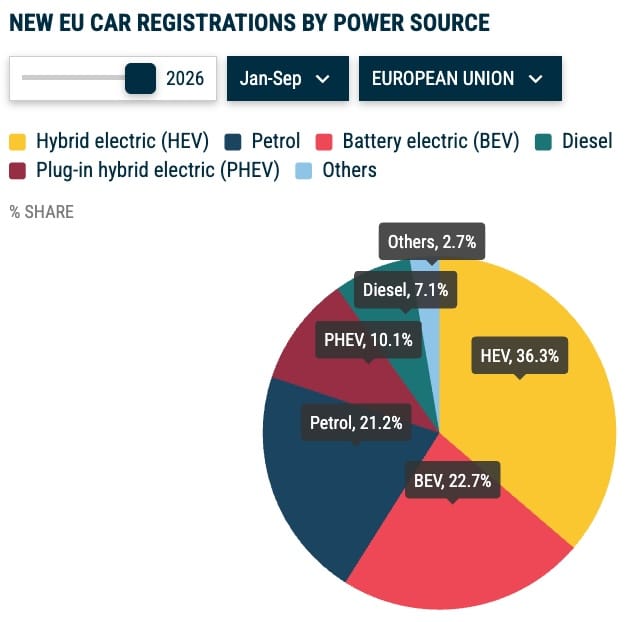
That swing in market share, with BEVs picking up 6.6 points of market share while fossil fueled cars lost 8.7 points, is unusually sharp, and indicates a clear shift from internal combustion engine (ICE) vehicles to electric models.
But it’s actually even more startling than that:
By the end of September 2026, petrol car registrations continued to decline, falling by 19.1%, with significant downturns across all major European markets. France saw the sharpest decline, with volumes plunging by 36.1%, while other key markets also posted double-digit losses: Germany (-22.7%), Spain (-19%), and Italy (-16.4%)
And the growth rates of EV sales in the largest EU markets are not to be missed:
Three of the four largest EU markets, which together accounted for 64% of all battery-electric car registrations, recorded strong growth: France (+79.1%), Germany (+58.1%), and Denmark (+40.3%). Belgium also posted a more moderate 15.7% increase.
It’s worth looking another level deeper at the French data. According to French data engineering company AAADATA, sales in September 2026 shows roughly equal market shares for BEVs (at 42%) and hybrids (43%), while ICE vehicle sales are falling off a cliff to a mere 15% combined market share:
The market in September 2026 continues the momentum observed since the beginning of summer, in a context of a calendar significantly different from that of September 2025. […]
Internal combustion engines saw a marked decline. Sales of gasoline cars fell by 39% to 16,391 units (10% market share), and diesel car sales by 62% to 2,412 units (2% market share). This decline occurred against the backdrop of stricter taxation and record-high fuel prices in September, driven by geopolitical tensions in the Middle East. Sales of gasoline-LPG vehicles increased by 23% to 5,234 units (3% market share).
Trucks have joined the party
For the many years that I’ve been observing the electrification of mobility, electric trucks were always a bit of an ever-nascent sector, with very modest, single-digit market shares. For the longest time, that gave hydrogen fuel-cell boosters one last peg they could hang their hats on, on the theory that if there were a hydrogen-refueling infrastructure suitable to meet the needs of commercial trucking, fuel cell vehicles (FCV) could more easily meet the requirements of long-haul trucking for weight and distance.
I never bought that argument, personally, because I didn’t see any combination of industrial players and policy coming together to build such a thing when the price of EV batteries was dropping like a stone year after year. And lo, that refueling infrastructure never materialized while EV trucks got more and more fit for purpose.
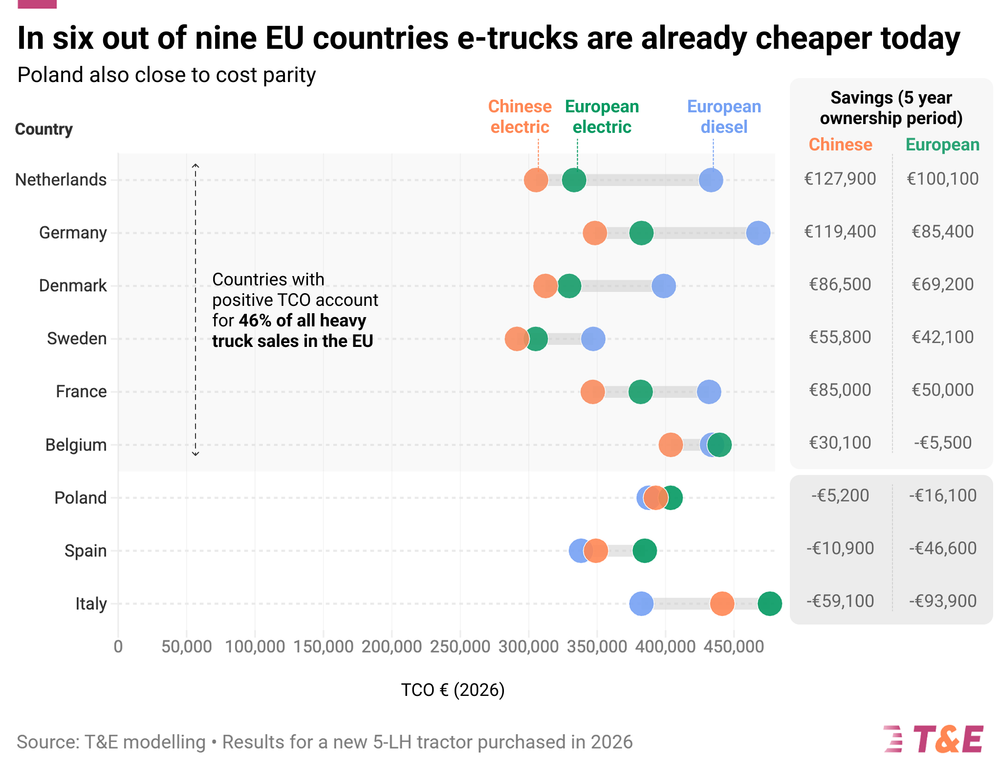
So I was pleased to see Justin Gerdes’ roundup of new data on electric truck sales globally. He points to BNEF data showing that electric truck sales have finally hit double-digit market shares in Denmark, Netherlands and Sweden, and 20% in China. The reason? They’re finally cheaper than the ICE equivalents on a total cost of ownership (TCO) basis. That may not be how people typically think about a car purchase, but it absolutely is how fleet managers decide which trucks to buy:
A report published last month by the campaign group Transport & Environment (T&E) finds that electric trucks deliver a lower total cost of ownership in six out of nine major EU markets. The six markets (Belgium, Denmark, France, Germany, the Netherlands, and Sweden) together account for 46% of all new heavy trucks sold in the EU.
Justin also highlights a novel “social leasing” approach that France is taking to make EVs affordable for low-income households:
“Allow low-income households to lease an EV for less than €200 a month over three years, without a deposit. The government subsidizes a large share of the cost in cooperation with carmakers. Drivers can return the car when the lease ends, or buy it.”
“Since 2024,” they write, “social leasing has helped finance 100,000 cars, and 36,000 people have already applied for the 50,000 EVs on offer since the latest funding round kicked off in July – a figure the French government said proves the program’s success.”
Just this week, French officials launched a similar program with a goal to finance 55,000 heat pumps over the next two years.
Bravo! I’ll be very interested in seeing how both of those incentives perform.
An axis of wrongness
The collapse of the ICE car sector in France sheds a rather interesting light on the recent meeting of the EU member states, which saw a policy proposal mooted that would employ French protectionism and German ambition-reduction to try to sustain their ICE manufacturers as they circle the drain. As Alan Beattie reported for the FT, “It’s a particular genius to take the worst ideas from both sides and synthesise them into an axis of wrongness.”
The proposal envisages:
The watering down of the 2035 phaseout of combustion engines, with manufacturers now able to achieve only a 90 per cent reduction in carbon emissions without having to offset the remaining 10 percentage points elsewhere. The plan would also introduce multiyear target periods to give carmakers more flexibility around timing. (The German bit.)
A new category of vehicles powered exclusively by renewable fuels, including e-fuels and biofuels, as long as — of course! — they are produced in Europe. (Another German bit.)
The inclusion of the UK (though not Turkey, South Korea or Japan) in the “made in Europe” subsidy and public procurement rules as they apply to the car industry, as long as London adopts “full reciprocity” with Brussels, including aligning with conditions on investment from third countries. (The French bit.)
But protectionism and watered-down electrification targets only get you so far, when the basic problem is chronic overcapacity, as Liam Denning writes for Bloomberg:
About 85 million new passenger vehicles will be sold around the world this year, according to a new report from BloombergNEF. Yet the global industry is capable of churning out 142 million vehicles. […]
The shift to EVs exacerbates the problem of excess capacity, as not only Chinese EV makers but startups such as Rivian Automotive Inc. open their own dedicated assembly lines. While dedicated capacity for producing gas-guzzlers is projected to decline by about 5 million units by 2030, more than 10 million vehicles’ worth of mixed and EV-only capacity is expected to open in the same period.
A healthy industry demands that capacity be taken out of the system. As trade restrictions grow, that process must center on China, home to only a quarter of global vehicle sales but more than a third of its manufacturing capacity. There is, however, a deal to be struck that could help with this process, with the US leading the way.
As much as US automakers are shielded from Chinese competition for now, they also risk irrelevancy and condemning American drivers to unaffordable vehicles under perpetual protectionism. Accommodating Chinese competition through mandatory joint venture plants in the US offers a way of importing needed know-how and technology without sacrificing the domestic industry altogether (as I have argued here).
Those who followed my prior work on the Energy Transition Show podcast will know that joint ventures with China regularly surfaced as intelligent approaches to some of the thorny problems of the mid-transition, offering legacy Western manufacturers a way to survive the Schumpeterian creative destruction required by the energy transition while embracing the newer, better technologies produced by China. It’s just good industrial policy, albeit one that’s harder to sell to jingoistically-minded politicians.
China still leading
According to the latest data from the China Passenger Car Association (CPCA) and reported by Lekai Liu for Carbon Brief, new-energy vehicles (NEVs) made up a record two-thirds of new car sales in China in September. (China uses “NEVs” to refer to the entire group of electrified vehicles, including fully-electric battery electric vehicles and plug-in hybrids.)
That’s up from just 6% of sales six years ago.
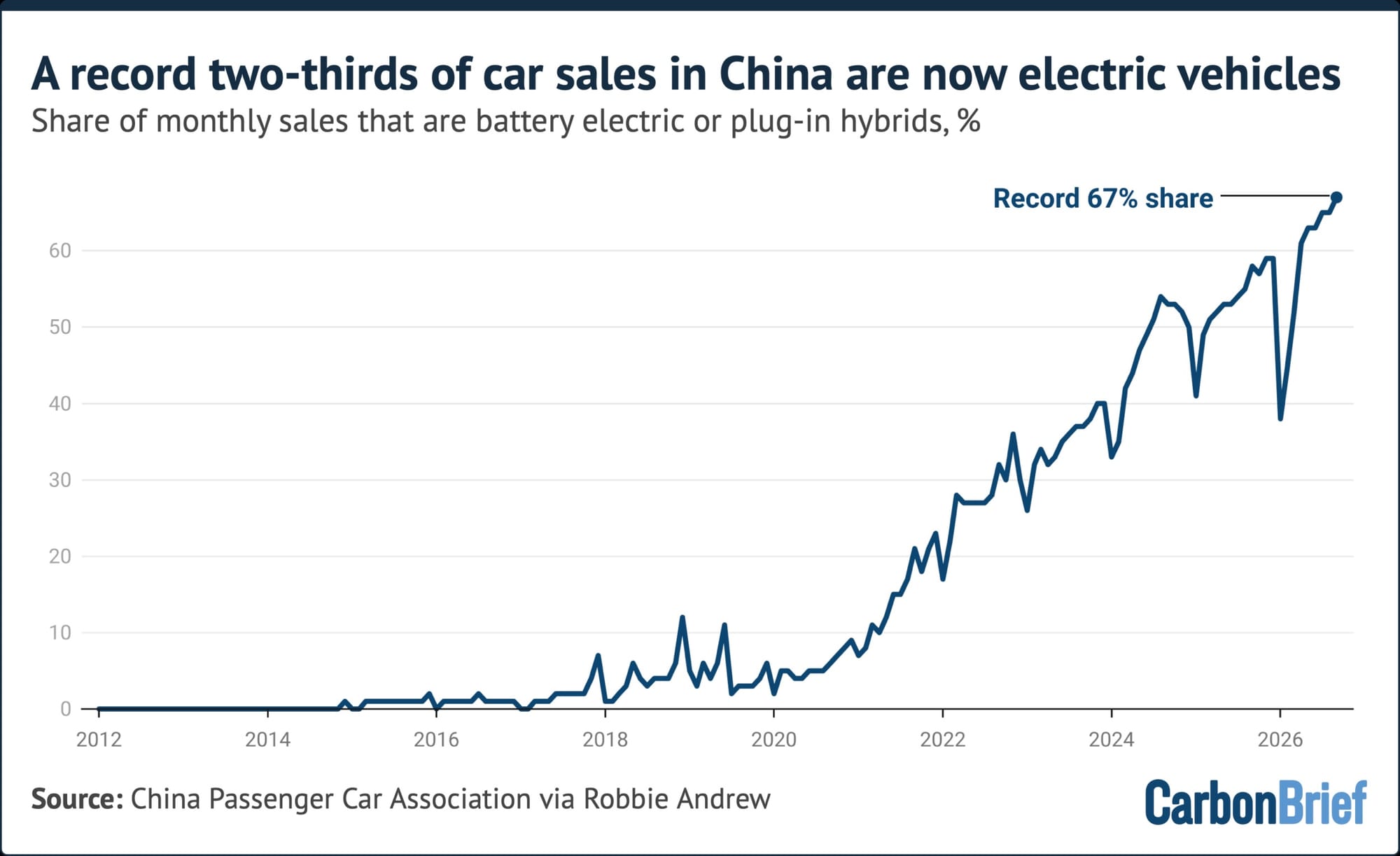
That has helped China weather the soaring cost of fuel better than most:
Cui Dongshu, secretary-general of the CPCA, cited higher petrol prices as an explanation for September’s weak combustion-car sales, in comments to financial news outlet National Business Daily.
Imports of oil into China in January-September have fallen 15% compared to 2025, equivalent to 470m barrels, as ongoing conflict tightened supply and drove up prices.
China’s passenger-car NEV fleet has displaced 143m barrels of oil so far during the strait of Hormuz crisis, Euan Graham, senior energy analyst at thinktank Ember, tells Carbon Brief. […]
Erica Downs, a senior research scholar at Columbia University’s Center on Global Energy Policy, tells Carbon Brief that the strait of Hormuz crisis and higher oil prices are “reinforcing China’s electrification of road transport”.
She says the “world’s largest oil supply disruption” vindicates China’s early bet on EVs, which was partly driven by concerns about oil-supply security.
As the article notes, sales of ICE cars in China peaked in 2017 and have been declining ever since.
China remains the top exporter of EVs to the world, with Chinese carmakers’ exports of NEVs more than doubling in 2026 (as of September). Which, again, supports Denning’s suggestion that it would be smarter for European partners to partner with them rather than attempting to bar the door against them.
V2G materializing
Another huge promise of vehicle electrification that has always seemed to recede into the horizon, like a mirage, is the possibility of using the large batteries in vehicles as battery backups for home (“V2H”) or for the power grid (“V2G”). It seems we might finally be breaking through the barriers to adoption there as well.
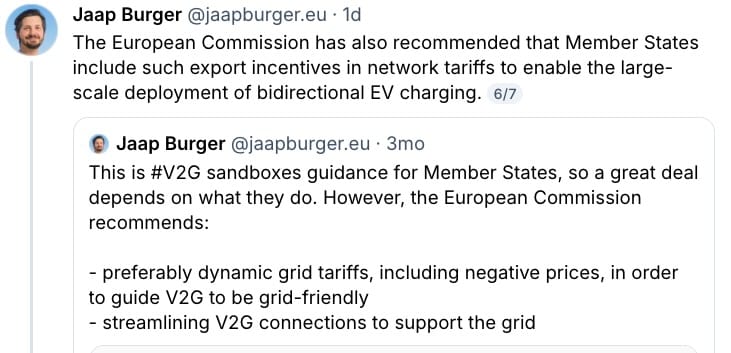
As EV smart charging and V2G expert Jaap Burger (formerly of the Regulatory Assistance Project) detailed on his recent thread on Bluesky and Mastodon, several countries are finally trialing bidirectional tariffs that would support the business case for selling energy back to the grid, including Australia, Switzerland, France, and Brussels. And the European Commission is laying the groundwork for true V2G:
The energy regulator in Germany has just formally made V2G and V2H legal, Kirsti Knolle reports for Reuters, which is an enormous step in the right direction:
Germany's energy regulator on Thursday issued new rules allowing electric vehicle owners to use car batteries to power their homes or feed electricity back into the grid, a breakthrough for vehicle-to-grid technology after the agency revised its draft following industry criticism.
And Tesla recently introduced a proprietary solution that will enable V2H:
Tesla has introduced Powershare Home Backup for new Model 3 and Model Y vehicles in the U.S., bringing Vehicle-to-Home (V2H) functionality to its two best-selling cars. Tesla Energy announced on X that it’s “now available for new Model 3 & Model Y with Powerwall 3,” and says it can extend home backup by “over 2 days.”
Tesla also announced V2G support, but only for the Cybertruck and only in parts of California and Texas:
In addition to Powershare home backup, Cybertruck owners in parts of California and Texas get access to Powershare Grid Support, a virtual power plant (VPP) program that allows the vehicle battery to send power to the grid and earn the owner benefits for participation in grid-supporting events.
Unfortunately, unlike the Cybertruck, the Model 3 and Y cannot yet send stored energy to the grid. If this functionality is enabled in the future, it could represent a revolution in the amount of energy available to Tesla’s VPP operations.
It’s a start. And for those of us who have been waiting for literally decades to see V2G become real, it’s a very exciting prospect.
The most dogged of those people is unquestionably Willet Kempton, who has championed the technology for more than 30 years. A professor at the University of Delaware, he led a study sponsored by the utility Exelon and published earlier this year demonstrating that owners of EV cars could make more than $1,100 per year by enrolling their vehicles in V2G programs, and that:
over the course of a year and a half, […] heavier vehicles with 33 kW charging, such as a van or bucket truck, could make even more profits — up to $3,195 to $9,741 per year.
In a recent interview, he sounded quite bullish:
Kempton said that, while it took a while for all the parts to come together, and in particular to establish communication standards, V2G finally has the potential to take off. “There's a ramp for growth,” he noted, pointing to the rollout of V2G vehicles in Europe. “They're not yet a significant part of the electric system, but that could happen pretty quickly.”
This post isn’t about EVs
Consumers in the US, UK and Australia have mainly experienced the pain of the disruption of global oil markets when they go to refill their fuel tanks. But as we mused in TT#16, much of the rest of the world is reacting with mass protests and riots, prompting my comparison to the early days of the Arab Spring.
Since I published that, the unrest has spread from a handful of schools in France to violent riots across France, Italy, Albania, Spain, Portugal, Greece, and beyond. As with the Arab Spring, the initial spark was about costly essentials (then it was food; now it’s fuel) but quickly become a conflagration over generalized economic insecurity.
If you are lucky enough not to be in a country where protestors are filling the streets, bear this context in mind, and pay attention to the rest of the world. Because today, EV sales are about much more than cheaper, better, and cleaner mobility. Now they are an essential part of maintaining global domestic tranquility.
Got an item you’d like us to cover?
We’d like Transition Times to help increase the visibility of all the great work that’s being done out there. So if you have an article, report, study, podcast episode, newsletter post, video clip or anything else that you think is worthy of a shout-out in Transition Times, email it to suggestions [at] transitiontimes [dot] net! We welcome all submissions, as long as they’re relevant to the energy transition.
Sources
Mathias de Rozario, “Europe EV sales rose 70% in September, around 30% of market share,” Reuters, October 19, 2026.
Press release: “New car registrations: +5.7% in September 2026 year-to-date; battery-electric 22.7% market share,” ACEA, October 22, 2026.
Press release: “New hybrid cars (43%) retain a larger market share than electric cars (42%), in a context of fuel prices at record levels.” AAADATA, October 1, 2026.
Alan Beattie, “The self-destructive wishful thinking about European autos and trade,” Financial Times, October 19, 2026.
Liam Denning, “57 Million Unwanted Cars Are Dragging Down Big Auto,” Bloomberg, October 16, 2026.
Justin Gerdes, “What I’m reading: Surging electric truck sales, France's clean tech social leasing success, and global energy transition tracker,” Quitting Carbon, October 9, 2026.
Nikolas Soulopoulos, “The Electric Trucking Market’s Record Rise: Three Things to Know,” BNEF, September 29, 2026.
Lekai Liu, “Chart: A record two-thirds of car sales in China are now electric vehicles,” Carbon Brief, October 23, 2026.
Jaap Burger’s threads on Bluesky and Mastodon, October 21, 2026.
Kirsti Knolle, “German regulator clears path for EV batteries to power homes and feed grid,” Reuters, October 1, 2026.
Nehal Malik, “Tesla Introduces Powershare Home Backup for Model 3 and Y,” Not a Tesla App, October 6, 2026.
Ben Zientara, “Tesla’s best-selling vehicles can now send power to your home, but the real revolution is yet to come,” PV Magazine, October 8, 2026.
Willett Kempton, Garrett A. Ejzak, Safoura Faghri, Catherine M. Gilman, Maria Mediavilla Gallano, John G. Metz, and Rafael B. S. Veras, “Evaluating the Capabilities and Value of V2G Grid Services in Fleet Operations,” University of Delaware, March 31, 2026.
Michelle Hampson, “EVs could earn drivers $1,100 a year via V2G,” GlobalSpec, September 30, 2026.
Lucien Libert and Antony Paone, “Injuries and arrests as French high school student protests spread,” Reuters, September 30, 2026.
Giuseppe Fonte, Emilio Parodi and Anna Uras, “Italy's Meloni approves tougher anti-riot laws after Milan violence,” Reuters, October 20, 2026.
Teresa Medrano and Suman Naishadham, “From France to Albania, social unrest is setting Europe’s streets ablaze,” Associated Press, October 20, 2026.
Angeliki Koutantou, Angelos Tsatsis, and Valentini Anagnostopoulou, “Thousands of Greek students, teachers protest over education, pay,” Reuters, October 21, 2026.
We never use AI to produce any of the written or spoken content you find on Transition Times. We do use AI as a research tool (and vet the information so received).
We also occasionally use AI to generate graphics and sounds.