
TT#6: The Energy Transition Accelerates
Four recent reports detail how the energy transition is continuing to accelerate, with wind and solar utterly dominating new generation capacity, electrification expanding, and fossil fuels getting phased out.
Amid a daily onslaught of terrible news, it can be easy to miss the headlines about how the energy transition is accelerating now—partly as a reaction to the loss of oil and gas supply through the Strait of Hormuz, and partly simply as a result of the transition continuing to gather speed after a decade of accelerating growth.
So we thought we’d devote this week’s edition of Transition Times to some of the positive news you might have missed.
One of the fun things about an accelerating energy transition is that it gives us recurring headlines about new records being set for things like wind and solar production, EV sales, and advancing electrification in other sectors, like space heating and industry.
On June 3, PV Magazine reported on some fresh data showing that France, Germany, Portugal and Spain all set new records for daily solar production for the last week of May.
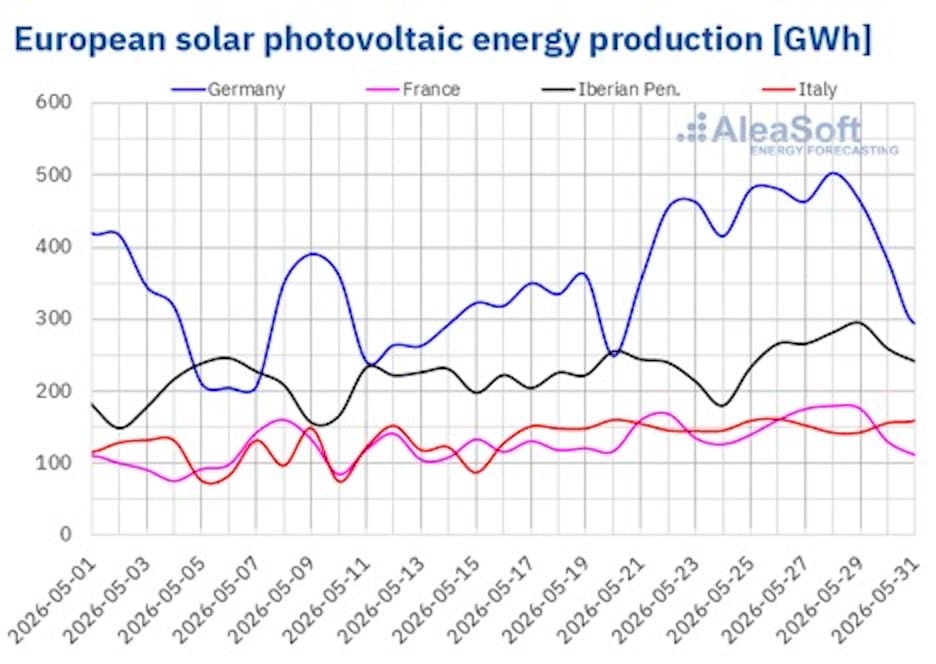
Source: AleaSoft via PV Magazine
There was good news elsewhere in Europe as well:
AleaSoft’s analysis of electricity prices found the weekly average electricity price decreased last week across the Belgian, British, Dutch, German and Nordic markets, which it attributes to higher solar and wind energy production, as well as lower electricity demand.
As we discussed in TT#2 and NN#2, the closure of the Strait of Hormuz has prompted most of the world to seek ways to reduce their dependence on expensive oil and gas, and transition to cheap, domestic renewables instead. That may have seemed like a phenomenon limited to certain geographies in the early days of the Iran War, but as the war has stretched into its fourth month, it’s becoming far more of a global, secular story.
On June 3, a stable of Bloomberg energy journalists reviewed the energy crises of the past several decades and showed how this energy crisis differs materially from the past. Asian and European countries are seeing reinvigorated interest in transitioning to renewables, both as a top-down national strategy to reduce their reliance on imported fossil fuels, and as a bottom-up strategy employed by citizens to reduce their own exposure to spiking prices for those fuels.
…the Philippine government has also taken steps towards a deeper, more structural plan to reduce the country’s dependence on fossil fuels, announcing that it will speed up the development of utility-scale renewable plants. Across Asia and Europe, other countries are doing the same.
[…]
However, countries are also trying to accelerate their longer-term reordering in response to the Iran war, partly by offering subsidies, loans or tax breaks to households for solar energy, batteries and heat pumps, which reduce the amount of power they draw from the grid, or move them off gas-based heating systems.
France announced the doubling of subsidies to speed up the deployment of heat pumps and electric vehicles, as part of a sweeping plan that states electrification is the “only structural and sustainable response to frequent energy crises.” In the UK, the government announced new planning regulations in March that will require developers to install heat pumps and solar panels in all newly built homes.
Germany and Spain have rolled out new incentives to try to encourage citizens to switch to electric vehicles. But the high price of fuel is making consumers lean toward EVs even without new policies. European sales surged for the third straight month since February, while more than 30 countries, including some in Asia, set a new record for monthly sales in March.
[…]
The conflict has highlighted how vulnerable oil and gas markets are to disruption. The three main objectives of any energy policy are reliability, affordability and security, said Gerald Butts, chairman of the political-risk consultancy Eurasia Group. When the US protected global trade, fossil fuels could often meet those objectives. “Clean energy technologies and electrification can now offer it too,” he said.
“When an aggressively marketing player like China can arrive at your policymaker’s doorstep with an entire electric stack, it’s a very attractive prospect,” Butts said. “People are underappreciating how much this crisis will accelerate the energy transition.”
BloombergNEF, the stalwart energy transition unit within the Bloomberg enterprise, published its flagship annual report on May 19. The New Energy Outlook 2026 emphasized the trend toward electrification replacing direct combustion of fuels in all sorts of sectors, with its ‘most likely’ Economic Transition Scenario (ETS) finding that:
In the long term, the ETS signals the start of an electricity-led era, with electricity meeting two-thirds of new energy demand over the next 24 years, while natural gas supplies another 25%. The demand is largely driven by electric vehicles, data centers and other electrification. […]
Energy transition timelines diverge widely by region. China is rapidly electrifying, with electricity already the dominant final energy carrier by 2023 and coal’s share of power generation falling from about 54% in 2025 to 19% in 2035 and 7% by 2050. In India, electricity overtakes oil and coal by 2041 despite continued coal use in industry. In Europe, electricity becomes the dominant fuel by 2043, while the US transitions more slowly, reaching that point in 2047.
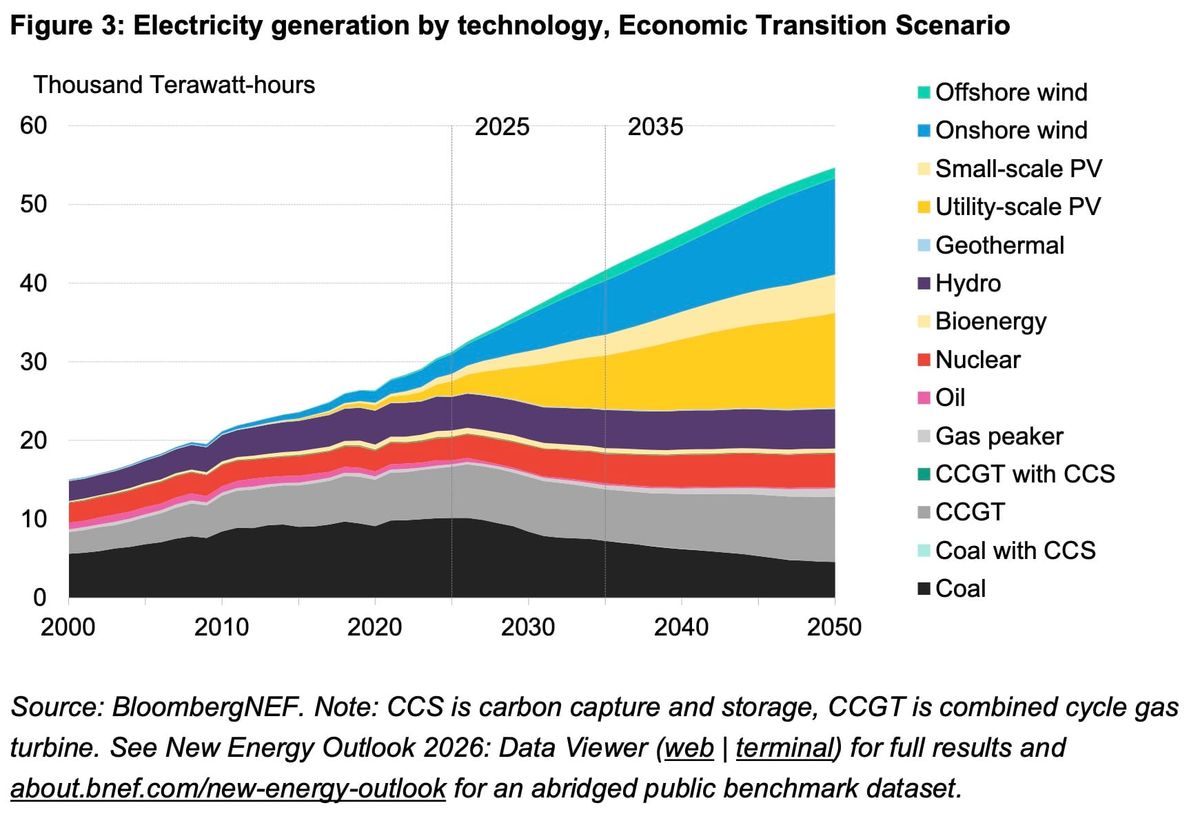
And that electricity will be increasingly provided by ‘low-carbon technologies.’ Although the BNEF chart below shows some anticipated growth from gas-fired generation, we here at Transition Times are skeptical that new gas generation will be able to compete with wind and solar on price alone, even if there were still significant global appetite to increase reliance on gas, which every passing month of the Strait being closed puts further in doubt. And as we have detailed in TT#5 and NN#4, we do not subscribe to the latest hype cycle of great expectations for the role of CCS.
Solar will become the world’s single largest source of electricity in the next six years, due to a major supply glut, technology advances, and falling prices.
[…]
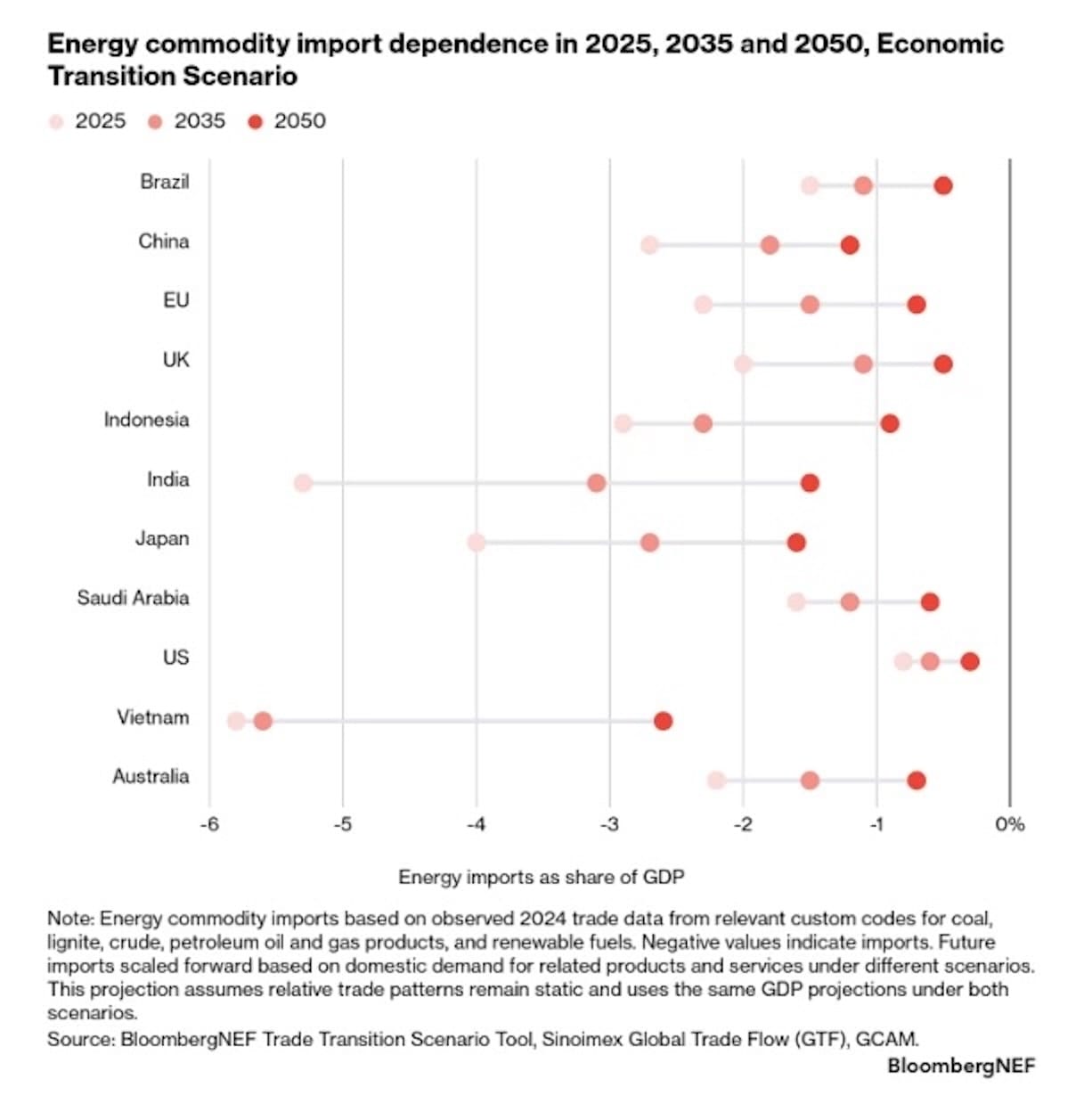
BNEF’s updated Economic Transition Scenario (ETS) maps out how the energy system is most likely to evolve over the next decade and through 2050. Far more so than in previous energy crises, many countries that are dependent on fossil fuels are able to reduce their economic exposure to energy commodity imports by adopting low-carbon technologies. Asian economies with high import liabilities such as Vietnam, Japan, Indonesia and India have the most to gain when looking at energy imports as a share of GDP. Those markets paid between 3% and 6% of their GDP on energy imports in 2025. The EU and China currently spend 2.3% and 2.7% of GDP on energy imports, respectively, but rapidly reduce these liabilities over the next decade in BNEF’s modeling. Meanwhile, net exporters such as the US and Saudi Arabia also modestly reduce import dependence.
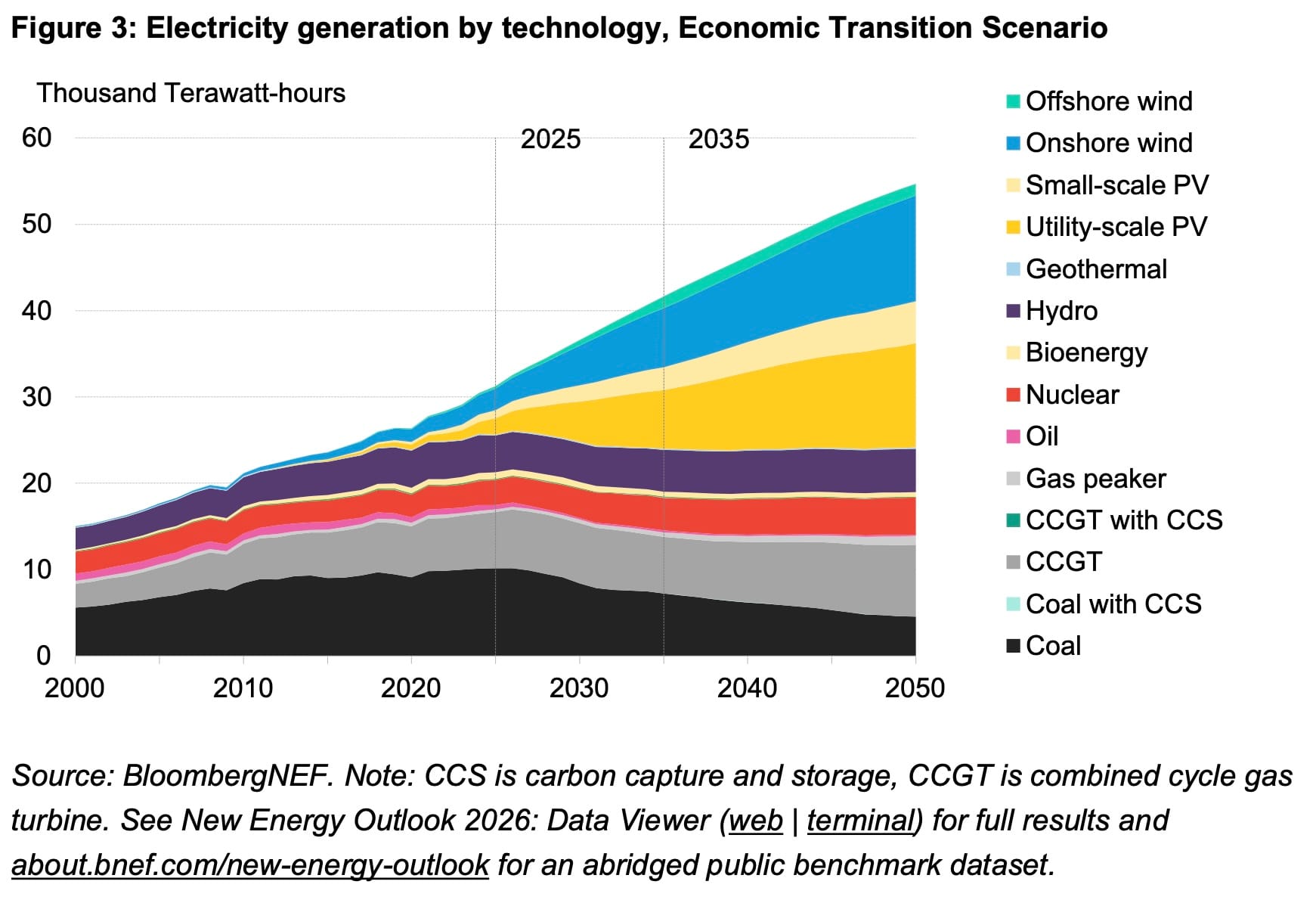
We’d rate the above scenario as mostly correct, although we expect nearly all new generation capacity to come from domestic wind and solar (with perhaps a smattering of geothermal and new nuclear plants), as has been the case for a decade straight already, since no compelling arguments have been made to suggest why those trends might change now.
Our view is at least partly influenced by the startling data presented back in April in Ember’s Global Electricity Review 2026 (published before Transition Times started up). Energy Transition Show Episode 274 covered that report in detail, highlighting a few standout results:
· For the first time, global electricity generation from fossil fuels fell—not because of some anomalous event like a pandemic or unusual weather, but simply because renewables grew faster than demand.
· As a result, global emissions from electricity generation also fell for the first time.
· Apart from coal’s rebound after Covid restrictions were lifted, solar power recorded the largest single year increase of any electricity source, ever.
· Renewable power generation exceeded coal generation for the first time in the modern era.
· China added more solar generation in 2025 than the entire world added in 2023.
And these are just a few highlights from four recent reports, although those reports represent an enormous amount of work done by teams of top-notch analysts. We encourage you to open those links and check out the reports for yourself!
And keep following Transition Times for more updates like this.
Got an item you’d like us to cover?
We’d like Transition Times to help increase the visibility of all the great work that’s being done out there. So if you have an article, report, study, podcast episode, newsletter post, video clip or anything else that you think is worthy of a shout-out in Transition Times, email it to suggestions [at] transitiontimes [dot] net! We welcome all submissions, as long as they’re relevant to the energy transition.
Sources
Patrick Jowett, “France, Germany, Portugal, Spain set daily solar records,” PV Magazine, June 3, 2026.
Akshat Rathi, Hayley Warren, Neil Jerome Morales, and Stephen Stapczynski, “Iran Shock Jolts Asia and Europe to Speed Up Energy Transition,” Bloomberg, June 3, 2026.
Press release: “BloombergNEF’s New Energy Outlook 2026: Transition to Newer Technologies, Expanded Electrification to Strengthen Nations’ Energy Security,” BloombergNEF, May 19, 2026.
Nicolas Fulghum, Wilmar Suarez, Katye Altieri, and Kostantsa Rangelova, Global Electricity Review 2026, Ember, April 21, 2026.
We never use AI to produce any of the written or spoken content you find on Transition Times. We do use AI as a research tool (and vet the information so received).
We also occasionally use AI to generate graphics and sounds.