
TT#7: China’s Energy Dominance
While the Trump administration has embroiled itself in multiple military conflicts in pursuit of an “energy dominance” based on the fuels that are getting rapidly phased out, China is seizing the opportunity to dominate in the energy transition solutions that are displacing them.
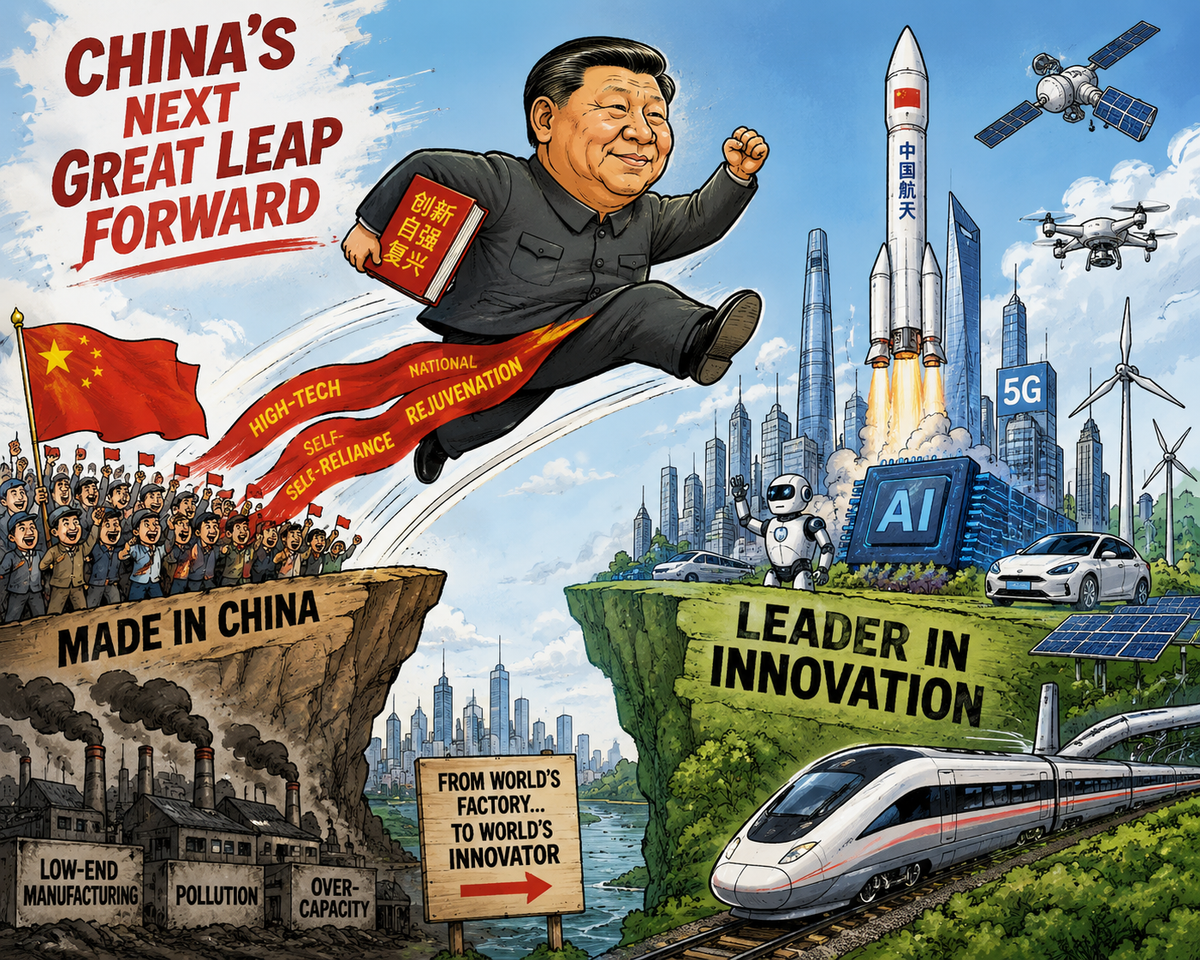
In 1958, when the People’s Republic of China was just nine years old, Mao Zedong launched his “Great Leap Forward” campaign to rapidly industrialize China. It was a disastrous failure, causing the worst famine in human history. But in the modern era, Chinese leadership has taken a very different kind of great leap forward toward industrialization, only this time with a lot less fanfare and a lot more success.
It’s becoming increasingly clear that China isn’t just dominating in the energy transition. A new miniseries in Le Monde declares that China is “devouring Europe” through “all-round dominance, from batteries to medicine, from high-speed trains to AI.”
For an excellent review of China’s new, outsized role in global manufacturing, trade, investment, economic development, and increasing geopolitical power, check out Kate Mackenzie and Tim Sahay’s latest Polycrisis newsletter, “The Beijing Pivot”:
For all the alarm about Chinese high-tech goods, advanced manufactures are only a small part of China’s exports. The vast majority of exports remain simpler goods like apparel, and so far China is not abandoning these industries as it moves up the value chain.
That poses a threat, or at least a dilemma, for many developing nations. China’s extensive production of cheap goods, both simple and complex, reduces the space available for lower-income countries to industrialize and produce their own low-tech, labor-intensive exports. This is what Shoumitro Chatterjee and Arvind Subramanian at the Peterson Institute for International Economics have called the “China squeeze.”
But in the energy transition specifically, China has leveraged a vigorous industrial policy to take an all-but-insurmountable lead in all of the key technologies it entails, while the US continues to miss the turn under Trump’s “energy dominance” strategy based on fossil fuels. And by avoiding the financial drain and distraction of foreign military entanglements, China has been free to quietly continue making inroads both geopolitically and economically all over the world.
Accordingly, the solutions of the energy transition portfolio were responsible for more than a third of China’s GDP growth in 2025, and some 11.4% of its total GDP, as Lauri Myllyvirta and Belinda Schaepe of the Centre for Research on Energy and Clean Air (CREA) wrote in their February update for Carbon Brief.
To get a good detailed look at China’s delivery of energy transition solutions to the world, check out Ember’s handy China Cleantech Exports Data Explorer which breaks down exports by sector. In the aggregate, China’s exports of batteries, EVs, grid technologies, heating and cooling systems, and solar and wind kit were up to $25 billion a month, or $250 billion a year, as of April 1 2026.
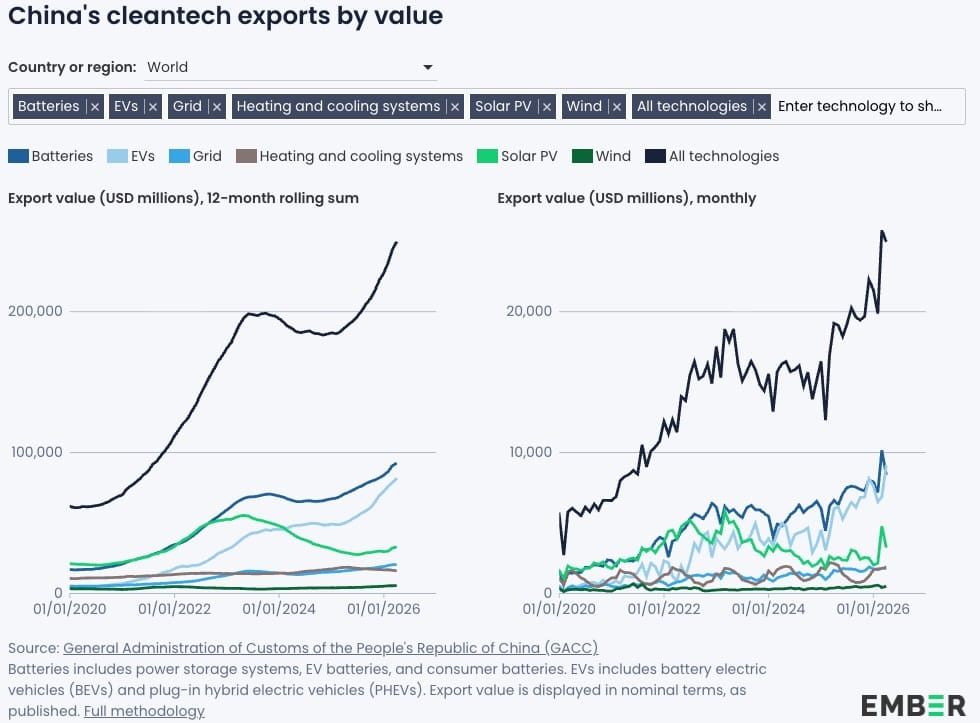
The analysts at Ember have recently published an excellent new analysis that builds on the China data to tell a much bigger story about Asia, titled Electric Asia. See Nelder Notes #5 for much more on that.
Nor is the Asian Giant merely self-funding its expansion. It’s becoming increasingly integrated with the rest of the global economy. For example, to take advantage of the increased demand for energy transition technologies as a result of the Iran war, banking giant HSBC created a $4 billion Sustainability and Transition Credit Facility “to support the global expansion of mainland Chinese companies involved in sustainable and transition technologies including clean power, data centres, electric vehicles and AI.”
One element of China’s deployment of electrified solutions that hasn’t received nearly as much attention as its construction of wind and solar farms is its rapid electrification of mobility. EV and PHEV sales (which it calls “new energy vehicles” or NEV) took a 61% market share in April, putting China—the largest auto market in the world—in third place for electric vehicle adoption globally, behind Norway and Denmark.
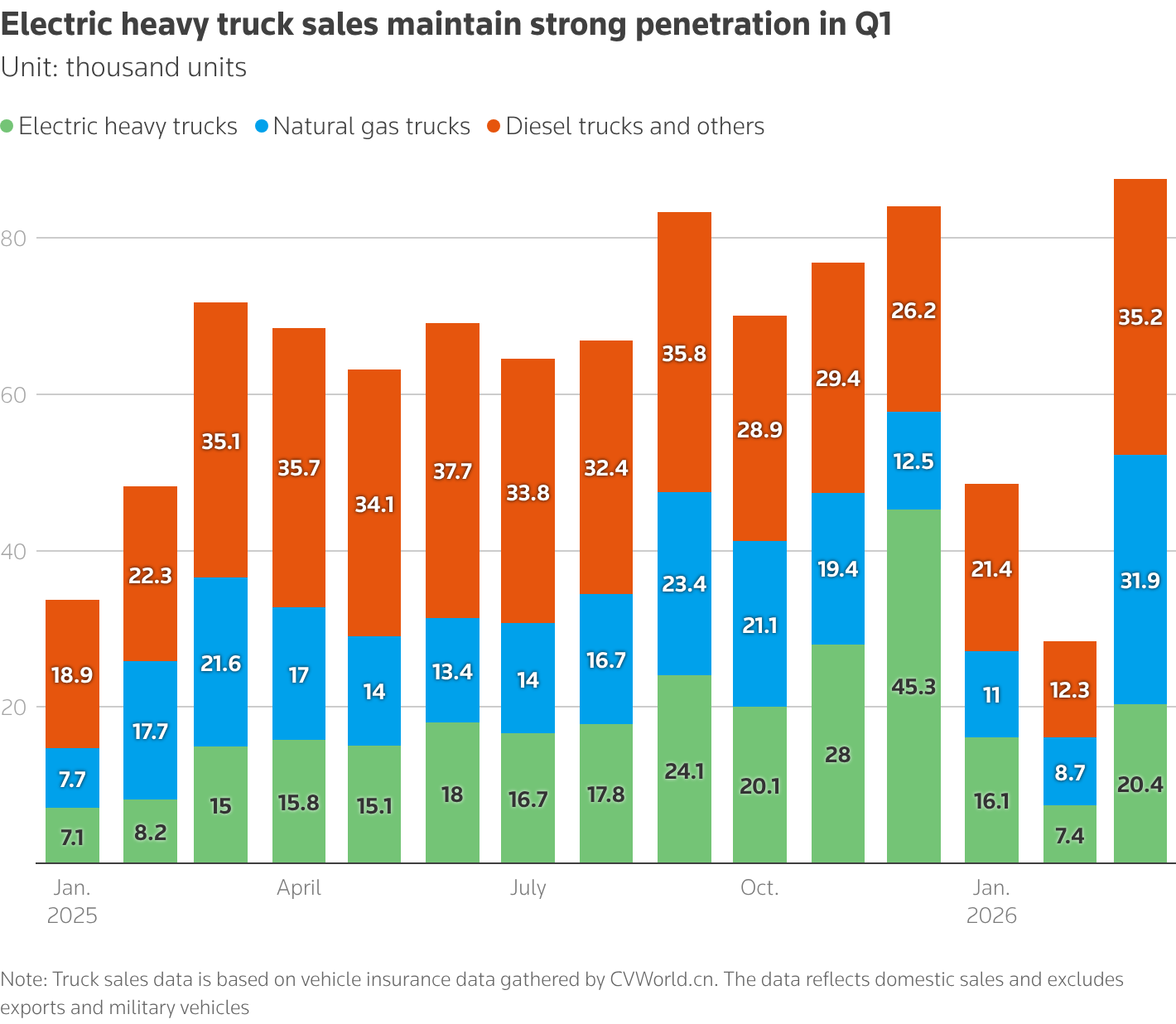
But even more impressive is its electrification of heavy trucks. Due to a 27% jump in retail diesel prices in China after the Iran war began, electric heavy truck sales are surging, growing 45% Y/Y to more than a quarter of the segment at the start of the year, on its way to a third of new truck sales this year.
China’s deployment of energy transition solutions is still booming, although it has reached such enormous scale by now that it’s beginning to slow down, as Anika Patel writes for Carbon Brief:
Solar power has been a major element of China’s renewables buildout since the mid-2010s.
The country installed 315 gigawatts (GW) of new capacity in 2025, adding more than half of all new solar globally. The year before, it added 277GW.
But the picture in 2026 to date is very different. Installations in March fell 56% year-on-year to 9GW, while new capacity in April totalled 10GW, a 79% drop compared to a year earlier, according to Carbon Brief’s analysis of official data.
The change has been anticipated by analysts as China has moved from a fixed-price tariff for renewables to a market-driven pricing regime. But its solar production is still growing, albeit at a somewhat less-than-breakneck pace.
However, the boom in Chinese batteries is nowhere near a similar inflection point. CATL, the world’s largest battery maker, told Reuters that energy storage has grown from about 2% of its battery sales five years ago to roughly 25% today, and could reach 50% by 2030. Its investments in Europe have made the continent CATL’s third-largest storage market, after China and the US, but there are constraints:
Energy storage in Europe, unlike the automobile industry, has not faced calls for sweeping requirements on local sourcing of components to protect domestic industries. Still, making such projects profitable has been a challenge.
Project delays and grid integration backlogs have become pervasive challenges, which CATL aims to fix through a 3 billion yuan ($440 million) energy storage testing centre it inaugurated in southern China last week to simulate grids and investigate causes of energy storage-related fires.
Grid integration challenges
Grid integration has increasingly become a challenge across the sector. After several decades of accelerating growth in energy transition solutions, starting from nearly zero and then growing to the point where wind and solar have met nearly all new electricity demand growth year after year, the transition has reached the point where it’s encountering some later-stage challenges. And because China is far and away the world leader in the energy transition, that’s where we can see the early signs of the kinds of challenges the rest of the world will have to manage as it reaches similar levels of renewable deployment and electrification.
Chief among them are grid integration challenges.
Lauri Myllyvirta’s June 4 analysis for Carbon Brief highlights an increasingly common one: curtailment of wind and solar. In China’s case, Myllyvirta explains, it’s been due to a lack of system flexibility:
More broadly, the key reason for curtailment is inflexible grid management. Flexible operation of coal and gas-fired power plants could very substantially increase the amount of solar and wind power the grid can accommodate.
Yet currently, coal-fired power generation is largely operated via medium- and long-term contracts to supply fixed amounts of electricity at fixed prices, meaning there is no incentive for adjustments in output to make space for solar and wind.
Similarly, electricity trading between provinces is predominantly contracted annually, preventing the variable output of solar and wind from being transmitted between jurisdictions in real time.
These issues have a clear impact on the amount of wind and solar that is curtailed. For example, power-system modeling carried out for the year 2023 indicates that flexible power-grid operation would have essentially eliminated the need for curtailment.
In short, coal plants are being run at significant costs and taking up grid space that would otherwise have been filled with wind and solar at free marginal cost, simply because of contractual arrangements and a general lack of grid flexibility. And as Myllyvirta explains, the government has recognized the issue and has issued new policies designed to improve flexibility. See the story for much more detail.
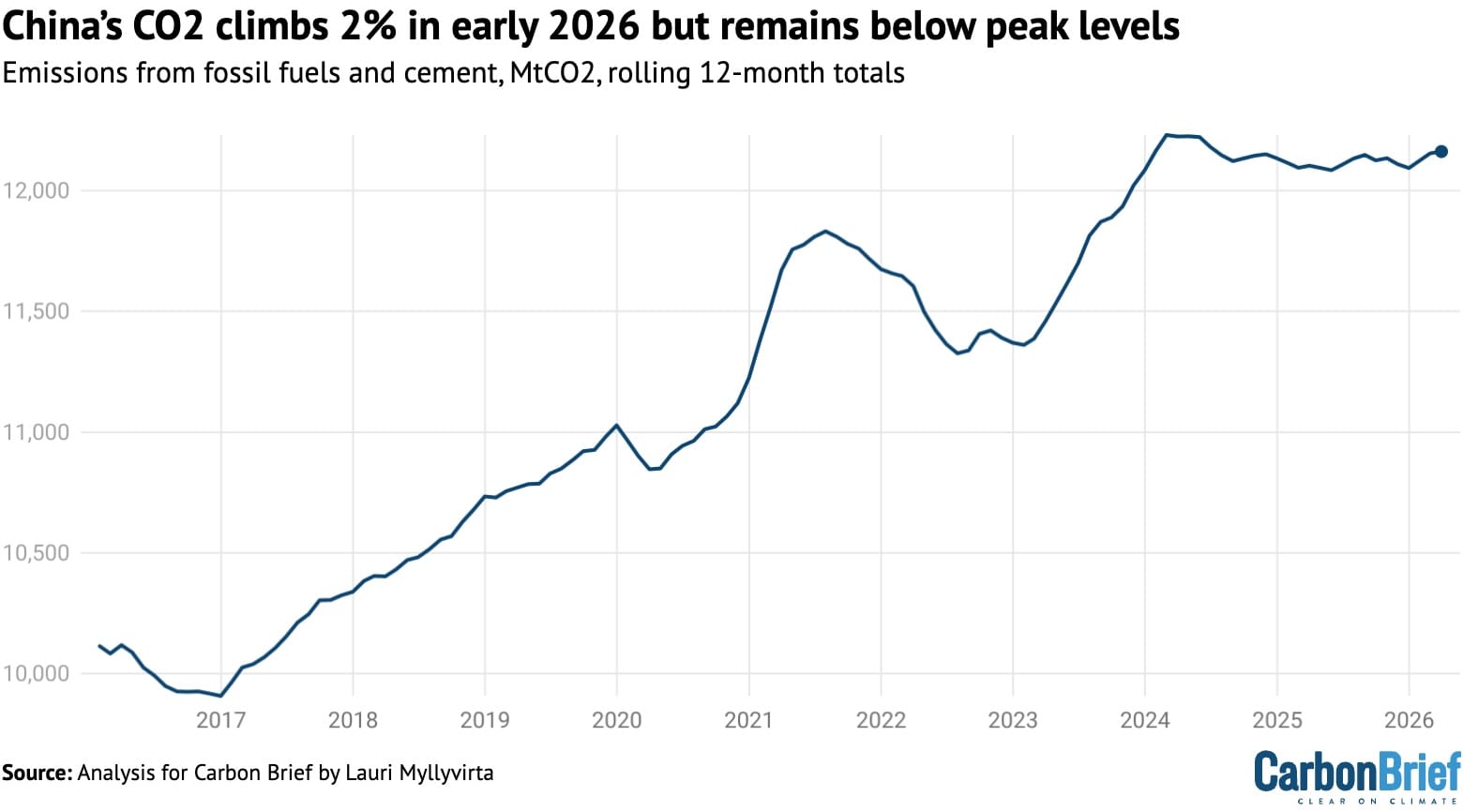
The preferential use of coal has, predictably, had an unwanted outcome: A 2% year-on-year increase in China’s total CO2 emissions in the first quarter of 2026, after two years of flat-or-falling emissions for the previous two years:
We’re increasingly seeing the energy transition constrained by system-level issues rather than technologies. Across Texas, Europe, Australia, Ireland, and China, the question is no longer whether clean-energy technologies can be built—it is whether electricity systems can integrate them fast enough while accommodating a surge in new demand.
In most regions, a lack of transmission capacity has been fingered as a key constraint driving wind and solar curtailment. But recent analysis from Beyond Fossil Fuels shows that in eight European countries, a lack of grid capacity on distribution grids has also resulted in 375 GW of wind and solar languishing in queues waiting to connect to the grid, along with 455 GW of battery storage systems. Together, those numbers are about equal to the total grid capacity of those eight countries.
Another analysis done for Beyond Fossil Fuels by Brattle Group and published in February found that clean flexibility—such as batteries, pumped hydro storage, and managed EV charging—could help drive the remaining fossil fuels (especially gas) out of the grid, saving Europeans €300 billion per year while avoiding renewable curtailment.
Those studies are the subject of Energy Transition Show Episode 279, for those who prefer audio format.
The important take-away for energy transition observers is about much more than merely deploying more renewable generation on the supply side, and is about much more than data centers on the demand side. Shrewd players will focus on the infrastructure that’s now required to break through grid bottlenecks with investment into integration, transmission, flexibility, and system management.
Got an item you’d like us to cover?
We’d like Transition Times to help increase the visibility of all the great work that’s being done out there. So if you have an article, report, study, podcast episode, newsletter post, video clip or anything else that you think is worthy of a shout-out in Transition Times, email it to suggestions [at] transitiontimes [dot] net! We welcome all submissions, as long as they’re relevant to the energy transition.
Sources
The Great Leap Forward: Causes, Famine, Death Toll & Why It Failed [Complete Guide], IAS Nova, April 13, 2026.
How China is Devouring Europe, Le Monde, June 2026.
Kate Mackenzie and Tim Sahay, “The Beijing Pivot,” The Polycrisis, June 12, 2026.
Jordan Pouille, “China's all-round dominance, from batteries to medicine, from high-speed trains to AI,” Le Monde, June 7, 2026.
Lauri Myllyvirta and Belinda Schaepe, “Analysis: Clean energy drove more than a third of China’s GDP growth in 2025,” February 5, 2026.
China Cleantech Exports Data Explorer, Ember.
Daan Walter, Sam Butler-Sloss, Antoine Issac, Kingsmill Bond, and Aditya Lolla, Electric Asia, Ember, June 11, 2026.
Simon Jessop, “HSBC to lend $4 billion to help China clean tech scale globally,” Reuters, May 17, 2026.
Qiaoyi Li, Zhang Yan and Ju-min Park, “China's domestic car demand stays weak but exports strengthen,” Reuters, May 10, 2026.
Anika Patel, “Chart: Why China’s solar boom is slowing down,” Carbon Brief, June 5, 2026.
Colleen Howe and Sudarshan Varadhan, “Chinese battery maker CATL expects energy storage to make up half of global sales by 2030,” Reuters, June 4, 2026.
Lauri Myllyvirta, “Analysis: China’s CO2 climbs 2% in early 2026 due to ‘wasted’ wind and solar,” Carbon Brief, June 4, 2026.
Grid expectations: The distribution backlog stalling Europe’s energy transition June 2026, AFRY and Beyond Fossil Fuels, June 2026.
“Clean flexibility supports a reliable grid without fossil-fuels,” Beyond Fossil Fuels, February 23, 2026.
We never use AI to produce any of the written or spoken content you find on Transition Times. We do use AI as a research tool (and vet the information so received).
We also occasionally use AI to generate graphics and sounds.